AI Chatbot Statistics 2026: Usage, Market Size and Trends
These AI chatbot statistics start with a huge number: ChatGPT now reaches more than 1.2 billion people every week.
Adoption is just as wide. About 49% of US adults use AI chatbots, and roughly one in four use them every day.
Below we cover market size, usage, industries, revenue, savings, age groups, regions, challenges and the road ahead.
Key Highlights
- ChatGPT has more than 1.2 billion weekly active users in 2026.
- The Gemini app has passed 1 billion monthly active users.
- 49% of US adults use AI chatbots, and 24% use them daily.
- The global chatbot market is worth an estimated $11.8 billion in 2026.
- The market is forecast to reach $41.2 billion by 2033.
- AI referred shoppers bring retailers 83% more revenue per visit.
- Only 7% of customers used a company chatbot in their latest service request.
How Many People Use AI Chatbots?
ChatGPT has more than 1.2 billion weekly users, and the Gemini app has more than 1 billion monthly users.
No consumer technology has spread this fast, and the AI chatbot statistics on users prove it. The Copilot family also passed 150 million monthly users last year, and ChatGPT counts 50 million paying subscribers.
| AI assistant | Reported users | Metric |
|---|---|---|
| ChatGPT | More than 1.2 billion | Weekly active users |
| Gemini app | More than 1 billion | Monthly active users |
| Copilot family | More than 150 million | Monthly active users |
What this means: These AI chatbot statistics show your customers already use chat assistants every week, so your brand needs to appear in their answers.
How Fast Is ChatGPT Growing?
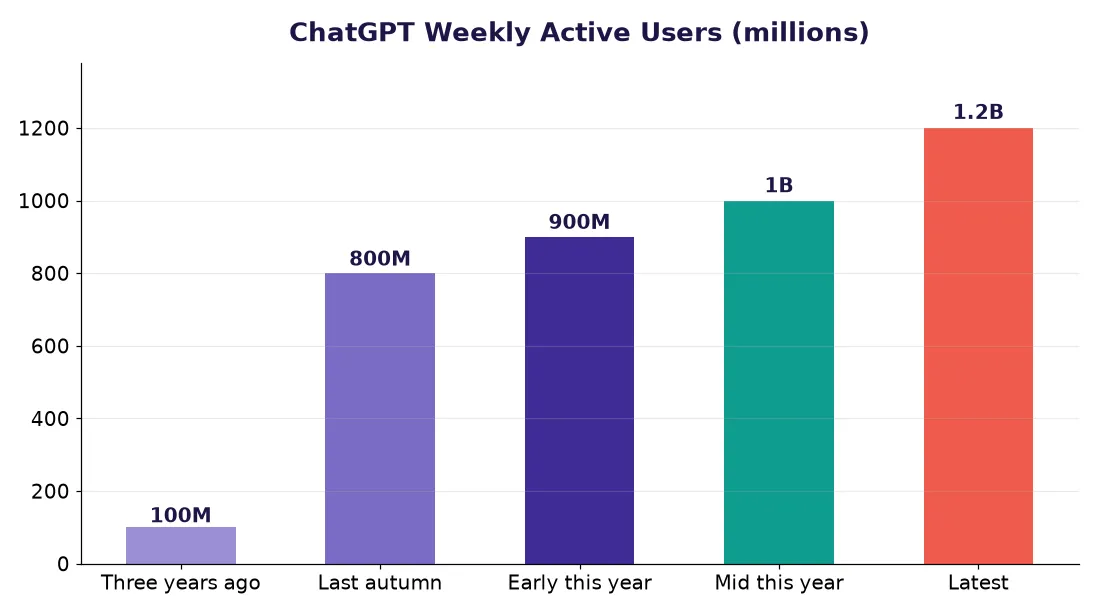
ChatGPT grew from 100 million to 1.2 billion weekly users in about three years.
These AI chatbot statistics show growth sped up in 2026. Weekly users jumped from 1 billion to 1.2 billion in roughly two months. That pace makes ChatGPT about 12 times larger than it was three years ago.
| Milestone | ChatGPT weekly users |
|---|---|
| Latest count, 2026 | 1.2 billion |
| Middle of 2026 | 1 billion |
| Early 2026 | 900 million |
| Autumn last year | 800 million |
| Three years ago | 100 million |
What this means: AI chatbot statistics suggest habits are still forming, so the user base could keep climbing for years.
How Big Is the AI Chatbot Market?
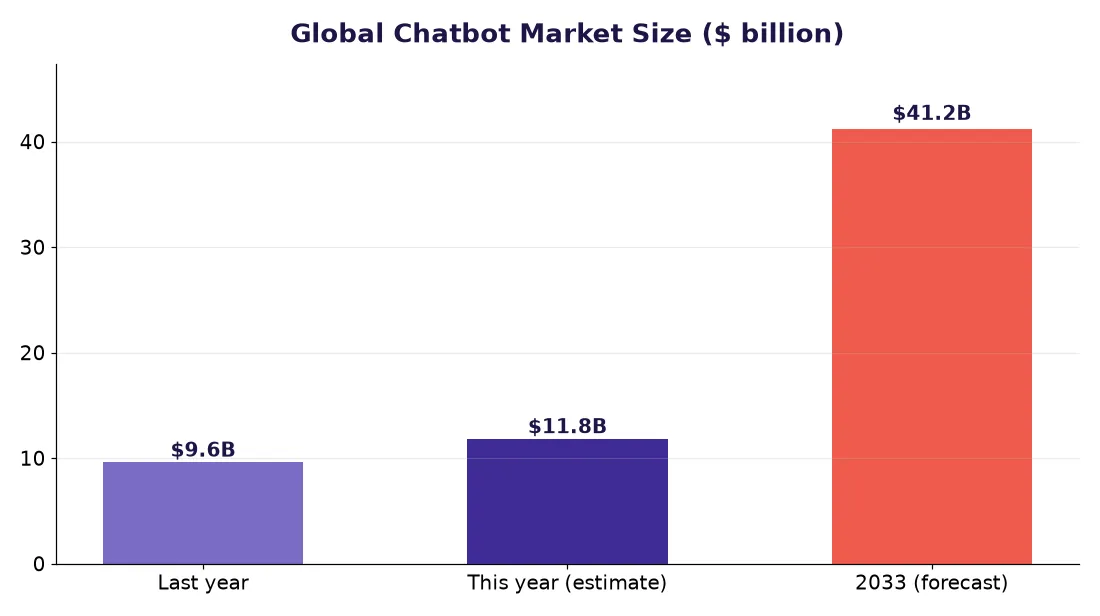
The global chatbot market is worth an estimated $11.8 billion in 2026.
That is up from $9.6 billion last year, a rise of about 23%. Analysts expect the market to reach $41.2 billion by 2033, growing 19.6% a year. Estimates vary because each forecast counts different products.
| Period | Global chatbot market |
|---|---|
| 2033 forecast | $41.2 billion |
| 2026 estimate | $11.8 billion |
| Last year | $9.6 billion |
What this means: AI chatbot statistics on market growth point to steady demand of close to 20% a year, with room for new tools and niche players.
How Often Do People Use AI Chatbots?
About 24% of US adults use AI chatbots every day.
That includes 12% who use them several times a day and 4% who say they use them almost constantly. Daily use now mirrors the early growth seen in our voice search statistics.
| How often US adults use AI chatbots | Share |
|---|---|
| Do not use AI chatbots | 51% |
| Several times a week or less | 25% |
| Daily in total | 24% |
| Several times a day | 12% |
| About once a day | 8% |
| Almost constantly | 4% |
What this means: AI chatbot statistics on frequency show chatbots becoming a daily habit, much like email and search.
What Do People Use AI Chatbots For?
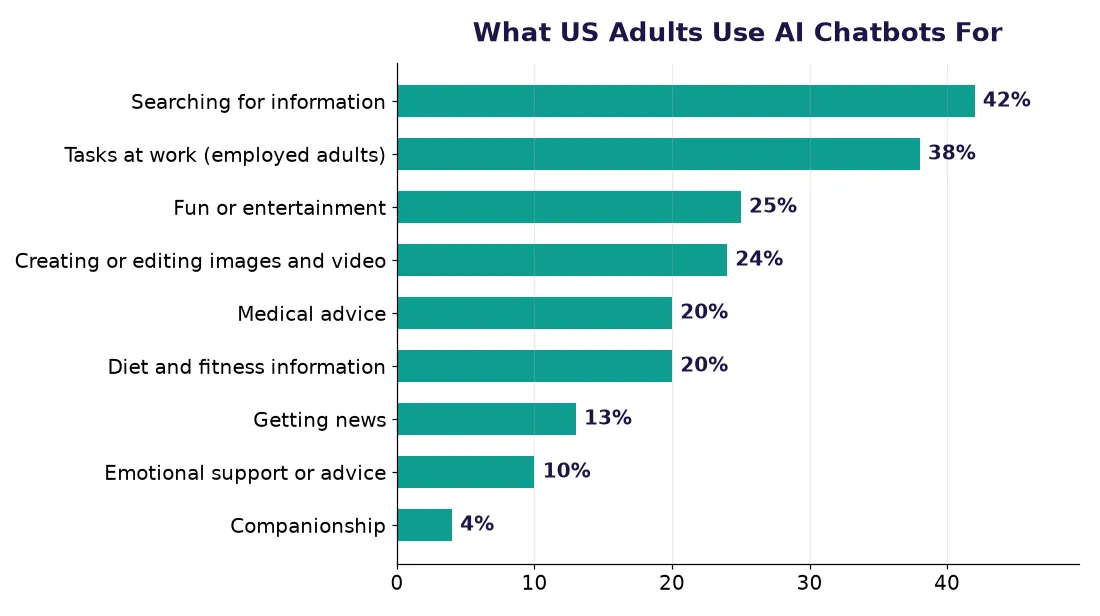
Searching for information is the top use, at 42% of US adults.
Work comes next, with 38% of employed adults using chatbots for job tasks. Creative use is big too, as 24% use chatbots to create or edit images and videos, a trend that matches our AI image generation statistics.
| Use | Share of US adults |
|---|---|
| Search for information | 42% |
| Tasks at work (employed adults) | 38% |
| Fun or entertainment | 25% |
| Create or edit images or videos | 24% |
| Medical advice | 20% |
| Diet and fitness information | 20% |
| Get news | 13% |
| Emotional support or advice | 10% |
| Companionship | 4% |
What this means: AI chatbot statistics on use cases show people treat chatbots as a smarter search box first, so clear and factual content wins.
Which AI Chatbots Do Americans Use Most?
ChatGPT leads, with 44% of US adults using it.
That share rose from 34% last year. Gemini follows at 24%, and Copilot reaches 17%.
| Chatbot | Share of US adults who use it |
|---|---|
| ChatGPT | 44% |
| Gemini | 24% |
| Copilot | 17% |
What this means: These AI chatbot statistics show one assistant dominates for now, but the next two still reach tens of millions of Americans.
Who Uses AI Chatbots the Most by Age?
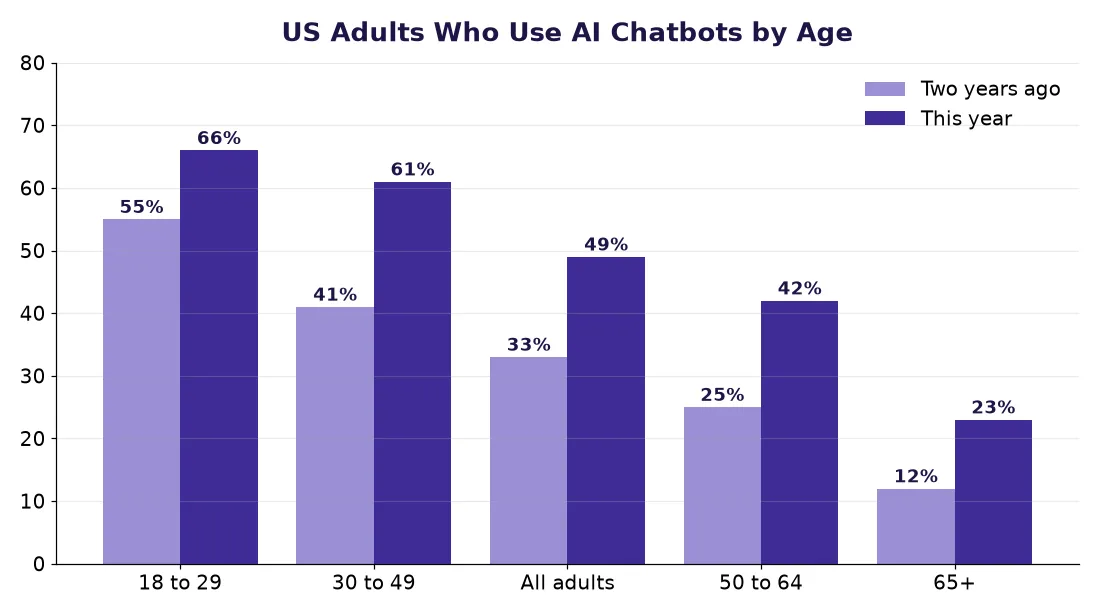
Adults aged 18 to 29 lead, with 66% using AI chatbots.
Adults aged 30 to 49 saw the biggest jump, up 20 points to 61%. Use among people 65 and older nearly doubled to 23%.
| Age group | Use in 2026 | Two years ago |
|---|---|---|
| 18 to 29 | 66% | 55% |
| 30 to 49 | 61% | 41% |
| All US adults | 49% | 33% |
| 50 to 64 | 42% | 25% |
| 65 and older | 23% | 12% |
What this means: These AI chatbot statistics show chatbots are no longer just for younger users.
Which Industries Use AI Chatbots the Most?
Retail and ecommerce is the largest chatbot vertical, and customer service is the largest use.
Ready made chatbot solutions hold 61.8% of market revenue, and standalone chatbots hold 58.2%. At work, 38% of employed US adults now use chatbots, which ties into our employee productivity statistics.
| Market segment | Leading category | Revenue share |
|---|---|---|
| Offering | Solutions | 61.8% |
| Type | Standalone chatbots | 58.2% |
| Region | North America | 31.3% |
What this means: Industry AI chatbot statistics show stores and support teams drive most spending, so these are the areas where chatbots must prove their value first.
How Do AI Chatbots Affect Revenue?
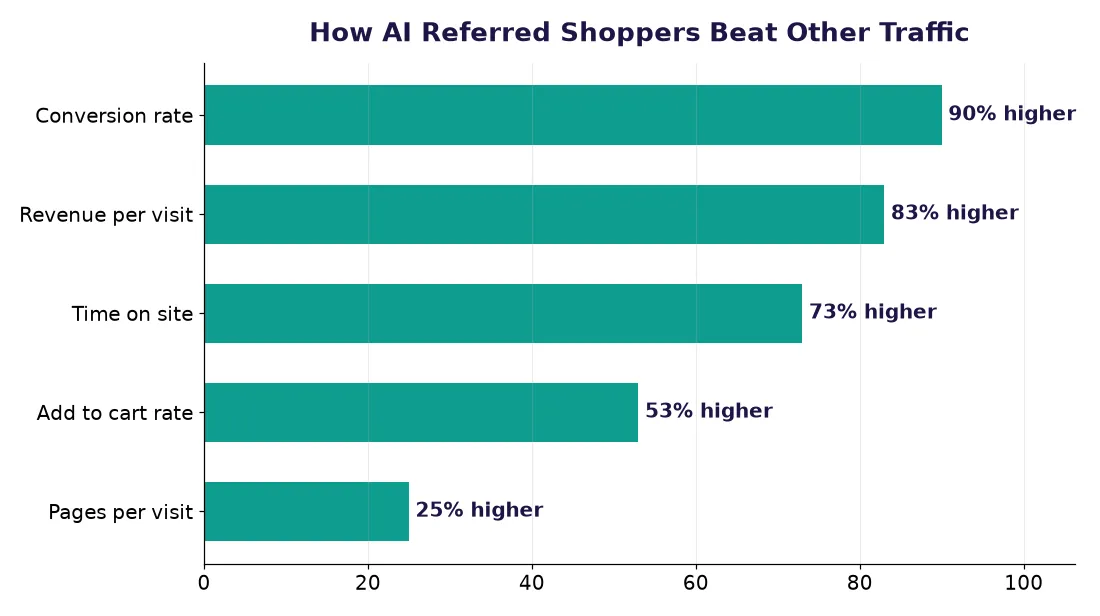
Shoppers who arrive from AI chatbots bring retailers 83% more revenue per visit.
They also convert 90% better than other traffic and spend 73% more time on site. A year earlier, these visitors converted worse than average.
| AI referred shoppers vs other traffic | Difference |
|---|---|
| Conversion rate | 90% higher |
| Revenue per visit | 83% higher |
| Time on site | 73% longer |
| Add to cart rate | 53% higher |
| Pages per visit | 25% more |
What this means: AI chatbot statistics on revenue turn chatbot visibility into a real sales channel, not just a trend.
What Are the Main Benefits of AI Chatbots?
One large payments company cut average resolution time from 11 minutes to under 2 minutes with an AI assistant.
The same assistant cut repeat inquiries by 25%, worked around the clock and spoke more than 35 languages. Shoppers benefit as well, since 77% of people who use AI for shopping feel more confident in their purchase.
| Benefit | Result |
|---|---|
| Shoppers who feel more confident using AI | 77% |
| Shoppers less likely to return an item | 69% |
| Languages supported by one service bot | 35+ |
| Drop in repeat inquiries | 25% |
| Resolution time | Under 2 minutes, down from 11 |
What this means: AI chatbot statistics on benefits show speed and confidence are the clearest wins, for both customers and the teams that serve them.
How Much Money Can AI Chatbots Save?
One AI assistant did the work of 700 full time agents in its first month.
It handled 2.3 million conversations, about two thirds of all service chats, and was expected to add $40 million in profit for the year. Looking ahead, analysts expect AI agents to cut customer service operating costs by 30% by 2029.
| Savings metric | Figure |
|---|---|
| Conversations handled in month one | 2.3 million |
| Equivalent full time agents | 700 |
| Expected profit improvement | $40 million |
| Forecast cut in service costs by 2029 | 30% |
What this means: AI chatbot statistics on savings show the gains are real at high volume, but only when the chatbot resolves issues well.
Which Regions Lead the AI Chatbot Market?
North America holds the largest share of the chatbot market, at 31.3%.
The US is the single biggest country market. Europe is growing steadily, though strict privacy rules make companies more careful. Worldwide, 7% of online news consumers use AI assistants for news, rising to 15% of people under 25.
| Region or group | Key figure |
|---|---|
| North America share of chatbot market | 31.3% |
| Under 25s using AI assistants for news | 15% |
| Online news consumers using AI assistants | 7% |
What this means: Regional AI chatbot statistics show North America leads spending today, but younger audiences worldwide are adopting chatbots fastest.
Can You Trust AI Chatbot Answers?
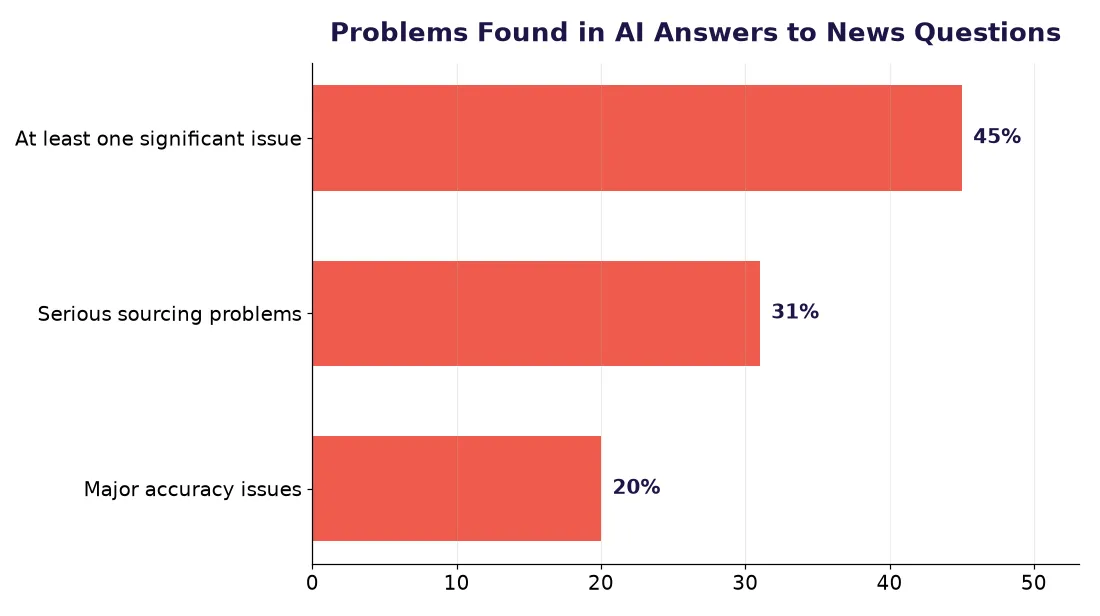
45% of AI assistant answers to news questions had at least one significant issue.
These AI chatbot statistics come from a large international study that tested more than 3,000 answers in 18 countries and 14 languages. About 31% had serious sourcing problems, and 20% contained major accuracy errors.
| Accuracy finding | Share of answers |
|---|---|
| Worst assistant with significant issues | 76% |
| At least one significant issue | 45% |
| Serious sourcing problems | 31% |
| Major accuracy issues | 20% |
What this means: AI chatbot statistics on accuracy are a reminder to double check important facts, especially for health, money and news.
Do Customers Like Customer Service Chatbots?
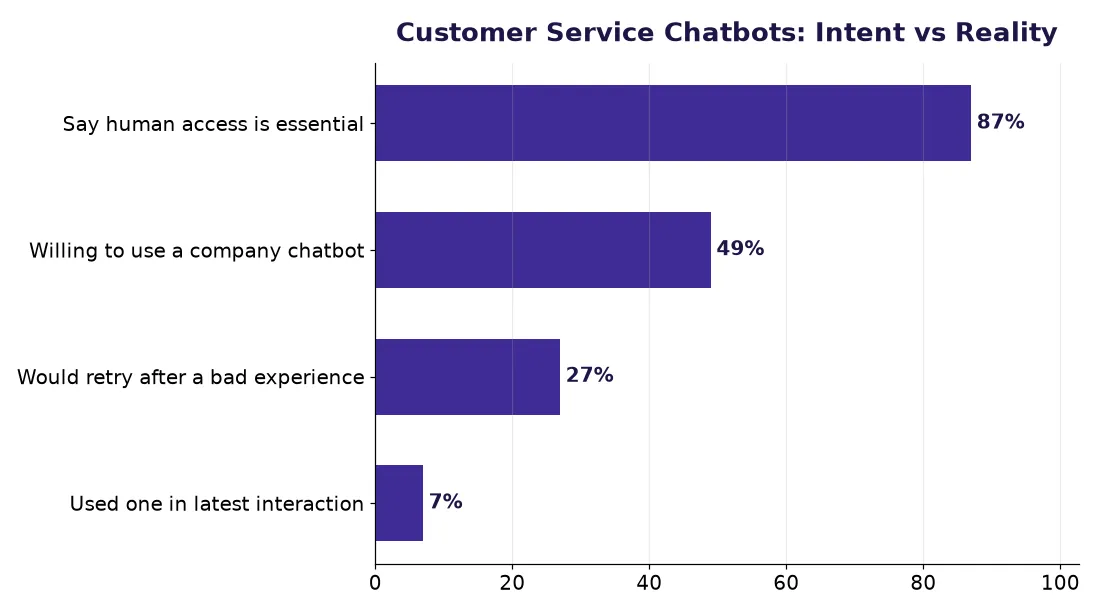
Only 7% of customers used a company chatbot in their latest service interaction.
Yet 49% say they would have used one if offered. Trust breaks fast, since only 27% would try a chatbot again after a bad experience. If you handle support in social DMs, a chatbot builder with human handoff can help keep a person in the loop.
| Customer service metric | Share of customers |
|---|---|
| Say human access is essential with AI service | 87% |
| Willing to use a company chatbot | 49% |
| Would retry after a bad experience | 27% |
| Used a chatbot in latest interaction | 7% |
What this means: AI chatbot statistics on service show reliability matters more than reach, and a human backup is a must.
What Is the Future of AI Chatbots?
The chatbot market is forecast to reach $41.2 billion by 2033.
Analysts also expect AI agents to resolve 80% of common customer service issues without a human by 2029. For this holiday season, AI traffic to US retail sites is forecast to rise 130% year over year. Agents that connect to other tools are a big part of this shift, as our MCP adoption statistics show.
| Forecast | Figure |
|---|---|
| Chatbot market by 2033 | $41.2 billion |
| Holiday AI retail traffic growth | 130% |
| Common service issues resolved by AI by 2029 | 80% |
| Service cost reduction by 2029 | 30% |
What this means: Future AI chatbot statistics point one way: chatbots are moving from answering questions to completing tasks, and that will reshape both shopping and support.
Did you know? About six in ten US adults now read AI summaries at the top of search results. Here is how AI answers are changing search.
Pros and Cons of AI Chatbots
Pros
- Available around the clock in dozens of languages.
- Cuts resolution times from minutes to seconds.
- Handles millions of conversations at once.
- Brings shoppers who convert 90% better.
- Lowers service costs at high volume.
- Helps people search, write and plan faster.
Cons
- Nearly half of news answers had significant issues.
- Customers rarely retry a bot after a bad experience.
- Most customers still expect access to a human.
Our verdict: AI chatbot statistics show the benefits clearly outweigh the drawbacks for most businesses. Start with a focused, well tested bot, keep a human option and measure results before you scale.
Quick Links:
- SEO Statistics
- Voice Search Statistics
- AI Image Generation Statistics
- MCP Adoption Statistics
- Employee Productivity Statistics
- Internet Outage Statistics
- Fantasy Sports Statistics
FAQs: AI Chatbot Statistics
AI chatbot statistics show ChatGPT alone has more than 1.2 billion weekly active users, and the Gemini app has more than 1 billion monthly users. In the US, 49% of adults say they use AI chatbots, and about 24% use them every day.
ChatGPT is the most popular AI chatbot. It is used by 44% of US adults, up from 34% last year. Gemini comes second at 24%, and Copilot follows at 17%. Every other assistant reaches a smaller share of American adults.
AI chatbot statistics put the global chatbot market at an estimated $11.8 billion in 2026, up from $9.6 billion last year. It is forecast to reach $41.2 billion by 2033, growing about 19.6% a year. North America holds the largest share of the market at 31.3%.
About 24% of US adults use AI chatbots every day. That includes 12% who use them several times a day and 4% who use them almost constantly. Another 25% use them several times a week or less, while 51% do not use chatbots at all.
Searching for information is the top use, at 42% of US adults. Work tasks follow, with 38% of employed adults using chatbots on the job. Other common uses include fun, creating images or videos, medical advice, diet tips, news and emotional support.
AI chatbot statistics by age show adults aged 18 to 29 use chatbots the most, at 66%. Adults aged 30 to 49 follow closely at 61%. Use among people 65 and older has nearly doubled in two years to 23%, so chatbots are spreading across every age group.
Yes. Shoppers who arrive from AI chatbots bring retailers 83% more revenue per visit than other traffic. They also convert 90% better, spend 73% more time on site and add items to their carts at a 53% higher rate, which makes AI visibility a valuable sales channel.
Customers are open to them but rarely use them. Only 7% used a company chatbot in their latest service interaction, even though 49% said they would have. Just 27% would try again after a bad experience, and 87% say access to a human is essential.
Not always. AI chatbot statistics from a large international test show that 45% of AI assistant answers to news questions had at least one significant issue. About 31% had serious sourcing problems and 20% had major accuracy errors, so it is wise to double check important answers before acting on them.
Conclusion: AI Chatbot Statistics 2026 in Numbers
AI chatbot statistics for 2026 confirm that chat assistants have gone fully mainstream. ChatGPT reaches more than 1.2 billion people every week, 49% of US adults use AI chatbots, and the global chatbot market is worth an estimated $11.8 billion. Expect chatbots to move from answering questions to completing tasks as the market heads toward $41.2 billion by 2033.
