
Internet Outage Statistics 2026: The Complete Data Guide
Every time your internet goes down, it feels like a small personal inconvenience. But zoom out to the global picture and you start to see something much bigger. Internet outages cost the world hundreds of billions of dollars every year. They shut down hospitals, freeze financial markets, knock out ecommerce platforms, and in some cases, silence entire countries. This guide puts every major internet outage statistic for 2026 in one place, written in plain English so anyone can understand what is really going on.
The Big Picture: Internet Outages at a Glance
Here is a fast snapshot of where things stand in 2026.
Metric | Figure |
Major global internet outages tracked (Cloudflare) | 174 in recent reporting period |
Average significant disruptions per week | 3 plus |
Global cost of downtime annually | $600 billion |
Average cost of downtime per minute | $15,000 |
Average hourly cost for mid-size to large enterprise | $300,000 plus |
Companies losing $300,000 or more per hour of downtime | 91% to 93% |
Global network outages increase (Jan to May 2025) | 33.38% |
Internet government shutdowns (Aug 2025 to Aug 2026) | 75 total or partial across 10 countries |
Currently active internet shutdowns (Aug 10, 2026) | 11 ongoing |
Data centers experiencing major outage in past 3 years | 50% |
Human error contribution to significant outages | 92% of all major events |
Power failures as share of major outages | 36% to 42% |
The number that should stop everyone in their tracks is $600 billion per year. That is the global annual cost of unplanned downtime according to Splunk and Cisco research published in May 2026. That is a 50% increase in just two years, reflecting how deeply dependent businesses and public services have become on continuous internet connectivity. When it goes down, the losses are immediate and enormous.
How Often Do Outages Actually Happen?
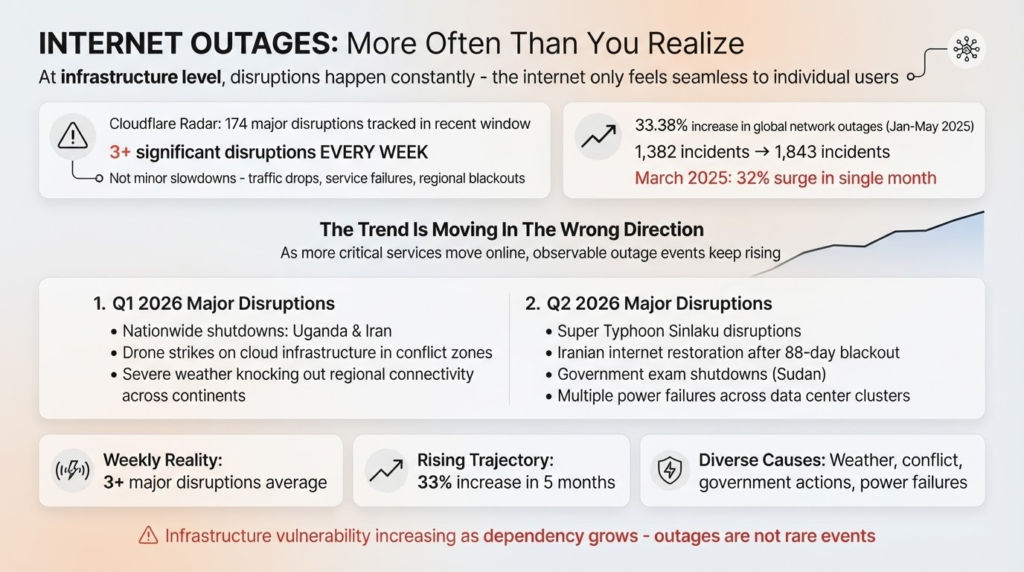
More often than most people realize. The internet feels seamless most of the time because individual users rarely experience a full outage. But at the infrastructure level, disruptions are happening constantly.
Cloudflare Radar tracked 174 major internet disruptions in a recent reporting window, averaging more than 3 significant disruptions every single week. These are not minor slowdowns. These are events measurable as traffic drops, service failures, or complete regional blackouts tracked across global monitoring systems.
Global network outages increased by 33.38% between January and May 2025, rising from 1,382 to 1,843 tracked incidents in that period alone. March saw a 32% surge in global outages within a single month. The trend is moving in the wrong direction. As more critical services move online, the number of observable outage events keeps rising.
In Q1 2026, there was a particular surge in internet disruptions including nationwide shutdowns in Uganda and Iran, drone strikes on cloud infrastructure in conflict zones, and severe weather events knocking out regional connectivity across multiple continents. Q2 2026 saw disruptions from Super Typhoon Sinlaku, Iranian internet restoration after an 88-day blackout, government-mandated exam shutdowns in Sudan, and multiple power failure events across data center clusters.
What Does an Internet Outage Actually Cost?
This is the section that makes CFOs and IT directors sit up very straight.
The $600 Billion Global Figure
Splunk and Cisco’s 2026 research puts the total global annual cost of unplanned outages at $600 billion. This is a systemic business crisis, not just an IT problem. It includes lost revenue, staff productivity losses, recovery costs, regulatory fines for service-level agreement violations, reputational damage, and long-term customer churn.
The average company loses $300 million per year to unplanned outages specifically. That same research found companies experience an average 3.4% stock price drop following a major publicly reported outage.
Cost Per Minute and Per Hour
The granular numbers are even more striking.
Organization Size | Cost Per Hour of Downtime |
Micro SMB (under 25 employees) | ~$100,000 per hour ($1,670 per minute) |
Small to medium business (20 to 100 employees) | $57,000 to $300,000 per hour |
Mid-size to large enterprise | $300,000 plus per hour |
Very large enterprise or critical infrastructure | $1 million plus per hour |
$15,000 per minute is the average cost of downtime across all business sizes according to Splunk’s 2026 research
91% to 93% of organizations say a single hour of downtime costs them more than $300,000
98% of organizations report that even one hour of downtime costs over $100,000
44% of mid-size and large enterprises report hourly downtime costs exceeding $1 million
33% of organizations report costs exceeding $1 million per hour for critical system failures
For ecommerce businesses specifically, a website with 99% uptime still has nearly 90 hours of potential downtime per year. At even the low end of ecommerce downtime costs of $57 per hour, that is over $5,000 in annual losses just from the 1% that 99% uptime fails to cover. Larger ecommerce operations can lose thousands of dollars per minute during peak periods.
Manufacturing is another sector where the numbers are brutal. Unplanned downtime consumes approximately 11% of annual revenue for the world’s largest manufacturers, equivalent to roughly $1.4 trillion in lost production value globally.
What Causes Internet Outages?
Understanding the causes is critical for both prevention and policy. The data reveals a clear pattern of who and what is to blame.
Human Error: The Number One Culprit
92% of operators say human error was at least a minor contributing factor in significant outages they experienced over the past three years
40% of organizations have suffered a major outage caused primarily by human error in the past three years
Of these human error incidents, 85% stem from staff failing to follow procedures or making configuration mistakes
Misconfiguration of network equipment, software updates pushed without proper testing, and incorrect DNS changes are the most common human error categories
Human error is the leading cause of internet and IT outages by a wide margin. This is not about people being careless. It reflects the extraordinary complexity of modern internet infrastructure. A single misconfigured routing rule can cascade into a global outage affecting millions of users. This is exactly what happened in major historical outages including the Facebook 2021 six-hour global shutdown.
Power Failures: The Persistent Problem
Power Failure Stat | Figure |
Share of major global public service outages caused by power failures (since 2016) | 36% |
Share of Q1 2026 outages caused by power failures | 42% |
Data centers experiencing power-related outages | Consistent across all facility tiers |
Power failures are the single most consistent technical cause of data center and internet outages. Despite enormous investment in backup generators, uninterruptible power supplies, and redundant power feeds, power remains the Achilles heel of internet infrastructure. A single power grid failure in a region with dense data center concentration can knock out multiple major services simultaneously.
Weather and Natural Disasters
Cloudflare’s Q2 2026 disruption summary documented outages caused by severe weather including earthquakes, typhoons, and flooding. Super Typhoon Sinlaku caused the longest single weather-related outage in Q2 2026. In Q1 2026, Winter Storm Fern affected more than 170 million Americans and caused significant power outages that cascaded into internet disruptions.
The US experienced 12 billion-dollar weather and climate disasters in the first half of 2026 alone, causing at least $31.9 billion in damage. Internet infrastructure sits directly in the path of these events and increasingly bears the cost.
Cyber Attacks
8.3% of attempted transactions globally in 2025 were suspected digital fraud or attack-related
25,000 network-layer DDoS attacks per Radware customer over a six-month period, averaging 139 attacks per day
90% of frontline cybersecurity managers report attacks are more frequent in 2026
Ransomware caused 42% of all data breach reports in New Jersey’s 2026 cyber threat assessment, representative of broader national trends
DDoS attacks targeting internet infrastructure are a growing cause of regional outages and service degradation
The line between cyber attack and internet outage is blurring. Distributed Denial of Service attacks can cause outages that are indistinguishable from technical failures at the user level. Ransomware attacks that encrypt infrastructure management systems can effectively take entire networks offline.
Government-Mandated Shutdowns
This is the category most Western users never think about, but it represents a significant and growing share of global internet disruptions.
75 total or partial internet shutdowns across 10 countries between August 2025 and August 2026
11 ongoing shutdowns as of August 10, 2026
Governments shut down internet to suppress political unrest, prevent cheating during national exams, and control information during military operations
Iran experienced an 88-day internet blackout before restoring national access in Q2 2026, with restoration reaching only 59% of pre-shutdown levels initially
Sudan implemented government-mandated shutdowns during exam periods, one of the most frequently cited causes of outages in Cloudflare’s Q2 2026 data
At least 313 shutdowns were implemented across 52 countries in a recent tracked year
In Eastern Europe and Central Asia, internet was shut down 29 times across seven countries
Government shutdowns are not technical failures. They are deliberate policy decisions that disconnect millions of people from global communication, commerce, education, and healthcare. The economic cost to affected countries is severe. Research consistently shows that a one-day internet shutdown costs a country approximately 1.9% of its daily GDP.
Cloud Outages: When the Biggest Players Go Down
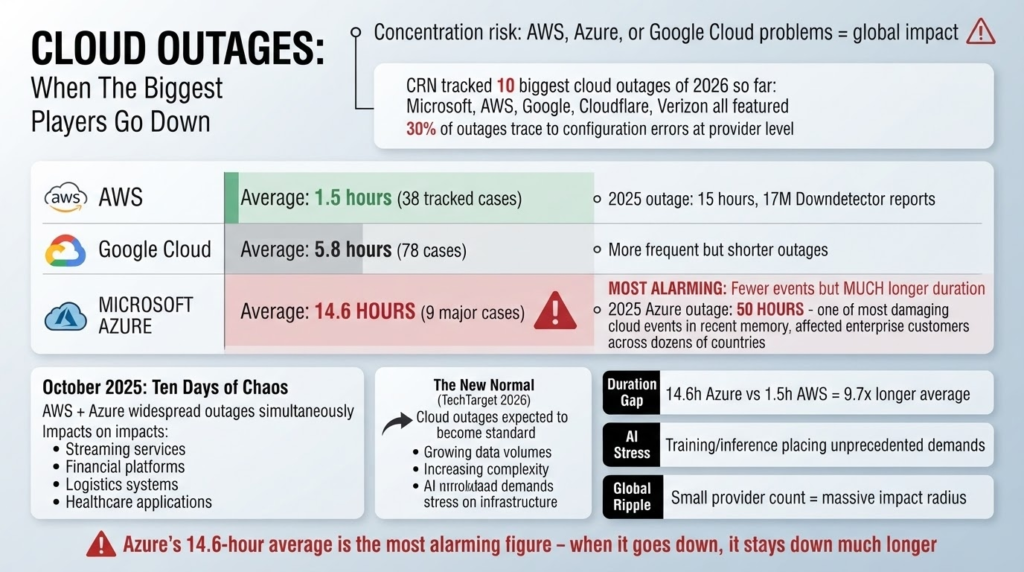
The concentration of internet infrastructure among a small number of cloud providers means that when AWS, Azure, or Google Cloud has a problem, the impact is global.
CRN documented the 10 biggest cloud outages of 2026 so far, with Microsoft, AWS, Google, Cloudflare, and Verizon all featuring. About 30% of cloud outage events trace back to configuration errors at the provider level.
Cloud Provider | Average Outage Duration (Historical) | Notable 2026 Context |
AWS | 1.5 hours average across 38 tracked cases | One 2025 outage lasted 15 hours with 17M Downdetector reports |
Google Cloud | 5.8 hours average across 78 cases | Consistently more frequent but shorter outages |
Microsoft Azure | 14.6 hours average across 9 tracked major cases | Fewer events but longer duration when they occur |
Azure’s average outage duration of 14.6 hours is the most alarming figure in this table. When Azure goes down, it tends to stay down longer than AWS or Google Cloud. The 2025 Azure outage that lasted 50 hours was one of the most damaging cloud events in recent memory, affecting enterprise customers across dozens of countries.
Cloud outages are now expected to become “the new normal” in 2026 according to TechTarget analysis, driven by growing data volumes, increasing complexity, and the accelerating pace of infrastructure changes needed to support AI workloads. AI training and inference are placing unprecedented demands on cloud infrastructure, and that stress is translating into more frequent disruptions.
Ten days in October 2025 saw both AWS and Azure suffer widespread outages that rippled across the global internet, affecting streaming services, financial platforms, logistics systems, and healthcare applications simultaneously.
Data Center Outages: What the Uptime Institute Found
The Uptime Institute publishes the most authoritative annual analysis of data center outages globally. Their 2026 report contains findings that every IT professional needs to understand.
50% of data centers experienced at least one impactful outage over the past three years, down from 53% in 2024
Progress is being made, but outages remain extremely common
Power remains the number one cause of the most severe data center outages
Both the frequency and severity of outages is the central focus for data center operators as AI demand surges
Nearly 40% of organizations have suffered a major outage caused by human error in the past three years
The slight improvement from 53% to 50% of data centers experiencing impactful outages is encouraging. But the baseline is still extremely high. Half of all data centers having a significant outage in any three-year period is not a success story. It reflects an industry that is still fundamentally struggling with reliability despite enormous investment in redundancy and resilience.
Power failures have accounted for 36% of the biggest global public service outages tracked since January 2016. Despite decades of investment in generators, battery backup, and redundant power feeds, power still takes down more critical infrastructure than any other single cause.
Government Internet Shutdowns: The Invisible Outage Crisis
Government-imposed internet shutdowns deserve their own section because they are one of the most significant and least discussed causes of large-scale internet disruption globally.
The Internet Society’s Pulse tracker shows 11 ongoing shutdowns worldwide as of August 10, 2026. These are not brief disruptions. Some last days, weeks, or months. Iran’s 88-day blackout in 2026 was one of the longest single national shutdowns ever recorded.
The geographic pattern of shutdowns is heavily concentrated in specific regions. Russia accounts for 65% of European shutdown events. Belarus accounts for 20%. Sub-Saharan Africa, South and Southeast Asia, and the Middle East are the most affected regions globally.
The economic cost of these shutdowns is severe and measurable. When a government shuts down the internet, it does not just inconvenience citizens. It stops ecommerce, freezes banking transactions, disrupts supply chains, prevents remote work, cuts off access to healthcare information, and isolates the country from the global digital economy. The longer the shutdown, the deeper the economic damage.
From a regulatory perspective, internet shutdowns are increasingly being challenged as human rights violations. The UN Human Rights Council has declared internet access a fundamental right. But enforcement mechanisms remain weak, and the number of shutdowns has been rising steadily from 75 documented events in 2016 to 296 by 2024 and continuing upward in 2025 and 2026.
Website Uptime: What the Numbers Actually Mean
When a hosting provider advertises “99% uptime,” that sounds impressive. The reality behind these numbers is worth understanding clearly.
Uptime Guarantee | Annual Downtime |
99% uptime | 87.6 hours of downtime per year |
99.9% uptime | 8.76 hours of downtime per year |
99.99% uptime | 52.6 minutes of downtime per year |
99.999% uptime | 5.26 minutes of downtime per year |
For a small ecommerce business, 87.6 hours of downtime per year costs between $5,000 and $100,000 depending on traffic volume. For a large ecommerce platform doing millions in daily sales, even 99.99% uptime with 52 minutes of annual downtime can represent hundreds of thousands of dollars in lost revenue.
Oh Dear, a website monitoring service, analyzed 1.8 million real outages across tens of thousands of monitored sites and found that outage duration and frequency varies significantly by hosting tier, geographic region, and time of day. Peak traffic periods and major sporting events are consistently the highest-risk times for ecommerce and media website outages.
The 43% of downtime events traced to network or IT infrastructure changes, according to Splunk, is a particularly useful data point for IT teams. Nearly half of all outages are caused by the systems that are supposed to improve things, software updates, configuration changes, infrastructure upgrades, and migration events that go wrong.
Industry-Specific Outage Impact
Not all industries suffer equally when the internet goes down. Some sectors have near-zero tolerance for outages. Others can absorb short disruptions more easily.
Industry | Downtime Sensitivity | Key Concern |
Financial services | Extreme. Seconds matter. | Market transactions, payment processing, fraud systems |
Healthcare | Extreme. Lives at risk. | Patient records, diagnostic systems, ICU monitoring |
Ecommerce | Very High | Direct revenue loss per minute of downtime |
Manufacturing | Very High | $260,000 per hour average. Production line halts |
Airlines and logistics | Very High | Flight management, booking, cargo tracking |
Media and streaming | High | Subscriber churn during major live events |
Education | Medium | Growing as remote learning becomes standard |
Government services | Medium to High | Benefits processing, tax systems, emergency services |
Manufacturing bears perhaps the least appreciated burden of internet and IT outages. Unplanned downtime consumes approximately 11% of annual revenue for large manufacturers, equivalent to $260,000 per hour across the sector. Modern manufacturing runs on connected systems. When the internet or IT infrastructure goes down, production lines stop, logistics coordination breaks, and supply chains freeze.
Healthcare outages have life-or-death consequences. A 2026 breach at ChipSoft, an online service provider for 70% of Dutch hospitals, demonstrated exactly how concentrated the risk has become in healthcare IT. When a single vendor goes down, the majority of hospitals in an entire country can lose access to patient records simultaneously.
The Bottom Line
The internet feels like it is always on. For most users in most places most of the time, it is. But underneath that apparent reliability is a system under enormous and growing stress. $600 billion in annual downtime costs. 174 major disruptions tracked by Cloudflare in a recent period. 91% of enterprises losing $300,000 or more per hour when systems fail. Human error in 92% of all significant outages. Eleven countries with active government-imposed internet shutdowns right now.
The internet is the backbone of the modern economy, the modern healthcare system, the modern education system, and increasingly the modern democratic process. When it goes down, the consequences are not just inconvenient. They are expensive, sometimes dangerous, and in the case of government shutdowns, sometimes a deliberate tool of political control.
The organizations and governments that take internet resilience seriously and invest accordingly are better positioned for every challenge that follows. Those that treat connectivity as a given, right up until the moment it is gone, are learning those lessons at $15,000 per minute.
FAQs
The most common causes of internet outages in 2026 include hardware failures, fiber cuts, power outages, and cyberattacks targeting network infrastructure. Software bugs and misconfigurations at major ISPs also account for a significant percentage of widespread disruptions.
The average internet outage in 2026 lasts between 2 to 4 hours for residential users, while enterprise-level outages are typically resolved within 1 to 2 hours due to priority support agreements. However, major infrastructure failures can extend downtime to several days in affected regions.
Internet outages cost businesses significant revenue because modern operations depend heavily on cloud services, e-commerce platforms, and real-time communication tools. A single hour of downtime can cost large enterprises hundreds of thousands of dollars in lost productivity and missed transactions.
According to the latest internet outage statistics for 2026, overall outage frequency has slightly decreased thanks to improved redundancy systems, but the severity and impact of individual outages has grown. This is largely due to greater dependency on a smaller number of centralized cloud and network providers.
Yes, analyzing internet outage statistics from 2026 allows companies to identify vulnerability patterns, peak downtime periods, and high-risk infrastructure components. This data-driven approach helps organizations invest in the right redundancy measures and disaster recovery plans to minimize future disruptions.
