
Ahrefs vs Semrush Statistics 2026: The Ultimate Data-Driven Comparison
Two tools dominate the professional SEO landscape in 2026. Semrush and Ahrefs are not just software products — they are the backbone of digital marketing strategy for millions of professionals, agencies, and enterprises across the globe. While countless comparison articles exist, most recycle the same surface-level features without diving into the actual hard numbers that define these platforms. This article goes deeper, covering every major statistical dimension — database size, users, revenue, pricing, market share, crawler activity, AI capabilities, and feature performance — so you can make a fully informed decision backed by data rather than affiliate bias.
If you want to try Semrush before committing to a full subscription, using a Semrush coupon is one of the smartest cost-saving moves available, especially for freelancers, small teams, and bloggers exploring the platform for the first time.
At-a-Glance Comparison: Semrush vs Ahrefs (2026)
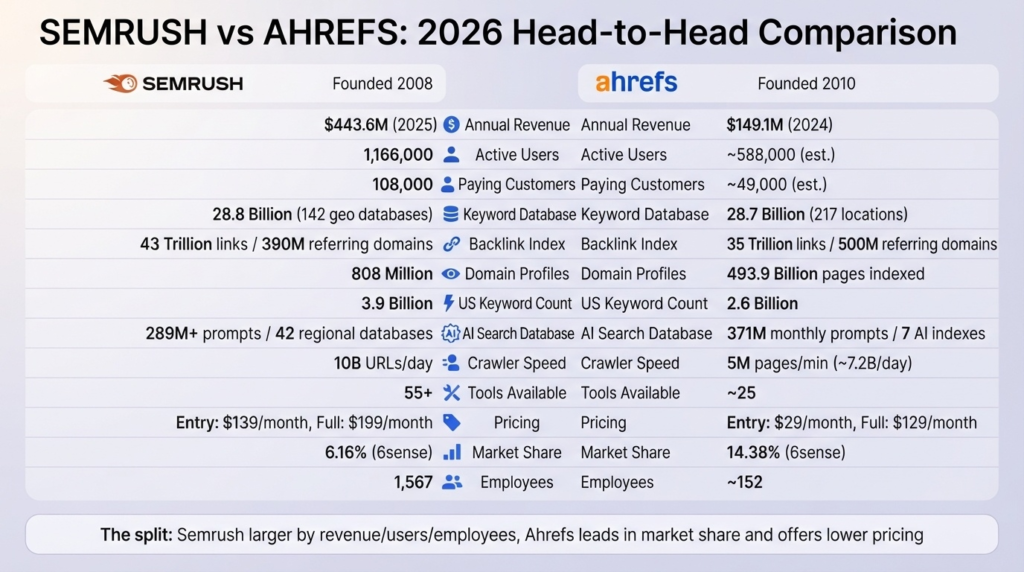
Metric | Semrush | Ahrefs |
Founded | 2008 | 2010 |
Annual Revenue | $443.6M (2025) | $149.1M (2024) |
Active Users | 1,166,000 | ~588,000 (est.) |
Paying Customers | 108,000 | ~49,000 (est.) |
Keyword Database | 28.8 Billion (142 geo databases) | 28.7 Billion (217 locations) |
Backlink Index | 43 Trillion links / 390M referring domains | 35 Trillion links / 500M referring domains |
Domain Profiles | 808 Million | 493.9 Billion pages indexed |
US Keyword Count | 3.9 Billion | 2.6 Billion |
AI Search DB | 289M+ prompts / 42 regional databases | 371M monthly prompts / 7 AI indexes |
Crawler Speed | 10B URLs/day | 5M pages/minute (~7.2B/day) |
Tools Available | 55+ | ~25 |
Entry Price | $139/month (SEO plan) | $29/month (Starter) |
Cheapest Full Plan | $199/month | $129/month (Lite) |
Market Share (SEO/SEM) | 6.16% (6sense) | 14.38% (6sense) |
Employees | 1,567 | ~152 |
Company Background: The Origin Stories
Understanding where these tools came from helps explain why they are built the way they are today. Semrush was founded in 2008 by a group of SEO and IT specialists in the United States with a vision to create a competitive intelligence platform for digital marketers. Starting with just two tools, the company has since grown into a publicly listed company on the New York Stock Exchange (NYSE: SEMR), generating $443.6 million in total revenue in 2025 and serving over a million active users globally. The scale, the breadth of features, and the sheer number of employees — 1,567 full-time staff and contractors — reflect a company that has gone all-in on becoming an all-in-one marketing platform.
Ahrefs, by contrast, was founded in 2010 in Singapore by Dmitry Gerasimenko, who remains the company’s CEO. What makes Ahrefs structurally remarkable is that it has grown to $149.1 million in annual revenue (2024) without taking a single dollar of venture capital. It is one of the most successful bootstrapped SaaS companies in the world. The company operates with an intentionally lean team of just 152 employees across 26 global locations — a headcount that is extraordinary given the scale of infrastructure it runs. Instead of investing in large sales teams and marketing budgets, Ahrefs invests in hardware and data. The result is one of the most technically sophisticated SEO data infrastructures ever built by a private company.
Revenue & Financial Statistics: A Tale of Two Business Models
The revenue trajectories of these two companies tell very different stories about how each has scaled.
Semrush’s revenue growth has been nothing short of explosive over the past six years, growing from $92.1 million in 2019 to $443.6 million in 2025 — a 382% increase. Its Annual Recurring Revenue (ARR) stood at $471.4 million as of December 2025, with revenue per paying customer rising to $4,369 in 2025 — a 24% increase from $3,522 in 2024. In Q1 2025 alone, Semrush crossed the $105 million quarterly revenue mark for the first time. The US market accounts for 45.31% ($170.73M) of Semrush’s total revenue, followed by the UK at 9.12% and the rest of the world at 45.57%.
Here is Semrush’s full annual revenue history:
2019: $92.1 million
2020: $124.88 million
2021: $188 million
2022: $254.32 million
2023: $307.68 million
2024: $376.82 million
2025: $443.6 million (+18% YoY)
Ahrefs operates differently as a private, bootstrapped company — it does not disclose detailed financial filings. However, from available data, its revenue journey looks like this:
2011: ~$1 million
2015: ~$7–15 million
2016: ~$12 million
2018: ~$37 million
2020: ~$65 million
2021: ~$86 million
2023: ~$100 million (crossed $100M ARR milestone)
2024: $149.1 million (first publicly confirmed figure)
While Semrush’s revenue dwarfs Ahrefs’ at roughly 3x the size, what makes Ahrefs remarkable is achieving $149 million with just 152 employees, compared to Semrush’s 1,567 staff. That means Ahrefs generates approximately $981,000 in revenue per employee, while Semrush generates roughly $282,000 per employee — Ahrefs is nearly 3.5x more revenue-efficient per head.
User Statistics: Scale vs. Precision
Semrush and Ahrefs serve fundamentally different audience sizes, and the data reflects this clearly. Semrush has been far more aggressive in building a free-tier user base as a top-of-funnel growth strategy, while Ahrefs historically focused on qualified paying customers.
Semrush’s user growth has been dramatic:
2019: 388,000 active users
2020: 471,000 active users
2021: 619,000 active users
2022: 898,000 active users
2023: 1,149,000 active users
2024: 1,166,000 active users
All-time registered accounts: 28 million+
Of the 1,166,000 active Semrush users, approximately 1,049,000 (89.97%) are on the free plan and only 108,000 are paying customers as of December 2025. This is actually a slight decline from 117,000 paying customers in Q4 2024 — a trend worth watching. Semrush’s enterprise segment counts approximately 5,800 customers contributing over $10,000/year in ARR and 500 customers contributing over $50,000/year in ARR.
Ahrefs takes a different approach. While it does offer free access through Ahrefs Webmaster Tools — which requires site verification rather than an email signup — it does not have a massive free-user base by design. According to 6sense, approximately 55,210 companies have adopted Ahrefs as of 2026. BuiltWith tracks 186,144 sites running Ahrefs Site Verification meta tags. Ahrefs’ paying customers are primarily small and startup-stage businesses, with 40.99% coming from companies with 0–9 employees and 24.60% from companies with 20–49 employees — a clear signal that the platform resonates with lean, technically focused teams.
In terms of website traffic, Ahrefs’ own website attracted 12.3 million visits in March 2025, with the US contributing 18.77% of traffic, India 17.36%, and the UK 6.28%. Semrush.com, by contrast, attracts far higher traffic volumes commensurate with its larger brand presence and marketing spend.
Market Share: A Surprising Reversal
One of the most counterintuitive statistics in this entire comparison is the market share data. Despite Semrush being the significantly larger company by revenue and user count, Ahrefs actually holds a higher SEO/SEM market share according to 6sense’s 2026 data:
Google Ads: 70.73% (SEO/SEM category leader)
Ahrefs: 14.38% market share — 55,210 company adopters
Semrush: 6.16% market share
Yext: 3.75%
This appears counterintuitive, but the discrepancy likely reflects how 6sense measures adoption — specifically tracking verified enterprise and mid-market software installations — rather than total registered accounts. Ahrefs’ paying base skews toward more technically dedicated SEO professionals who install and actively use the tool, while Semrush’s vastly larger free-user base includes many infrequent users who registered but don’t deeply integrate the tool into their workflows.
Ahrefs also claims that marketers at 44% of Fortune 500 companies use its platform — a remarkable penetration figure for a bootstrapped company.
Database Statistics: Where Each Tool Wins
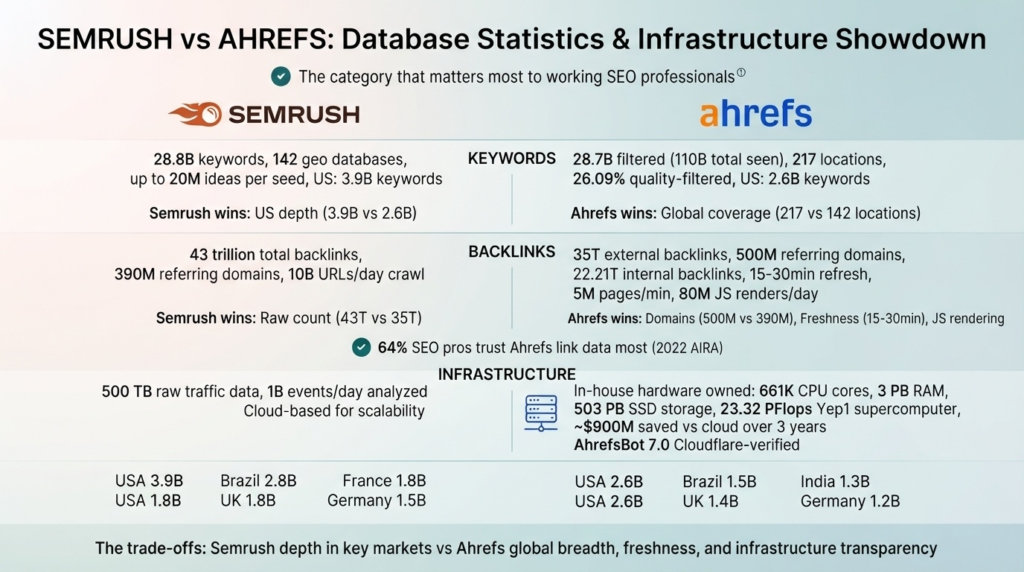
This is the category that matters most to working SEO professionals. Let’s break down the actual data infrastructure behind each platform.
Keyword Databases
Semrush and Ahrefs are remarkably close in raw keyword database size:
Semrush: 28.8 billion keywords across 142 geo databases, generating up to 20 million keyword ideas from a single seed keyword. US database alone: 3.9 billion keywords
Ahrefs: 28.7 billion filtered keywords across 217 locations. Total keywords ever seen: 110 billion (the 28.7B represents only 26.09% of the total, filtered for quality). US keyword database: 2.6 billion
Semrush wins on US keyword depth (3.9B vs 2.6B), while Ahrefs wins on global geographic coverage (217 locations vs 142). The fact that Ahrefs has seen 110 billion total keywords but shows only 28.7 billion suggests aggressive quality filtering — which many SEOs actually prefer because it reduces noise.
For geo coverage comparison, Ahrefs’ top keyword counts by country are: USA (2.6B), Brazil (1.5B), UK (1.4B), India (1.3B), Germany (1.2B). Semrush’s top counts are: USA (3.9B), Brazil (2.8B), UK (1.8B), France (1.8B), Germany (1.5B).
Backlink Databases
This is where the comparison gets most interesting — and most debated. Each tool claims superiority on a different metric:
Semrush: 43 trillion total backlinks from 390 million referring domains, crawling 10 billion URLs per day
Ahrefs: 35 trillion external backlink history records from 500 million referring domains, plus 22.21 trillion internal backlinks — a data layer no competing tool exposes at the same scale. Backlink index refreshes every 15–30 minutes. The crawler processes 5 million pages per minute and renders around 80 million pages per day specifically to capture JavaScript-inserted links
Semrush wins on raw backlink count (43T vs 35T). Ahrefs wins decisively on referring domains (500M vs 390M) and on crawl freshness, with backlinks updated every 15–30 minutes versus Semrush’s less frequent refresh cycle. Ahrefs is also the only SEO tool that renders JavaScript during its regular web crawl — a significant technical advantage for crawling modern, JS-heavy websites. In a 2022 AIRA survey, 64% of SEO professionals said they trust Ahrefs’ link data more than any competitor’s.
Infrastructure Statistics — Ahrefs vs. Semrush
One area where Ahrefs is uniquely transparent is its hardware infrastructure, which it builds and owns rather than renting cloud services:
Ahrefs in-house hardware: 661,000 CPU cores, 3 PB (petabytes) of RAM, 503 PB of SSD storage across 3 locations
Ahrefs Yep1 supercomputer: Rated at 23.32 PFlops of compute
Estimated cloud savings: ~$900 million over 3 years by running in-house vs. cloud
AhrefsBot version: 7.0, a Cloudflare-verified good bot
Semrush processes 500 TB of raw traffic data and analyzes 1 billion events per day through its Trends suite. Its infrastructure is cloud-based, built for scalability rather than ownership efficiency.
AI Visibility Statistics: The New Battleground
AI search is reshaping SEO, and both tools have built dedicated AI visibility tracking systems. This is where the 2026 picture is most different from what most comparison articles currently say.
Semrush AI Search Database:
289 million+ AI search prompts sourced from real clickstream data and Google’s AI Overviews dataset
42 regional databases for geo-specific AI search intelligence
36 million+ unique brands tracked
6 major AI platforms currently monitored
AI visibility tools track brand appearances across ChatGPT, Google AI Overviews/AI Mode, and Perplexity
AI visibility tracking available from $199/month (Starter plan) — not included in the $139 SEO plan
Ahrefs Brand Radar AI System:
371 million monthly AI prompts tracked across 7 AI indexes
AI Overviews: 281.9 million monthly prompts (the dominant AI surface)
AI Mode: 19.7 million monthly prompts
ChatGPT: 14.5 million monthly prompts
Gemini and Perplexity: 14.6 million monthly prompts each
Copilot: 13.3 million | Grok: 13.1 million
Tracks 36M+ unique brands across AI platforms
Brand Radar is included on every paid plan from $129/month — not gated behind an upgrade
This is one of the most important pricing differences in 2026 that most comparison articles miss: Ahrefs bundles AI visibility tracking into its $129/month Lite plan, while Semrush gates it behind its $199/month Starter tier. For teams that care specifically about AI search visibility, Ahrefs delivers this feature $70/month cheaper than Semrush.
Pricing Statistics: Tier-by-Tier Breakdown
Pricing structures for both tools changed significantly in 2025–2026. Many articles still quote Semrush’s old Pro/Guru/Business tiers — those plans no longer exist.
Semrush Current Plans (Verified July 2026):
Plan | Monthly Price | Billed Annually | Projects | Keywords | Notes |
Free | $0 | $0 | 1 demo | Limited | 10 reports/day |
SEO | $139/month | ~$117/month | 5 | 500 | SEO only — no AI tools |
Starter | $199/month | ~$165/month | 5 | 500 | SEO + AI Search |
Pro+ | $299/month | ~$248/month | 15 | 1,500 | 100 AI prompts/day |
Advanced | $549/month | ~$456/month | 40 | 5,000 | API access, 200 prompts/day |
Ahrefs Current Plans (Verified July 2026):
Plan | Monthly Price | Projects | Keywords | Crawl Credits/Month |
Ahrefs Free | $0 | Verified site only | — | Limited |
Starter | $29/month | Research only | — | — |
Lite | $129/month | 5 | 750 | 100,000 |
Standard | $249/month | 20 | 2,000 | 500,000 |
Advanced | $449/month | 50 | 5,000 | 1.5 million |
Enterprise | $1,499/month | 100 | 10,000+ | 5 million+ |
Key pricing insights that matter:
Ahrefs’ $29 Starter plan has no Semrush equivalent — making it the lowest entry point in the professional SEO tool market
At the Lite/SEO plan level, Ahrefs ($129) is $10/month cheaper than Semrush’s SEO plan ($139) and gives you 750 tracked keywords vs. 500
At mid-tier, Ahrefs Standard ($249) provides 2,000 tracked keywords and 20 projects, while Semrush Pro+ ($299) provides only 1,500 keywords and 15 projects — Ahrefs wins on both metrics while being $50/month cheaper
Semrush’s API access is available at $549/month (Advanced), while Ahrefs’ uncapped API requires the $1,499/month Enterprise plan — Semrush wins for developer access at mid-tier
The total cost difference over one year at comparable mid tiers is approximately $600/year in Ahrefs’ favor.
Feature-by-Feature Statistical Comparison
Keyword Research Winner: Semrush
Semrush’s Keyword Magic Tool processes 28.8 billion keywords and can generate up to 20 million keyword ideas from a single seed term — the highest idea generation capacity in the industry. Its standout differentiators include Topical Authority scoring (which measures how well your domain covers a topic cluster) and Personal Keyword Difficulty (PKD%), which customizes difficulty scores based on your specific domain. Ahrefs’ Keywords Explorer counters with its unique Clicks metric, which shows not just search volume but actual clicks to organic results — invaluable in an era where AI Overviews and featured snippets steal traffic from high-volume queries.
Backlink Analysis Winner: Ahrefs
Despite Semrush’s larger raw backlink count (43T vs 35T), Ahrefs wins on every metric that practicing SEOs care about most. Its 500 million referring domains vs Semrush’s 390 million, combined with a 15–30 minute refresh cycle, JavaScript rendering capability, and the unique internal backlink data layer (22.21 trillion internal links) give Ahrefs a decisive edge in link analysis. Features like Link Intersect (sites linking to competitors but not to you), Linking Authors (showing which writers prefer linking to your content), and Broken Backlinks make Ahrefs the tool of choice for link builders worldwide.
Technical SEO Audit Winner: Semrush (for enterprise), Ahrefs (for speed)
Semrush’s Site Audit tool checks 140+ issues and includes an AI Search Health score directly in the audit dashboard — telling you whether your site is visible to AI crawlers like GPTBot. Its thematic organization (Crawlability, HTTPS, Core Web Vitals, Internal Links, Markup) makes complex audits navigable for large sites. Ahrefs counters with an always-on audit feature that crawls your site every minute and an IndexNow integration for faster indexing across multiple search engines simultaneously.
Rank Tracking Winner: Semrush (for local SEO), Ahrefs (for value)
Semrush is the only tool offering city-level rank tracking — a non-negotiable feature for local SEO campaigns and multi-location businesses. For teams that don’t need city-level precision, Ahrefs provides 750 tracked keywords on Lite vs Semrush’s 500 on its SEO plan, at a lower price point.
PPC Research Winner: Semrush
Ahrefs has no PPC campaign building or management tools. Semrush’s Advertising Toolkit offers full competitor PPC research, campaign planning, a PPC Keyword Tool that exports directly to Google Ads Editor, Google Shopping insights, and unified paid/organic tracking in a single dashboard. For agencies or in-house teams running both SEO and paid campaigns, Semrush simply has no competition from Ahrefs in this category.
AI Visibility Winner: Ahrefs (on value), Semrush (on breadth)
As detailed above, Ahrefs includes Brand Radar AI tracking on all plans from $129/month, while Semrush gates AI visibility tools behind the $199/month tier. Semrush’s AI toolkit does cover more marketing touchpoints — content generation, ad copy, social media — but for pure AI search visibility tracking at the lowest cost, Ahrefs wins.
Content Marketing Winner: Semrush
Semrush has built an entire content marketing ecosystem that Ahrefs simply does not compete with. Its Topic Research tool generates content ideas from real questions and trending subtopics, while the SEO Content Template provides a complete content brief including target word count, readability score, and backlink source suggestions. Ahrefs has a Content Explorer tool and useful content gap analysis, but it is not a content marketing platform in the way Semrush is.
Review Ratings & Brand Trust Statistics
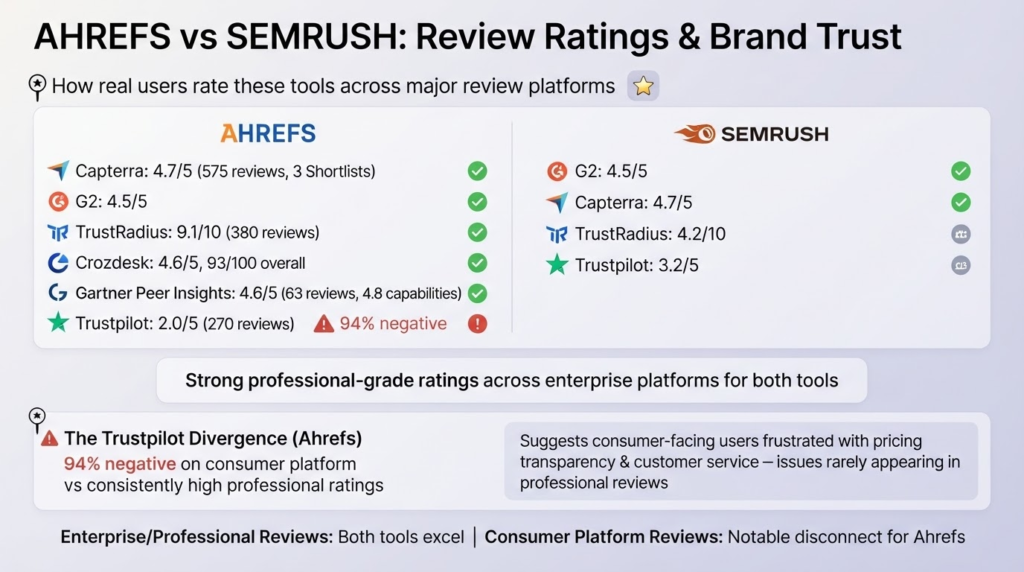
How do real users rate these tools across major software review platforms?
Ahrefs Reviews:
Capterra: 4.7/5 from 575 reviews (appears in 3 Capterra Shortlists)
G2: 4.5/5
TrustRadius: 9.1/10 from 380 reviews
Crozdesk: 4.6/5, overall score 93/100
Gartner Peer Insights: 4.6/5 from 63 reviews (product capabilities rated 4.8)
Trustpilot: 2.0/5 (270 reviews, 94% negative — largely customer support and pricing concerns)
Semrush Reviews:
G2: 4.5/5
Capterra: 4.7/5
TrustRadius: 4.2/10
Trustpilot: 3.2/5
Both tools have strong professional-grade ratings across enterprise software review platforms. The Trustpilot divergence for Ahrefs is notable — the overwhelming negativity (94%) on that particular platform suggests consumer-facing users frustrated with pricing transparency and customer service responsiveness, issues that rarely appear in professional reviews.
Crawler & Technical Infrastructure Statistics
This section is where Ahrefs’ engineering-first philosophy is most visible in raw numbers:
AhrefsBot 7.0 crawls 5 million pages every minute — one of the most active web crawlers after Googlebot
10 million new pages discovered per day; 300 million pages updated per day
80 million pages rendered per day for JavaScript-based link discovery (unique capability among SEO tools)
Backlink index refreshed every 15–30 minutes — among the fastest in the industry
493.9 billion pages indexed across 500.4 million post-vetting domains
The underlying database stores 170 trillion rows in its key-value data structure
AhrefsBot and AhrefsSiteAudit are both Cloudflare-verified good bots — meaning they are explicitly whitelisted and trusted by Cloudflare’s global security network
Ahrefs’ Yep search engine participates in the IndexNow protocol for faster content indexing
Semrush’s crawler processes 10 billion URLs per day and powers its Domain Analytics with 543 million desktop keywords and 774 million desktop domain profiles. Its Trends suite analyzes 1 billion events per day from a panel of 200 million users across 190 countries.
Who Should Choose What: The Data-Driven Verdict
Based purely on the statistics and features covered throughout this article, the right choice comes down to your primary workflow:
Choose Semrush if you need:
A full-stack digital marketing platform covering SEO, PPC, content, and social media
City-level local SEO rank tracking (Ahrefs does not offer this)
The largest US keyword database (3.9B vs 2.6B)
API access at sub-enterprise pricing ($549/month vs $1,499/month for Ahrefs)
A massive free user base gives you a well-documented, community-supported tool
Choose Ahrefs if you need:
The largest referring domain index for backlink analysis (500M vs 390M)
Faster, fresher backlink data (15–30 minute refresh vs slower Semrush updates)
JavaScript rendering during crawl for modern JS-heavy websites
AI visibility tracking included in base plans from $129/month (vs Semrush’s $199/month)
Better keyword-per-dollar value at every comparable plan tier
A cleaner, more intuitive interface that’s easier for beginners
The smartest move for well-funded agencies and enterprise teams is using both tools simultaneously — Semrush for content, PPC research, competitive intelligence, and local SEO; Ahrefs for link building, deep backlink analysis, and competitor research. The tools are genuinely complementary rather than fully substitutable. For those who can only afford one, using a Semrush coupon to trial Semrush’s full feature set at a reduced cost remains one of the best ways to test the all-in-one approach before committing.
Final Scorecard: Semrush vs Ahrefs
Category | Winner | Reason |
Revenue & Scale | Semrush | $443.6M vs $149.1M (2025 vs 2024) |
Revenue Efficiency | Ahrefs | ~$981K/employee vs ~$282K/employee |
Market Share (SEO/SEM) | Ahrefs | 14.38% vs 6.16% (6sense) |
Keyword Database (US) | Semrush | 3.9B vs 2.6B US keywords |
Keyword Database (Global) | Ahrefs | 217 locations vs 142 |
Backlink Count | Semrush | 43T vs 35T total links |
Referring Domains | Ahrefs | 500M vs 390M domains |
Backlink Freshness | Ahrefs | 15–30 min refresh vs Semrush |
Crawl Speed | Ahrefs | 5M pages/minute |
JS Rendering | Ahrefs | Only tool rendering during regular crawl |
AI Visibility Pricing | Ahrefs | Included at $129/mo vs $199/mo |
Keyword Research Tools | Semrush | PKD%, Topical Authority, 20M ideas |
Backlink Analysis | Ahrefs | Deeper metrics, faster, larger domain index |
Technical SEO (Enterprise) | Semrush | 140+ checks, AI Search Health score |
Rank Tracking (Local) | Semrush | Only tool with city-level tracking |
PPC Research | Semrush | Ahrefs has no PPC tools |
Content Marketing | Semrush | Topic Research, SEO Content Template |
Entry Price | Ahrefs | $29 Starter vs no Semrush equivalent |
Value at Mid-Tier | Ahrefs | More keywords, more projects, less money |
Overall Winner | Semrush (all-in-one) / Ahrefs (SEO depth) | Depends on use case |
FAQs
Semrush leads with over 25 billion keywords in its database, while Ahrefs offers approximately 20 billion keywords. Semrush's larger dataset makes it particularly strong for keyword research across multiple regions and languages.
Ahrefs is widely regarded as the stronger backlink analysis tool, boasting over 35 trillion known links compared to Semrush's roughly 43 trillion, though Ahrefs updates its index more frequently. For in-depth link building research, most SEO professionals still favor Ahrefs for its crawl speed and data freshness.
Semrush's entry-level Pro plan starts at around $139.95 per month, while Ahrefs' Lite plan begins at approximately $129 per month. Ahrefs offers slightly more affordability at the base tier, but Semrush provides more tools per plan, making it better value for agencies needing an all-in-one platform.
Semrush includes a dedicated Traffic Analytics and Market Explorer feature that provides estimated competitor traffic, audience insights, and market share data that Ahrefs currently lacks. These unique competitive intelligence tools make Semrush the preferred choice for comprehensive competitor research strategies.
Semrush offers more robust local SEO features, including a dedicated Local SEO toolkit with listing management, GBP integration, and local rank tracking across specific zip codes. Ahrefs provides rank tracking but lacks the same depth of local-specific tools, giving Semrush a clear edge for local search optimization.
