
SEO vs AEO vs GEO: The Stats That Prove Search Has Changed Forever
Let’s start with a number that should make every marketer stop scrolling: 80% of Google searches now end without a single click. That’s not a typo. Eight out of ten people who type a query into Google in 2026 never visit a website. They get their answer from the search engine itself — and leave.
The internet wasn’t always like this. For nearly two decades, the deal was simple: create good content, rank on Page 1, get traffic. That was SEO, and it worked beautifully. But three things happened that broke the old contract — AI Overviews from Google, the explosion of conversational tools like ChatGPT and Perplexity, and the rise of voice assistants that answer questions out loud. Suddenly, there wasn’t just one game to play. There were three.
Here’s how each one is defined at the most fundamental level:
SEO (Search Engine Optimization) is the original — ranking high in traditional search results so users click through to your site.
AEO (Answer Engine Optimization) is the pivot — structuring your content so AI assistants, voice search tools, and featured snippets quote you as the answer.
GEO (Generative Engine Optimization) is the new frontier — making sure your brand gets cited, referenced, and trusted by AI models like ChatGPT, Gemini, Claude, and Perplexity when they generate responses.
These aren’t just buzzwords. The stats behind each one tell a story about where attention is moving, where budgets need to go, and which businesses are going to get left behind.
SEO: Still The Giant, But The Giant Is Tired
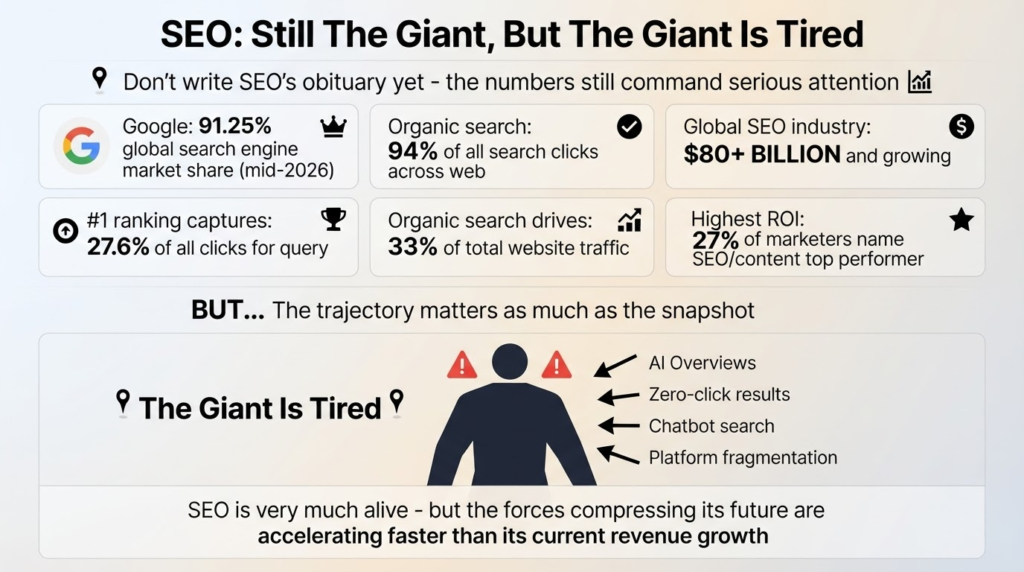
SEO’s Numbers Still Demand Respect
Don’t write SEO’s obituary yet. The numbers still command serious attention.
Google holds 91.25% of global search engine market share as of mid-2026
Organic search accounts for 94% of all search clicks across the web
The global SEO industry is valued at over $80 billion and continues to grow
Websites ranking #1 on Google still capture approximately 27.6% of all clicks for that query
Organic search drives 33% of total website traffic across major industries
SEO and content consistently deliver the highest ROI of any digital channel, with 27% of marketers naming it their top performer
So yes — SEO is very much alive. But here’s the catch: it’s being squeezed from all sides, and the trajectory matters just as much as the snapshot.
The Zero-Click Crisis Is Real
The zero-click rate climbed from 50% in 2019 to 64.82% in 2026. Google AI Overviews — those AI-generated summaries at the very top of search results — appeared for nearly 25% of keywords at their 2025 peak. A study by Ahrefs analyzing 300,000 keywords found that AI Overviews reduce click-through rates by 34.5%. For content marketers who built entire businesses on blog traffic, that number hits like a gut punch.
The implication? SEO is no longer a complete strategy. It’s a foundation — an essential one — but a foundation you still need to build on.
AEO: The Art of Becoming The Answer
What AEO Actually Targets
If SEO is about being found, AEO is about being chosen. And the distinction matters enormously in a world where AI reads your content and decides whether to quote you or ignore you.
AEO zeroes in on the following surfaces across search:
Featured snippets — the boxed answer at the top of Google results
Google’s AI Overviews — the AI-generated summaries above the traditional results
Voice search results — answers read aloud by Siri, Alexa, and Google Assistant
Chatbot references — when AI tools like ChatGPT pull from your content
People Also Ask boxes — nested Q&A panels within Google’s SERP
The Voice Search Angle Is Staggering
153.5 million people globally use voice assistants, and 40.7% of voice search answers are pulled directly from featured snippets. Over 80% of voice answers originate from the top 3 organic results. If you’re not ranking in the top 3, your voice search presence is essentially zero.
Here’s the stat that defines AEO’s urgency: Zero-click searches jumped from 56% in 2024 to 69% in 2025. The gap between someone asking a question and someone visiting your website is wider than it has ever been. AEO is the strategy that lets you benefit from zero-click behavior instead of losing to it. When Google quotes you in a featured snippet, you get the brand visibility, the trust signal, and sometimes the traffic — all without the user technically “clicking” the traditional result.
Enterprise Budgets Are Catching On Fast
Companies allocated an average of 12% of their digital marketing budgets to AEO in 2025
56% of digital marketing leaders reported high satisfaction with their AEO investments
AEO adopters are capturing 3.4x more traffic from AI search than brands that haven’t adapted
GEO: The New Battleground Nobody Fully Understands Yet
What Makes GEO Different From Everything Else
GEO is where things get genuinely exciting — and genuinely complicated. It’s the practice of ensuring that when a generative AI model synthesizes an answer from across the internet, your content, your brand, and your expertise are part of what it draws from.
Think about the last time you asked ChatGPT a question. It didn’t give you ten blue links. It gave you a paragraph — a confident, synthesized answer. Behind that answer, the model referenced dozens of sources, cited some explicitly, and absorbed others implicitly. GEO is about being one of those sources.
The Market Size Tells The Whole Story
Year | Global GEO Market Size | Growth Rate |
2025 | ~$770 million | — |
2026 | $1,089.3 million | 40.6% CAGR |
US Market Alone (2026) | $365.4 million | 42.9% CAGR |
That’s not niche. That’s a billion-dollar industry that barely existed 24 months ago.
The Traffic Numbers Are Jaw-Dropping
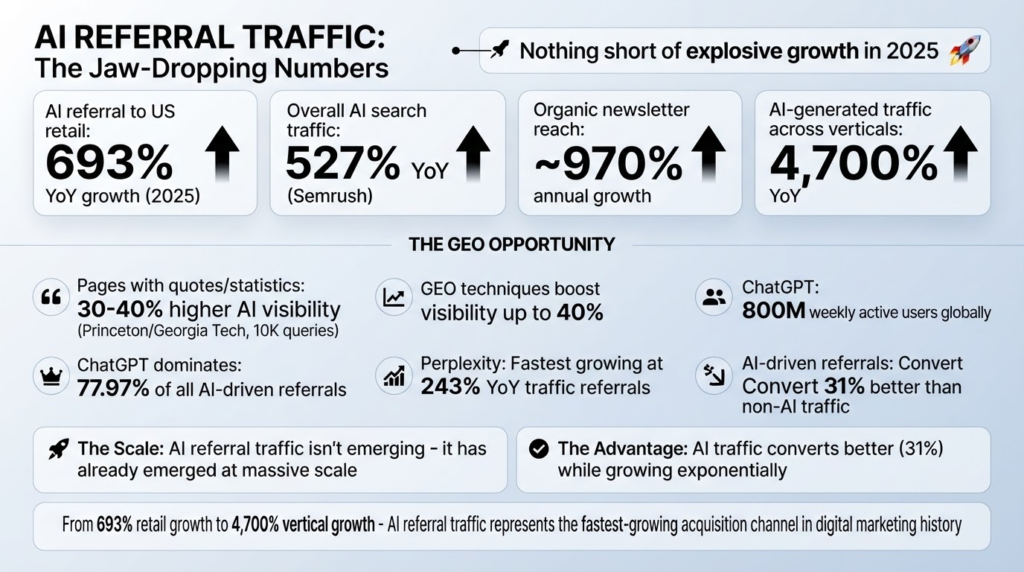
The referral traffic data from AI platforms is nothing short of explosive:
AI referral traffic to US retail websites grew 693% year-over-year during 2025
Overall AI search traffic is up 527% year-over-year according to Semrush’s latest reporting
Some analysts tracking organic newsletter reach put the annual growth figure closer to 970% in a single year
Year-over-year growth in AI-generated traffic across verticals: 4,700%
The GEO Opportunity By The Numbers
Pages containing quotes and statistics have 30–40% higher visibility in AI-generated responses (Princeton/Georgia Tech research across 10,000 real-world queries)
Specific GEO techniques can boost content visibility in AI responses by up to 40%
ChatGPT alone handles 800 million weekly active users globally
ChatGPT dominates AI referral traffic with 77.97% of all AI-driven site referrals
Perplexity is growing fastest at 243% year-over-year in traffic referrals
AI-driven referral traffic converts 31% better than non-AI traffic
💡 That last point deserves its own spotlight. Not only is AI search sending more traffic — the traffic it sends buys more. Users arriving via generative AI tools are further along in their decision process, more trusting of recommendations, and more likely to convert. GEO isn’t just a visibility play — it’s a revenue play.
The Side-By-Side: SEO vs AEO vs GEO
Complete Comparison At A Glance
Factor | SEO | AEO | GEO |
Primary Goal | Rank high in search results | Become the quoted answer | Get cited by AI models |
Main Platforms | Google, Bing | Google Snippets, Voice, AI Overviews | ChatGPT, Perplexity, Gemini, Copilot |
Key Metric | Rankings + CTR | Featured Snippet wins + voice answers | AI citations + referral traffic |
Content Format | Long-form, keyword-rich pages | Concise Q&A, structured data, FAQs | Authoritative, data-rich, quotable content |
Technical Focus | Backlinks, page speed, crawlability | Schema markup, clear answers, conciseness | E-E-A-T signals, citations, structured facts |
ROI Timeline | 3–12 months | 1–4 months | 2–8 months (still emerging) |
2025 Budget Allocation (avg) | 40–60% of SEO budget | 12% of digital budget | Fastest-growing allocation |
Zero-Click Impact | Hurt by zero-click | Benefits from zero-click | Immune to zero-click |
Who Benefits Most | E-commerce, local businesses, publishers | High-intent brands, voice use cases | SaaS, B2B, consultancies, thought leaders |
The Mindset Difference: One Query, Three Strategies
A Real-World Snapshot
One of the most useful ways to understand the three disciplines is to think about how each one approaches the same question: “What is the best CRM for small businesses?”
How SEO Would Approach It
SEO would produce a comprehensive 3,000-word blog post targeting the keyword “best CRM for small businesses,” building backlinks to it and aiming for Page 1, Position 1 on Google — focusing on click-through and session time.
How AEO Would Approach It
AEO would structure the content as a direct, conversational answer — starting with a clear definition, using FAQ schema markup, keeping the first paragraph tight enough to be pulled into a featured snippet or read aloud by a voice assistant without the user needing to click anything.
How GEO Would Approach It
GEO would ensure the article contains original statistics, expert quotes, and authoritative claims — so that when ChatGPT or Perplexity synthesizes a response about CRMs, it pulls your article as a source and either cites it directly or uses your framing in its generated answer.
The critical insight: all three approaches are working on the same piece of content. They’re not competing strategies — they’re layered ones.
Who’s Actually Winning Right Now?
Breaking Down The Winners By Strategy
The brands and creators making the most noise in 2025–2026 are those treating search as an ecosystem rather than a single channel. Here’s how the competitive landscape breaks down by discipline:
Businesses still winning purely on SEO tend to be local service providers (plumbers, dentists, contractors), large e-commerce brands with massive domain authority, and news publishers with real-time content advantages. Their strength is volume — millions of indexed pages and years of earned authority.
Businesses winning on AEO are typically those with expertise in high-intent question categories — financial advisors, health platforms, legal information sites, and SaaS tools whose brand name gets searched as a question (“how does [Tool] work?”). Their content is structured, concise, and built to be quoted.
Businesses winning on GEO are the ones investing in thought leadership, original research, and building genuine authority in their niche. AI models don’t cite random blog posts — they cite sources they’ve “learned” are trustworthy. That trust is built through consistent, accurate, well-structured, data-rich content over time.
The Brutal Truth About Where Search Is Heading
The Stat That Should Close Every Marketing Meeting
Here’s a number that might be the most important one in this entire piece: 44% of AI-powered search users say AI is now their primary and preferred source of information — topping traditional search (31%), retailer sites, and social media, according to McKinsey research from 2025.
That is a sea change in behavior, and it’s happening faster than most marketing departments are moving. Meanwhile:
AI platforms’ share of web traffic has quadrupled in just 12 months (from 0.03% to 0.13% and still climbing)
ChatGPT reached 55.2 billion visits by June 2025, up 80% in a single year
Google AI Overviews now appear for 15–25% of all search queries depending on the month
Year-over-year growth in AI-generated traffic: 4,700%
The old model — write a blog post, rank it, get clicks, sell something — isn’t dead, but it is no longer sufficient as a standalone strategy.
The Playbook: How To Start Optimizing For All Three
Building Your Layered Search Strategy
The good news? The strategies stack on top of each other beautifully. You don’t need to throw out your existing SEO work. You need to build on it intelligently.
SEO — Your Non-Negotiable Foundation
Maintain technical health: site speed, Core Web Vitals, and mobile usability as baseline requirements
Build genuine backlinks from authoritative domains in your industry
Target informational and transactional keywords with well-structured, comprehensive content
Publish consistently to build topical authority signals that both Google and AI models recognize
AEO — Layer Two, The Conversion of Content Into Answers
Structure content with clear question-and-answer formatting throughout every page
Implement FAQ schema and HowTo schema markup wherever applicable
Write introductory paragraphs that can stand completely alone as direct answers
Target “People Also Ask” questions in your content to capture secondary SERP real estate
Optimize for conversational, long-tail queries that match natural voice search patterns
GEO — Layer Three, The Authority Play
Include original data, statistics, and research in every major piece of content you publish
Quote real experts and cite credible external sources so AI models trust your accuracy
Build E-E-A-T signals — demonstrate genuine Experience, Expertise, Authoritativeness, and Trustworthiness
Create content that AI models would want to reference: clear, structured, factual, and citable
Build brand mentions consistently across the web so AI models recognize and prioritize your name
The Bottom Line
Three Battlefields. One Strategy. No Excuses.
The search landscape in 2026 isn’t a single battlefield — it’s three. And the brands sitting out AEO and GEO because “SEO still works” are correct in the short term and dangerously wrong in the long term.
SEO gives you the traffic that’s still out there to be claimed. AEO makes sure you capture value even when traffic doesn’t come. GEO makes sure you’re part of the AI-powered conversation that is increasingly where decisions get made — before anyone even opens a browser.
The stat that should close every meeting about digital strategy right now: AI referral traffic converts 31% better than traditional traffic and grew 693% in one year. That’s not a trend to monitor. That’s a train that has already left the station.
The question isn’t whether to invest in all three. The question is how fast you can move.
FAQs
SEO (Search Engine Optimization) focuses on ranking web pages in traditional search results, while AEO (Answer Engine Optimization) targets direct answers in voice search and featured snippets. GEO (Generative Engine Optimization) is the newest discipline, optimizing content to appear within AI-generated responses from tools like ChatGPT and Google Gemini.
Zero-click searches now account for over 60% of all Google queries, meaning users get answers without ever visiting a website. Combined with the rapid rise of AI answer engines, relying solely on traditional SEO means missing massive portions of how people actually find information today.
To succeed with GEO, focus on writing authoritative, well-cited content that directly answers specific questions using clear, structured formatting. AI engines tend to favor sources with strong topical authority, trustworthy backlink profiles, and content that includes verifiable statistics and expert quotes.
No, AEO extends well beyond voice search and applies to any platform that delivers direct answers, including featured snippets, People Also Ask boxes, and AI chatbots. Optimizing for answer engines means structuring content so machines can easily extract and surface concise, accurate responses across multiple touchpoints.
Yes, a well-rounded content strategy that combines technical SEO, answer-focused formatting, and authoritative sourcing can perform across all three disciplines simultaneously. The brands seeing the strongest results today are those treating SEO, AEO, and GEO as complementary rather than competing strategies.
