
SEO Statistics 2026: 100+ Latest Facts, Data & Trends You Need to Know
Search engine optimization is no longer just a marketing channel — it is the backbone of digital visibility in an era defined by AI, voice search, and intensifying competition. As Google continues to process over 5 trillion searches per year, understanding the most up-to-date SEO statistics is not optional for marketers and businesses — it is survival. Whether you are a solopreneur, a content creator, or an enterprise SEO team, the data in this article will help you sharpen your strategy, benchmark your performance, and make smarter investment decisions in 2026.
This article covers everything from Google’s search dominance and organic traffic ROI to AI Overviews, backlinks, local SEO, mobile performance, keyword research, and the future of the SEO industry. If you are also looking for the best tool to act on these insights, using a Semrush coupon is one of the smartest ways to get access to the world’s leading SEO platform at a reduced cost.
Quick SEO Statistics Snapshot for 2026:
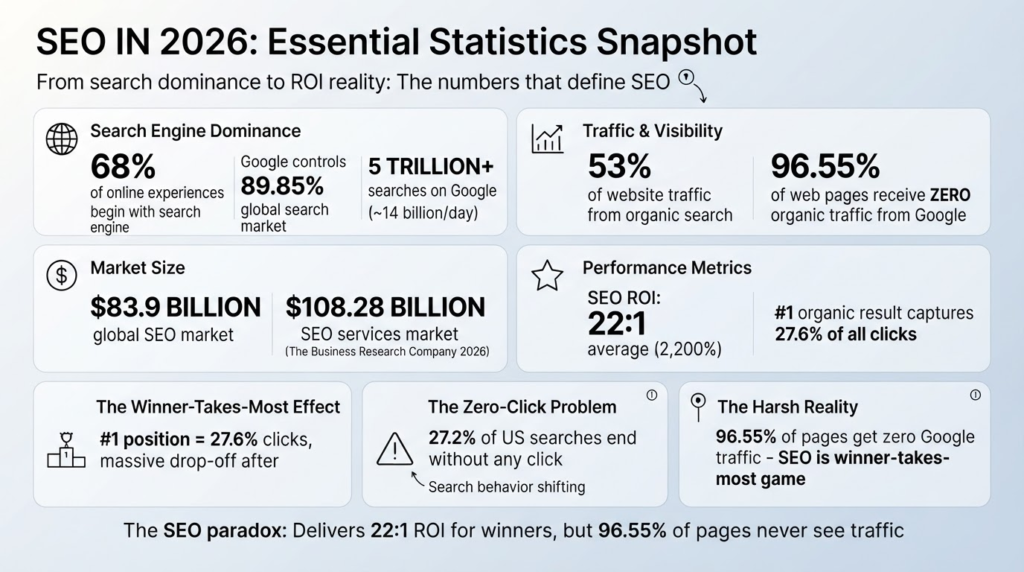
68% of all online experiences begin with a search engine
89.85% of the global search engine market is controlled by Google
5 trillion+ searches are processed by Google every year (~14 billion/day)
53% of all website traffic worldwide comes from organic search
96.55% of all web pages receive zero organic traffic from Google
$83.9 billion — estimated global SEO market size in 2026
$108.28 billion — SEO services market valuation (The Business Research Company, 2026)
SEO delivers an average ROI of 22:1 (2,200%)
The #1 organic Google result captures 27.6% of all clicks
27.2% of US searches now end without a single click
The SEO Industry in 2026: Market Size & Growth
The SEO industry has matured into a colossal global market, and the numbers in 2026 are nothing short of staggering. According to Mordor Intelligence, the global SEO services market is estimated at $83.98 billion in 2026, growing from $74.9 billion in 2025 — representing a year-over-year growth of approximately 12.1%. More bullish forecasts from The Business Research Company place the market even higher, at $108.28 billion in 2026, with projections to reach $203.83 billion by 2030 at a compound annual growth rate (CAGR) of 17.1%.
For context, the SEO market was valued at just $60 billion in 2020. That means the industry has grown nearly 40% in six years — and analysts suggest it could reach $148–156 billion by 2031, driven by AI integration, voice search expansion, and the growing complexity of multi-platform digital marketing.
Key industry facts that frame this growth include:
49% of business owners say SEO is their most effective digital marketing strategy (Website Builder Expert)
45% of marketers use websites, blogs, and SEO as their primary marketing channel (HubSpot State of Marketing 2026)
35.4% of marketers plan to increase their SEO investment in 2026
30.2% of marketers say websites, blogs, and SEO deliver the best ROI of any marketing channel
Interest in “AI SEO” has increased by 3,300% between 2020 and 2025 (Google Trends)
Demand for SEO specialists is forecasted to increase by 22% between 2020 and 2030
Google Search Engine Statistics: Still the Undisputed King
No SEO strategy can exist without first understanding the sheer dominance of Google. The following statistics make it absolutely clear why almost every SEO effort on earth is built around a single platform.
Google holds 89.85% of the global search engine market across all devices (StatCounter)
On mobile devices specifically, 93.58% of online experiences begin with Google
Bing holds just 5.13% of global market share, followed by Yahoo (1.48%), Yandex (1.3%), and DuckDuckGo (0.75%)
Google maintains a web index of approximately 400 billion documents
The average Google user makes 4.2 searches per day, though the median sits at just 1.8
15% of all Google searches have never been searched before — a figure Google itself has confirmed
80.3% of internet users used a search engine in the past month (DataReportal Digital 2026)
The average session on google.com lasts 10 minutes 14 seconds, with a bounce rate of just 28.2%
63.41% of all US web traffic referrals come from Google (SparkToro)
21.1% of Google’s web traffic originates from the United States
These numbers confirm one fundamental truth about modern digital marketing: if you are not optimizing for Google, you are essentially invisible online.
Organic Traffic & Click-Through Rate (CTR) Statistics
The distribution of clicks across Google’s search results is one of the most important sets of data any SEO professional can understand. The gap between position #1 and position #10 is not just significant — it is transformative.
The #1 result on Google gets 27.6% of all clicks (Backlinko)
According to First Page Sage, the first organic result commands an even higher 39.8% average CTR
The top 3 organic results receive 68.7% of all clicks on a given search results page
96.6% of all Google search clicks go to results on the first page
Moving up just one position in the SERP increases relative CTR by 32.3% — but moving from position 2 to position 1 can boost CTR by nearly 74%
Only 9% of Google users scroll to the bottom of the first page
59% of Google users click on only one page per search session
65% of people who search on Google click on an organic result during their session
Title tags between 40–60 characters have the highest average CTR at 33.3%
URLs containing terms similar to the target keyword have a 45% higher CTR than those without
Branded keywords in position #1 earn a 60.4% CTR — more than double the average for non-branded terms in the same position
The average Google search session lasts just 76 seconds, with 25% of sessions lasting under 31 seconds
Zero-Click Searches & AI Overviews: The New Reality
One of the most disruptive forces reshaping SEO in 2025–2026 is the explosive rise of zero-click searches and Google’s AI Overviews. These two phenomena are fundamentally changing how traffic flows from search to website, and every marketer needs to understand them deeply.
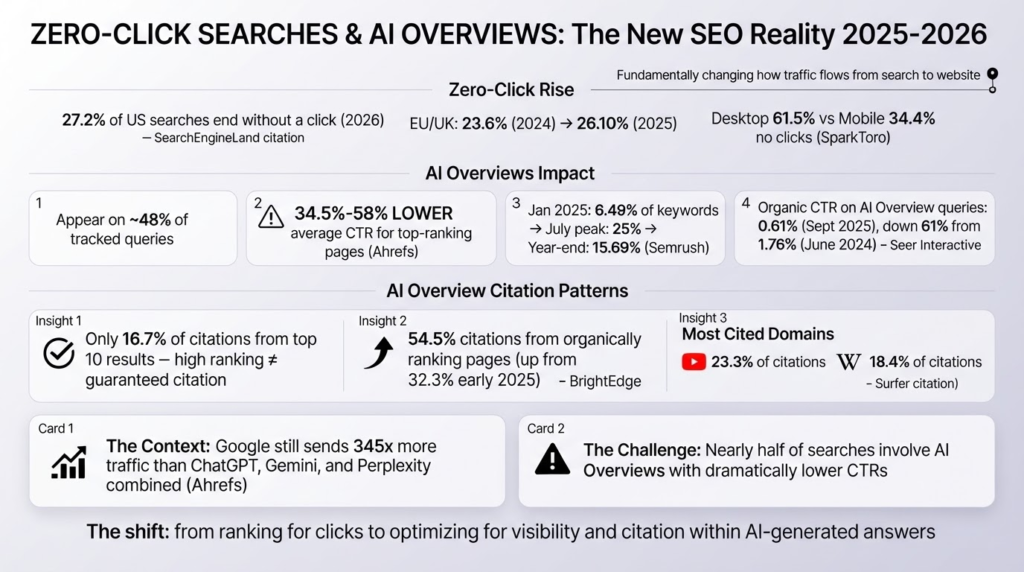
27.2% of US searches now end without a click (SearchEngineLand, 2026)
In the EU/UK, zero-click searches rose from 23.6% in 2024 to 26.10% in 2025
61.5% of desktop searches and 34.4% of mobile searches result in no clicks (SparkToro)
AI Overviews are now associated with a 34.5%–58% lower average CTR for top-ranking organic pages (Ahrefs)
AI Overviews now appear on approximately 48% of tracked queries
After starting the year at 6.49% of keywords in January 2025, AI Overviews rose to nearly 25% of keywords in July 2025 before sliding to 15.69% by year-end (Semrush)
Only 16.7% of AI Overview citations come from the top 10 results — meaning ranking highly does not guarantee citation
54.5% of AI Overview citations come from pages that rank organically, up from just 32.3% at the start of 2025 (BrightEdge)
Organic CTR on queries with AI Overviews fell to just 0.61% in September 2025, down 61% from 1.76% in June 2024 (Seer Interactive)
YouTube accounts for ~23.3% of citations across Google AI Overviews, making it the most cited domain overall (Surfer)
Wikipedia appears in ~18.4% of AI Overview citations — the second most cited domain globally
Google still sends 345 times more traffic than ChatGPT, Gemini, and Perplexity combined (Ahrefs)
SEO ROI & Business Impact Statistics
The business case for SEO investment has never been stronger. While paid advertising delivers immediate traffic, the compounding long-term returns from organic SEO are in a different league entirely.
SEO delivers an average ROI of 22:1 (2,200%), making it the second-most-profitable digital marketing channel after email (Website Builder Expert)
SEO campaigns can generate more than 700% ROI in certain industries (ACCESS Newswire Inc.)
SEO drives 1,000%+ more traffic than organic social media (BrightEdge)
SEO leads have a 14.6% close rate, compared to just 1.7% for outbound leads such as cold calling or print advertising
The average SEO conversion rate across industries is ~2.4%, with verticals like legal services reaching over 7%
Ecommerce SEO can generate a 5.2x ROI over a 36-month period
It takes an average of 6–12 months to see significant improvements in ROI from SEO, with meaningful results typically starting after 3 months
Technical SEO alone delivers an ROI of 117% — higher than content marketing at 16%, though lower than thought leadership marketing
AI search visitors are reportedly worth 4.4x more than traditional organic visitors in terms of conversion rate (Semrush analysis, June 2025)
Marketers who regularly calculate ROI are 1.6 times more likely to receive budget increases for their marketing activities
Keyword Research Statistics: The Foundation of SEO
Keywords remain the cornerstone of any SEO strategy, but the data around keyword behaviour reveals a market that is far more nuanced than most people assume.
94.74% of all keywords have monthly search volumes of 10 or fewer (Ahrefs)
Only 0.0008% of keywords receive more than 100,000 monthly searches
Long-tail keywords comprising 10–15 words receive 1.76 times more clicks than single-word queries (Backlinko)
As of 2026, “ChatGPT” is the most searched keyword on Google globally, with over 768 million monthly searches (Ahrefs)
Google Keyword Planner overestimates search volume in over 50% of cases — making third-party tools like Semrush essential for accurate research
46.08% of clicks in Google Search Console go to hidden/anonymous query terms
Brands account for 45.7% of all Google searches — meaning nearly half of all queries are navigational in nature (Ahrefs)
15% of all daily searches are entirely new queries that have never been seen before
For marketers who want to act on this data with the industry’s most comprehensive keyword database — containing over 28.8 billion keywords — grabbing a Semrush coupon is the most cost-effective way to get started.
Ranking & Content Statistics: What It Takes to Reach Page One
Achieving a top Google ranking is one of the most competitive endeavors in digital marketing. The following data reveals just how difficult — and how important — it truly is.
96.55% of all web pages get zero organic search traffic from Google (Ahrefs)
Only 1.74% of newly published pages reach Google’s top 10 within one year for at least one keyword
72.9% of pages currently ranking in Google’s top 10 are more than 3 years old
The average top-ranking page also ranks in the top 10 for nearly 1,000 other related keywords
Google rewrites title tags 33.4% of the time — and it is 57% more likely to rewrite tags that are too long
62.78% of meta descriptions are rewritten by Google
25.02% of top-ranking pages don’t even have a meta description at all
7.4% of top-ranking pages have no title tag whatsoever
When Google ignores a page’s title tag, it uses the H1 tag as a replacement 50.76% of the time
The average first-page Google result contains 1,447 words
The average blog post in 2025 was 1,333 words — though only 39% of marketers who publish 2,000+ word articles report strong results
30.9% of featured snippets rank in position one in the organic results
AI-cited content is, on average, 25.7% fresher than pages ranking in standard organic results (Ahrefs)
Backlink Statistics: Authority Still Matters Enormously
Despite the rapid changes in the SEO landscape, backlinks remain one of the most powerful ranking signals Google uses. The data confirms that link authority is still essential in 2026.
The #1 result in Google has approximately 3.8 times more backlinks than pages in positions 2–10 (Backlinko)
~95% of all web pages have zero backlinks pointing to them
Top-ranking pages gain followed backlinks from new referring domains at a pace of +5% to +14.5% per month
Long-form content (3,000+ words) generates 77.2% more backlinks than short articles under 1,000 words
66.5% of all backlinks built in the last 9 years are now dead — link rot is a massive ongoing challenge (Ahrefs)
73.6% of domains have reciprocal links, meaning some of the sites they link to also link back to them
Pages with at least one exact-match anchor text internal link have 5x more traffic than pages without (Zyppy)
67.5% of SEO professionals say link building has a big impact on search engine rankings (uSERP)
92% of marketing specialists believe link building will remain a key Google ranking factor over the next five years
59% of those surveyed believe backlinks will have even more impact on future rankings (uSERP)
SEOs typically spend 1–2 hours to build a single link (Aira)
Technical SEO Statistics: The Silent Performance Driver
Technical SEO is often the most neglected aspect of optimization, yet the data shows it has enormous impact on visibility, user experience, and conversions.
88.5% of website visitors leave due to slow loading times — the #1 reason for bounce (GoodFirms)
73.1% of users cite poor mobile responsiveness as a major reason for abandoning a website
Only 33% of websites pass Core Web Vitals thresholds (Ahrefs)
72.3% of websites have slow pages — a persistent and widespread problem
95.2% of websites have 3XX redirect issues
88% of websites have HTTP-to-HTTPS redirect issues
59.5% of websites are missing H1 tags
51.3% of websites have multiple H1 tags
68.5% of websites have page titles that don’t match their SERP titles
62.7% of websites contain at least one page that links to a redirect
The average load time of a first-page Google result is 1.65 seconds — though there is no direct correlation between page speed and rank position
Over 67% of domains using Hreflang have implementation issues
Local SEO Statistics: Dominating Your Geographic Market
For businesses that serve local customers, local SEO is arguably the highest-ROI marketing activity available. The data is compelling.
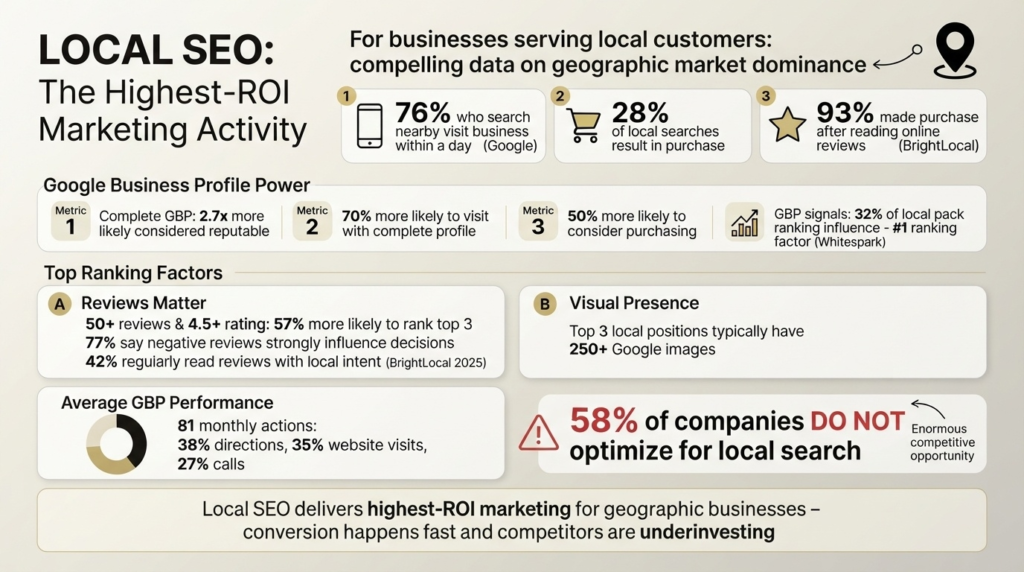
76% of people who search for something nearby on their smartphone visit a related business within a day (Google)
28% of local searches result in a purchase
93% of consumers have made a purchase after reading online reviews (BrightLocal)
Customers are 2.7 times more likely to consider a business reputable if it has a complete Google Business Profile
Customers are 70% more likely to visit a business with a complete GBP profile, and 50% more likely to consider purchasing
Google Business Profile signals account for 32% of local pack ranking influence — the single most important ranking factor category for local search (Whitespark)
GBP listings with 50+ reviews and a 4.5+ rating are 57% more likely to rank in the top local results
Businesses in the top 3 local positions on Google Business Profile typically have over 250 Google images in their listings
42% of consumers regularly read online reviews when browsing with local intent (BrightLocal 2025)
77% of consumers say negative reviews have a strong influence on their purchasing decisions
On average, a GBP listing generates 81 monthly actions: 38% direction requests, 35% website visits, and 27% calls
58% of companies do not optimize for local search — leaving an enormous competitive opportunity on the table
Mobile SEO Statistics: The Mobile-First World
Mobile devices are now the dominant way humans interact with the internet, and mobile SEO has become the default — not an afterthought.
Mobile accounts for 51.04% of global platform market share as of May 2026 (StatCounter)
62%+ of all global web traffic comes from mobile devices
On mobile, 93.58% of online experiences start with Google
51% of smartphone users have discovered a new company or product while conducting a mobile search (Google)
56% of in-store shoppers used their smartphone to research items while physically inside a store
57% of local searches come from a mobile or tablet device (ReviewTrackers)
Only 17% of websites maintain the same SERP ranking positions across both mobile and desktop
37% of websites lose their ranking position when switching from desktop to mobile results
The average eCommerce conversion rate on mobile is 2.53%, compared to 1.89% on desktop
Voice Search SEO Statistics: The Fastest-Growing Search Format
Voice search has quietly become one of the most significant shifts in how users find information online, and it is accelerating rapidly in 2026.
1 billion+ voice searches occur every month in the United States alone (AIOSEO)
27% of global internet users use voice search on mobile (Semrush)
71% of internet users prefer conducting voice searches over typing queries
50% of US consumers use voice search on a daily basis
70% of voice search results come from Google’s Featured Snippets and People Also Ask boxes
50% of Google searchers click on something within the first 9 seconds of seeing a result; 25% click within 5 seconds
Smartphones account for 56% of all voice search activity
Voice assistant users are 59% more likely to say that AI integration with other apps is a key part of how they use technology
Voice assistant users are 33% more likely than average consumers to have made an online purchase in the past week
AI & SEO Statistics: The New Frontier
Artificial intelligence has fundamentally disrupted the SEO landscape — from how content is created, to how search engines respond to queries, to how brands measure their digital visibility.
87% of marketers now use AI to create or help create content (Ahrefs)
74% of all new web content contains AI-generated material (Ahrefs)
82.1% of readers say they can recognize AI-generated content at least occasionally (Search Engine Land)
56% of companies are already using AI in digital marketing; 44% are still waiting for more stable solutions (SurveyMonkey)
Companies that use AI in their content process publish 42% more content per month — a median of 17 articles vs 12 for non-AI users
75% of marketers use AI tools to reduce time spent on manual SEO tasks like meta description optimization (HubSpot)
Nearly 70% of businesses report higher ROI from using AI in SEO (Semrush)
ChatGPT processes ~125 million prompts per day, yet its search market share remains under 1% vs Google (SparkToro)
Perplexity processes ~600 million monthly search queries (Backlinko)
ChatGPT accounts for 77.97% of all AI referral traffic globally (SE Ranking)
Perplexity drives 15.10% of all AI referral traffic to websites
AI search traffic has grown by an astonishing 527% year-over-year (Previsible AI Traffic Report)
Since the release of ChatGPT, there has been a 33% decrease in writing jobs (Bloomberry)
Search interest for “AI SEO” increased by 3,300% between 2020 and 2025
66% of consumers believe AI will replace traditional search within five years
SEO Pricing & Salary Statistics: The Economics of the Industry
Understanding the cost of SEO and the earning potential within the industry is essential for business owners, marketers, and aspiring SEO professionals alike.
Monthly SEO retainers in the US typically range from $1,500 to $5,000 per month for mid-sized businesses
One-time SEO projects range from $5,000 to $30,000 depending on scope
Hourly SEO consulting rates range from $100 to $300 per hour
78.2% of SEOs charge monthly retainers for some or all of their services (Ahrefs)
The most popular monthly retainer bracket is $501–$1,000/month (20.4% of SEOs)
The most popular hourly rate is $75–$100/hour (24% of SEOs)
The median annual SEO salary in the US rose from $49,211 in 2023 to $58,288 in 2024
Self-employed SEOs earn the most on average at $60,232/year, while agency SEOs average just $44,169
Technical SEO specialists command the highest salaries — SEO Directors average 13 years of experience and command top compensation
In the UK, the median average SEO salary is £39,719, rising to £48,026 in London
64.5% of SEO professionals worldwide received a pay raise in the past year (AIOSEO)
Content Marketing & SEO Statistics
Content and SEO are inseparable in 2026. The data underscores just how central content strategy is to organic visibility and engagement.
73% of B2B marketers and 70% of B2C marketers include content marketing in their overall strategy
70% of internet users prefer to learn about a company through blog posts rather than advertisements
50% of marketers actively invest in content marketing
50% of buyers read a company’s blog while making purchase decisions
Only 39% of marketers who publish 2,000+ word articles report strong results — quality still matters more than volume
The average blog post in 2025 was 1,333 words — a leveling-off after years of the “long-form is king” trend
Headlines with 14–17 words generate 76.7% more social shares than shorter titles (IncRev)
Content of 3,000+ words generates 77.2% more backlinks than content under 1,000 words
25% of marketers plan to create content that reflects their brand’s core values
Final Thoughts: What These SEO Statistics Mean for Your Strategy in 2026
The data tells a very clear and urgent story. SEO remains the single highest-ROI digital marketing channel available to businesses of every size — but the rules of the game are shifting fast. The rise of AI Overviews, zero-click searches, and generative search engines means that simply ranking #1 no longer guarantees the traffic it once did. Success now requires a multi-dimensional approach: appearing in AI citations, building real brand authority, creating content that answers second and third-order questions, and maintaining technically impeccable websites across both mobile and desktop.
The good news is that the businesses and marketers who adapt to these shifts stand to gain enormous competitive advantages. And with a market growing toward $148–$200 billion by the end of the decade, the demand for skilled SEO practitioners and the value of organic visibility will only continue to rise.
If you want to leverage the world’s most comprehensive SEO platform — with a database of 28.8 billion keywords, 43 trillion backlinks, and 55+ research tools — grabbing a Semrush coupon before you start is the smartest move you can make in 2026.
FAQs
In 2026, key SEO statistics include that over 68% of online experiences begin with a search engine, and Google holds more than 90% of the global search market share. Core Web Vitals, AI-driven search features, and mobile-first indexing continue to be critical ranking factors shaping SEO strategy.
AI has dramatically reshaped SEO in 2026, with Google's Search Generative Experience (SGE) now influencing how results are displayed for billions of queries. Studies show that AI-generated search summaries are reducing traditional organic click-through rates by up to 30%, forcing marketers to adapt their content strategies.
Yes, voice search remains highly relevant in 2026, with over 50% of searches now conducted via voice-enabled devices globally. Optimizing for conversational, long-tail keywords and featured snippets is essential for capturing voice search traffic.
Page speed remains a critical ranking factor because 53% of mobile users abandon a site that takes longer than three seconds to load, directly impacting bounce rates and conversions. Google's Core Web Vitals metrics continue to measure loading performance as part of its overall page experience ranking signals.
Yes, small businesses can compete effectively by targeting niche, long-tail keywords, which account for approximately 70% of all search traffic according to 2026 data. Focusing on local SEO strategies is also highly effective, as 46% of all Google searches have local intent.
