
Fantasy Sports Statistics 2026: Market Size, Players, Platforms and Trends
Fantasy sports is no longer a hobby for a niche crowd of sports nerds. It is a multi-billion dollar global industry that touches everything from cricket in India to NFL in the United States. The numbers are massive, the growth is fast, and the regulatory drama is real. Here is everything you need to know.
Global Market Size and Revenue:
The fantasy sports market is one of the fastest-growing segments in the entertainment economy right now. Global market size estimates vary by research firm, but the consensus points to a very large number in 2026.
Research Firm | 2026 Market Size | Projected 2030/2031 | CAGR |
Grand View Research | $31.5 Billion | $56.4 Billion (2030) | ~15% |
Mordor Intelligence | $42.37 Billion | $80.31 Billion (2031) | 13.66% |
Precedence Research | $43.74 Billion | N/A | N/A |
Research and Markets | N/A | $67.7 Billion (2034) | 8.8% |
IBISWorld (US only) | $10.4 Billion | N/A | 1.4% |
The wide range across firms comes from differing definitions. Some include daily fantasy sports (DFS), sports betting, and pick’em games together. Others count only traditional season-long leagues. Regardless of which number you trust, the direction is the same: upward and fast.
The football segment alone is valued at $14.2 billion in 2026 and is projected to reach $32 billion by 2033, growing at a 12.3% CAGR according to Metastat Insight. North America holds 36 to 42 percent of the global share, while Asia Pacific is the fastest-growing region, driven almost entirely by the cricket market in India.
How Many People Actually Play Fantasy Sports:
United States and North America:
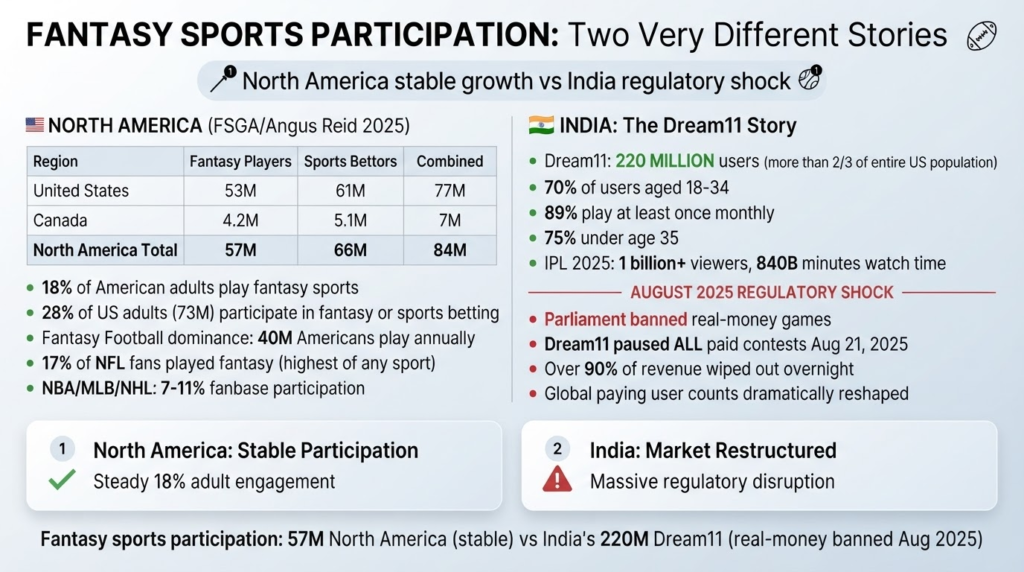
According to the Fantasy Sports and Gaming Association (FSGA) 2025 research conducted with Angus Reid Group, the player counts are very clear.
Region | Fantasy Players | Sports Bettors | Combined Participants |
United States | 53 million | 61 million | 77 million |
Canada | 4.2 million | 5.1 million | 7 million |
North America Total | 57 million | 66 million | 84 million |
That means roughly 18 percent of American adults played fantasy sports in the past year. A broader stat shows nearly 28 percent of all US adults, roughly 73 million people, participated in either fantasy sports or sports betting in the past 12 months.
Fantasy football is the king of the category. Approximately 40 million Americans play fantasy football each year. About 17 percent of all NFL fans played fantasy football in the last 12 months, the highest participation rate of any US sports fanbase. NBA, MLB, and NHL fantasy participation sits between 7 and 11 percent of each sport’s fanbase.
India (Dream11 and Cricket):
India is a different story entirely. Dream11 has approximately 220 million users in India alone. For context, that is more than two-thirds of the entire US population. Over 70 percent of Dream11 users are aged 18 to 34. The Federation of Fantasy Sports in India reports that 89 percent of users play at least once a month, and 75 percent are under 35. IPL 2025 drew over one billion total viewers and generated more than 840 billion minutes of watch time.
However, a massive regulatory shock hit in August 2025. India’s Parliament passed an online gaming bill that banned real-money games. Dream11 paused all paid contests on August 21, 2025. This single legislative event wiped out over 90 percent of Dream11’s revenue stream overnight and reshaped global paying user counts dramatically.
Who Are Fantasy Sports Players: Demographics:
The fantasy sports audience has a very specific profile.
Gender: About 80 percent of all fantasy sports players in the US and Canada are men. In fantasy NFL specifically, 87 percent of players are male. This gender gap is the single biggest diversification target operators are chasing.
Education: 84 percent of fantasy sports players hold a bachelor’s degree or higher.
Income: 63 percent earn more than $50,000 annually.
Age: The 18 to 34 age group dominates globally, especially in India. In the US, 18 to 39 year olds account for 71 percent of all players.
Engagement: 66 percent of next-generation fantasy players update their lineups daily. 64 percent pay league entry fees.
Platform Market Share and Growth:
Platform Share (Fantasy Football MAU, Aug 2025):
Platform | MAU Share | YoY Growth |
ESPN Fantasy | 48% | Moderate |
Sleeper | 33% | +39% |
Yahoo Fantasy | 18% | Slow |
PrizePicks | Growing | +82% |
Underdog | Growing | +35% |
FanDuel | Established | +3% |
DraftKings | Established | +5% |
The most important trend here is the pick’em surge. PrizePicks grew monthly active users by 82 percent year over year. Sleeper grew 39 percent. Underdog grew 35 percent. Meanwhile, DraftKings and FanDuel, the legacy giants, grew MAU at only 5 and 3 percent respectively. Fantasy football monthly active users overall jumped 40 percent between August 2023 and August 2025, per Sensor Tower data.
FanDuel and Sleeper each average 14 minutes of daily time spent in the app, leading engagement metrics across the entire betting and fantasy ecosystem.
Operator Revenue and Financials:
DraftKings:
DraftKings is the largest pure-play fantasy and sports betting operator by revenue.
Metric | 2022 | 2023 | 2024 | Q1 2026 |
Average MUPs | 1.9M | 2.7M | 3.7M | N/A |
ARPMUP | $96 | $113 | $106 | N/A |
Q4 Quarterly Revenue | N/A | $1.23B | $1.39B | $1.65B |
FY Revenue Guidance | N/A | N/A | N/A | $6.5B to $6.9B |
Q4 2024 saw DraftKings report 4.8 million average monthly unique payers, a 36 percent year over year increase. Q1 2026 revenue came in at $1.65 billion, with full year 2026 guidance of $6.5 to $6.9 billion and adjusted EBITDA guidance of $700 million to $900 million.
FanDuel:
FanDuel generated $5.79 billion in revenue in 2024, a 19.6 percent increase. Q1 2026 revenue grew 6 percent year over year. FanDuel had 4.5 million active users and users staked $50.8 billion in 2024.
How Much Do Players Spend:
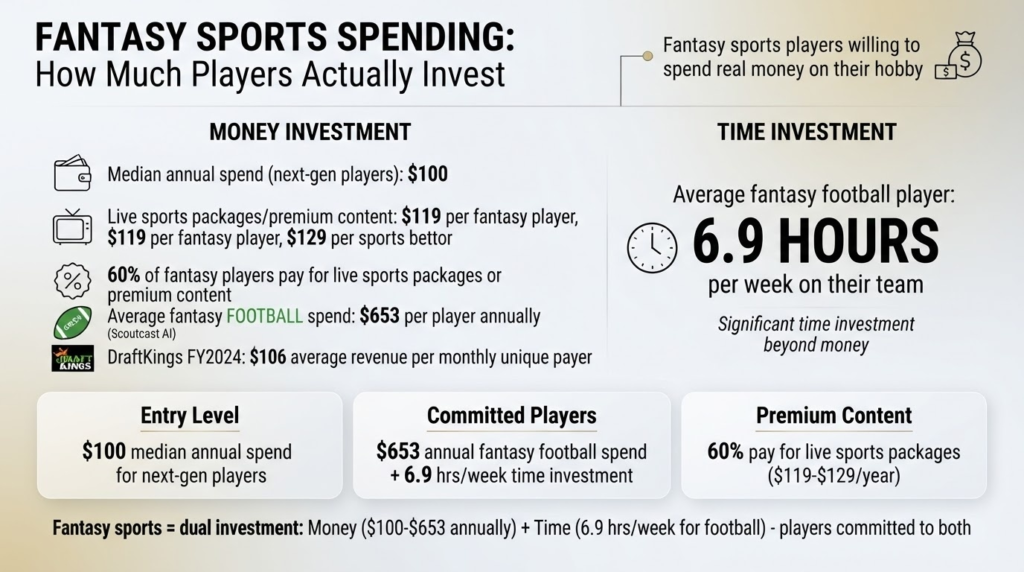
Fantasy sports players are willing to spend real money on their hobby.
Median annual spend on fantasy sports (next-gen players): $100
Annual spend on live sports packages or premium content: $119 per fantasy player, $129 per sports bettor
About 60 percent of fantasy players pay for live sports packages or premium content
Average fantasy football player spends 6.9 hours per week on their team
Average annual spend for fantasy football specifically: $653 per player (Scoutcast AI)
DraftKings FY2024 average revenue per monthly unique payer: $106
AI and Technology in Fantasy Sports:
Artificial intelligence is changing how fantasy sports platforms work. Demand for AI-related features in fantasy apps is rising fast in 2026. Key trends include AI-driven player analysis and injury predictions, machine learning for lineup optimization, personalized recommendations based on user behavior, real-time statistical feeds and computer vision tracking, and blockchain-based transparent contest mechanics.
The AI-powered fantasy sports development space is attracting serious venture capital. Companies like Scoutcast AI are building dedicated AI tools for fantasy football specifically. Businesses investing in AI-powered fantasy platforms are targeting faster user acquisition and better retention through predictive personalization.
Legal and Regulatory Landscape:
Fantasy sports regulation in the US is a patchwork at the state level.
Sports betting is legal in 39 states plus DC; 30 states offer online betting.
Traditional DFS (season-long) is legal or unregulated in most states.
New York banned DFS pick’em style contests in fall 2023, affecting PrizePicks and Underdog.
California forced PrizePicks and Underdog to pivot to peer-to-peer formats.
Illinois enacted its first-ever fantasy sports regulatory framework, effective July 1, 2026.
India banned real-money online gaming in August 2025, removing Dream11’s paid contest revenue.
The regulatory pattern is consistent worldwide: governments are drawing clear lines between skill-based season-long fantasy and house-banked pick’em products that look too much like traditional gambling.
Key Takeaways at a Glance:
57 million people in the US and Canada play fantasy sports right now
Global market is worth $31.5B to $42.4B in 2026, heading toward $80B by 2031
Dream11 has 220 million users in India but faced a massive ban in August 2025
ESPN holds 48 percent of fantasy football platform share; Sleeper is growing fast at 39 percent YoY
DraftKings guides for $6.5B to $6.9B in FY2026 revenue
Pick’em apps like PrizePicks are growing 82 percent YoY vs. 3 to 5 percent for legacy DFS books
The average fantasy football player spends $653 per year and 6.9 hours per week on their team
80 percent of players are male and 84 percent hold a college degree
Fantasy sports is a healthy, growing industry. But the growth is shifting away from traditional platforms toward faster, simpler formats that younger players prefer. That shift, combined with tightening regulation in key markets, means the next three years will look very different from the last three.
FAQs
The global fantasy sports market is projected to reach approximately $48 billion by 2026, driven by increasing smartphone penetration and the legalization of sports betting in multiple regions. North America continues to dominate the market, accounting for the largest share of revenue and active users.
By 2026, the number of fantasy sports players worldwide is expected to surpass 150 million, with significant growth coming from emerging markets in Asia and Latin America. The United States and Canada alone are projected to account for over 60 million active participants.
DraftKings, FanDuel, and ESPN Fantasy remain dominant platforms in 2026, while newer entrants leveraging AI-driven analytics and real-time data integrations are rapidly gaining market share. Mobile-first platforms are increasingly preferred, with over 80% of users accessing fantasy sports through smartphone apps.
Fantasy sports growth is fueled by expanded legal frameworks, increased sports media coverage, and the integration of advanced player statistics and predictive analytics that enhance user engagement. Social features, in-app competitions, and cryptocurrency prize pools have also attracted younger demographics to the space.
Daily fantasy sports (DFS) has seen explosive growth and now rivals traditional season-long formats in terms of revenue generation, largely due to its quick-turnaround format that appeals to casual players. However, season-long leagues still maintain a dedicated user base, particularly among older and more experienced fantasy sports enthusiasts.
