
AI Image Generation Statistics 2026: The Complete Data Guide
A few years ago, creating a professional image meant hiring a photographer, buying stock photos, or spending hours in design software. Today you type a sentence and get a stunning image in seconds. AI image generation has moved from a curiosity to one of the most widely used technologies on earth, and the numbers behind it are genuinely mind-blowing.
This article covers every major stat you need to understand the AI image generation world in 2026, from market size and daily usage to the biggest platforms, creator earnings, legal battles, and what is happening to the traditional photography industry.
The Big Picture: AI Image Generation at a Glance
Here are the headline numbers that tell you just how big this has become.
Metric | Figure (2026) |
AI images generated daily | 80 million |
Monthly active users of AI image tools | 150 million plus |
Cumulative AI images created since 2022 | 30 billion plus |
Adobe Firefly assets generated | 24 billion plus |
Global AI image generation market value | $12.4 billion |
Generative AI market overall | $67.2 billion |
AI image generator market projected by 2030 | $30 billion |
AI image generator market CAGR | 32.5% |
Share of social media images that are AI generated | 15 to 20% |
Human accuracy in detecting AI images | 38% |
Enterprises using generative AI in at least one function | 82% |
Eighty million AI images created every single day. That works out to roughly 920 images every second, around the clock, every day of the year. The scale is almost impossible to visualize. For context, professional photographers upload approximately 1.8 billion photos to stock sites per year. AI image tools are now producing more images in a month than the entire global stock photography industry produces in a year.
Market Size and Growth: Where Is the Money?
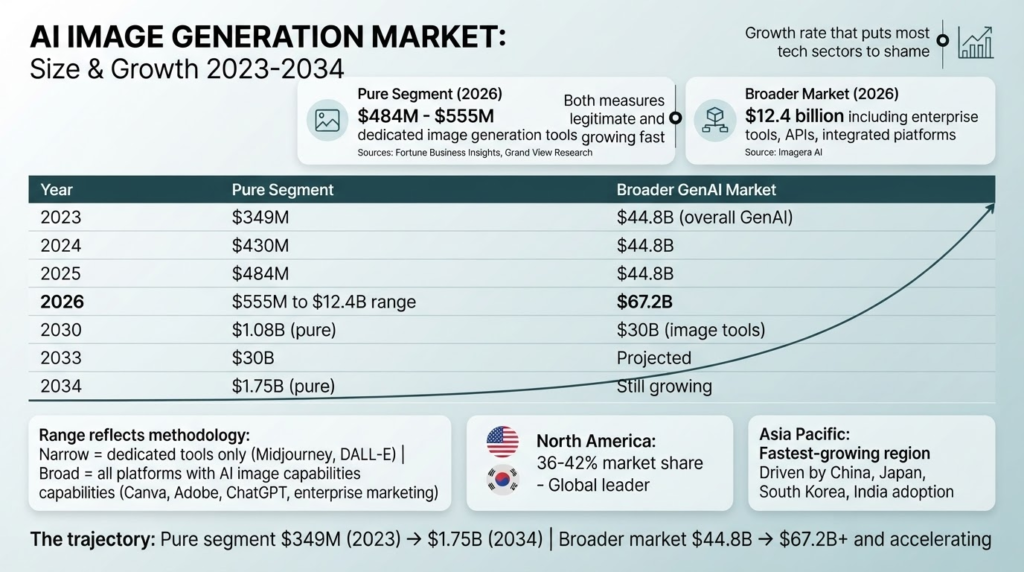
The AI image generation market is growing at a rate that puts most other tech sectors to shame.
The global AI image generator market was valued at $484 million to $555 million in 2026 in the pure image-generation-tool segment, according to Fortune Business Insights and Grand View Research. However, when you include the broader generative AI market that powers images including enterprise tools, APIs, and integrated platforms, the market value jumps to $12.4 billion according to Imagera AI’s 2026 analysis.
Here is how the numbers scale across different time horizons:
Year | AI Image Generator Market (Pure Segment) | Broader Generative AI Market |
2023 | $349 million | $44.8 billion (overall GenAI) |
2024 | $430 million | $44.8 billion |
2025 | $484 million | $44.8 billion |
2026 | $555 million to $12.4 billion (range) | $67.2 billion |
2030 | $1.08 billion (pure segment) | $30 billion (image tools) |
2033 | $30 billion | Projected |
2034 | $1.75 billion (pure segment) | Still growing |
The range in market size estimates reflects different methodologies. Narrow definitions count only dedicated image generation tools. Broader definitions include every platform with AI image capabilities embedded, such as Canva, Adobe Creative Cloud, ChatGPT’s image features, and enterprise marketing platforms. Both measures are legitimate and both are growing fast.
North America leads globally with 36 to 42% of the AI image generation market share. Asia Pacific is the fastest-growing region, driven by massive adoption in China, Japan, South Korea, and India.
How Many Images Are Being Created Every Day?
This is the stat that really puts the scale of AI image generation in perspective.
80 million AI images are generated every day globally
30 billion plus cumulative images have been created since AI image generation went mainstream in mid-2022
Adobe Firefly alone has generated 24 billion plus assets since its launch in March 2023
Firefly generated its first 1 billion assets in just 3 months after launch
DALL-E 3 generated approximately 916 million images before it was retired in May 2026
Stable Diffusion produces an estimated 34 million images daily across all its community channels
Midjourney has 1.2 to 2.5 million daily active users generating images on its platform
To put 30 billion cumulative AI images in context, National Geographic has published roughly 10 million photographs in its entire history. AI tools have created 3,000 times that number in about three years.
The volume also reflects how AI image generation has moved beyond individual hobbyists. Businesses now run automated image generation pipelines that produce hundreds or thousands of images per campaign. A single marketing team can generate more visual content in a day than an entire agency creative department could produce in a month three years ago.
The Major Platforms: Who Is Winning?
The AI image generation space has several clear leaders. Each serves a different type of user with a different approach.
Midjourney:
Midjourney is the quality king of AI image generation. Its outputs are widely considered the most visually stunning of any platform available to general users.
Midjourney Stat | Figure |
Registered users | 20 million plus |
Daily active users | 1.2 to 2.5 million |
Annual revenue | $500 million |
Global market share (AI image generation) | 26.8% |
Team size | Approximately 100 people |
Pricing | $10 to $120 per month |
Midjourney generating $500 million in annual revenue with only around 100 employees is one of the most remarkable revenue per employee ratios in tech history. That works out to roughly $5 million in revenue per employee. The company has never taken outside investment and remains entirely self-funded and profitable.
Midjourney launched Version 8 in 2026 with video generation capabilities added alongside its flagship image tools. It is also fighting a major copyright lawsuit from Disney and other entertainment companies over the use of their content in training data, which is one of the biggest legal stories in the AI image space right now.
Adobe Firefly:
Firefly Stat | Figure |
Total assets generated | 24 billion plus |
Monthly active users | 6 million plus |
Year-on-year user growth | 65% |
Weekly active rate among users | ~70% |
Firefly ARR | Approaching $300 million |
Unique advantage | Trained on licensed content only |
Adobe Firefly’s defining advantage over every competitor is commercial safety. Firefly was trained exclusively on Adobe Stock images and other fully licensed material, meaning any image you create with Firefly can be used commercially without copyright risk. For businesses, agencies, and brands, this is a massive deal. It removes the legal uncertainty that hangs over content created with tools trained on scraped internet images.
DALL-E and OpenAI Image Tools:
DALL-E 3 was officially retired by OpenAI on May 12, 2026. Before retirement, it had generated approximately 916 million images and held roughly 24.35% of user-preference market share among AI image tools. OpenAI replaced DALL-E with native image generation built directly into GPT-4o, which delivers roughly 4x faster generation at a 20% lower cost than its predecessor. OpenAI’s image tools collectively still hold around 24% market share in user preference.
Stable Diffusion:
Stable Diffusion Stat | Figure |
Registered users | 10 million plus |
Daily images generated | 34 million |
AI image market value it serves | $8.7 billion in 2024 growing to $60.8 billion by 2030 |
Key advantage | Open source and free to run locally |
Stable Diffusion occupies a unique position in the market. It is open source, which means anyone can download and run it on their own computer for free. This has made it the engine behind an enormous ecosystem of community models, fine-tunes, and commercial applications. Film studios, game developers, and advertising agencies use custom Stable Diffusion models in production workflows at a scale that is not visible in public-facing user statistics.
Canva AI Image Generation:
Canva has 170 million monthly active users across 190 countries, making it the largest design platform by user count. Canva has AI image generation built directly into its design editor. It recently moved to a monthly allowance model for AI image generation in March 2026. Canva’s AI tools are used by 85% of Fortune 500 companies in some capacity. A Canva study found that 97% of marketing leaders now use AI and 99% plan to increase AI investment in 2026.
Platform Comparison: Side by Side
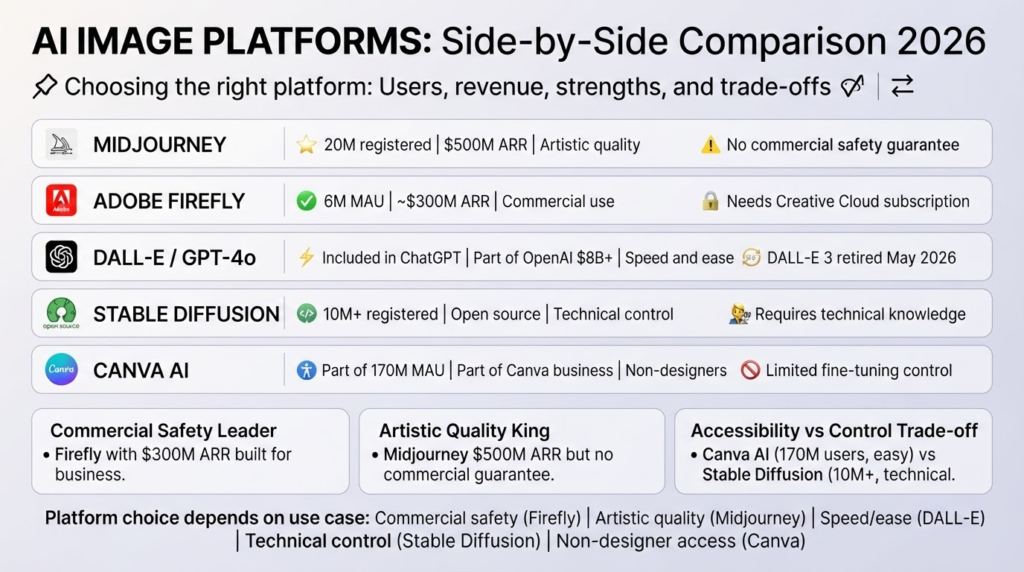
Platform | Users | Revenue | Best For | Key Limitation |
Midjourney | 20M registered | $500M ARR | Artistic quality | No commercial safety guarantee |
Adobe Firefly | 6M MAU | ~$300M ARR | Commercial use | Needs Creative Cloud subscription |
DALL-E / GPT-4o | Included in ChatGPT | Part of OpenAI’s $8B+ | Speed and ease | DALL-E 3 retired May 2026 |
Stable Diffusion | 10M+ registered | Open source | Technical control | Requires technical knowledge |
Canva AI | Part of 170M MAU | Part of Canva business | Non-designers | Limited fine-tuning control |
Who Is Using AI Image Generation and Why?
The user base for AI image generation has expanded dramatically beyond early tech-enthusiast adopters.
150 million plus people use AI image generators monthly as of 2026
82% of large enterprises use generative AI in at least one business function
86% of creators now use generative AI in their work
71% of social media images in marketing contexts are now AI-generated or AI-assisted
93% of marketers use AI to generate content faster
42% of marketers use generative AI specifically for image creation
The top reasons people and businesses use AI image generation are:
Speed: Creating visuals in seconds instead of hours
Cost: Reducing reliance on expensive photographers and stock photo subscriptions
Customization: Getting exactly the image they need rather than settling for a stock photo
Volume: Generating dozens of image variations for A/B testing ad campaigns
Accessibility: Non-designers can create professional visuals without design skills
In the advertising world specifically, AI image generation has become a core tool. Brands now test dozens of visual variations of the same ad campaign simultaneously, optimizing based on performance data. This kind of creative velocity was simply not possible before AI image tools existed.
AI Image Generation and the Stock Photography Industry
The impact on traditional stock photography is real and measurable, though the industry has not collapsed as some predicted.
Demand for generic stock images has declined 20 to 40% since AI image generation went mainstream
Companies like Shutterstock and Getty Images have pivoted to licensing AI training data and building their own AI generation tools
Getty Images launched its own AI image generator trained exclusively on its licensed content
Shutterstock integrated DALL-E into its platform
The residual demand for human-shot photography remains in the 60 to 80% range for specialized content that AI still struggles with, including authentic candid moments, specific real people, and highly nuanced cultural contexts
Stock photography contributors are feeling the squeeze. Royalty rates have declined as download volume for traditional stock images falls. The photographers who are surviving and thriving are those who have specialized in niche areas that AI cannot replicate, including sports, news, documentary, and fine art photography.
Can Humans Even Tell the Difference Anymore?
This is one of the most fascinating and concerning statistics in the entire AI image space.
Human accuracy in detecting AI-generated images: 38% to 62%
The 38% figure means humans perform worse than random chance at identifying AI images in some studies
A coin flip would give you 50% accuracy. Trained humans are doing worse than that in some tests.
The deepfake detection market is now worth $15.7 billion, reflecting how serious this problem has become
The EU AI Act now requires AI-generated images to carry watermarks or disclosures that are machine-detectable
The inability of people to reliably distinguish real photos from AI-generated ones has major implications for journalism, social media, advertising, legal evidence, and political communication. This is no longer a theoretical future problem. It is happening right now at scale, and regulatory frameworks are scrambling to keep up.
The Legal Picture: Copyright Chaos
AI image generation is at the center of some of the most important copyright legal battles in decades.
The core legal question is this: when a company trains an AI model on millions of images scraped from the internet without permission, does that violate copyright law? Courts in the US and Europe are actively working through this question.
Key developments in 2026:
Midjourney faces a major lawsuit from Disney and other entertainment companies over training data
The US Copyright Office has confirmed that purely AI-generated images without meaningful human creative input are ineligible for copyright protection
The US Supreme Court declined to review an appeal on this question, leaving the Copyright Office’s position standing
Getty Images settled a high-profile case and pivoted to licensing its content for AI training
Adobe Firefly is positioned as the safest commercial option because its training data was fully licensed from the start
Norton Rose Fulbright tracked six major AI copyright cases going through courts in 2026
The legal uncertainty around training data is the single biggest risk hanging over the AI image generation industry. If courts rule that training on unlicensed data is infringement, it could force major platforms to retrain models from scratch on licensed data, a process that would take years and cost billions.
AI Image Generation and Social Media
Social media has become the most visible battleground for AI-generated imagery.
15 to 20% of all social media posts now contain AI-generated or AI-assisted visuals
Some analysts project that up to 90% of online visual content could be AI-generated or AI-assisted by the late 2020s
71% of social media images used in marketing contexts are AI-generated
Major platforms including Instagram, LinkedIn, and X are developing AI image labeling systems
The EU AI Act’s transparency requirements, live from August 2, 2026, require disclosure of AI-generated content
The rise of AI imagery on social media is creating a new kind of visual pollution where it is increasingly impossible to know whether a photo represents something real or imagined. This is reshaping how audiences trust visual content and is pushing platforms to develop better detection and labeling systems.
The Bottom Line
AI image generation is one of the fastest-growing technologies in human history. Eighty million images per day. 150 million monthly users. A market growing at 32.5% per year. Tools that can produce in seconds what used to take days. And the uncomfortable reality that humans can no longer reliably tell the difference between a photograph and an AI hallucination.
The industry is navigating massive legal uncertainty around copyright, a regulatory landscape that is tightening across the EU and US, and a genuine cultural reckoning about what visual authenticity means in a world where any image can be fabricated instantly. The platforms that solve the copyright problem cleanly, like Adobe Firefly, are positioned to win the enterprise market. The platforms that produce the most beautiful results, like Midjourney, will keep the creative community. And the platforms that make it easiest for everyday people, like Canva, will continue to grow their already enormous user bases.
The camera changed how humans see the world. AI image generation is changing what seeing even means.
FAQs
In 2026, AI image generation has surpassed 15 billion images created monthly across major platforms, with the market valued at over $1.8 billion globally. Adoption rates have grown by more than 300% compared to 2023 levels, driven by advances in diffusion models and multimodal AI systems.
Over 200 million people worldwide actively use AI image generation tools in 2026, spanning professional creatives, marketers, and casual users. Mobile-based AI image apps account for nearly 45% of total usage, reflecting a major shift toward on-device generation capabilities.
According to 2026 industry data, AI image generation is augmenting rather than replacing human designers, with 78% of creative professionals reporting they use AI tools to enhance their workflow. However, entry-level stock image roles have seen a 40% reduction as businesses increasingly rely on AI-generated visuals.
The rapid growth is primarily driven by dramatic reductions in generation costs, improved output quality, and widespread API integrations into existing software platforms. Enterprise adoption has been a major catalyst, with Fortune 500 companies allocating an average of $2.3 million annually to AI visual content tools.
Legal use of AI-generated images for commercial purposes varies by jurisdiction, but over 60 countries have established clearer regulatory frameworks for AI content by 2026. Most major AI image platforms now offer commercial licensing tiers, though businesses are advised to review platform-specific terms and emerging copyright legislation in their region.
