
Employee Productivity Statistics 2026: The Real Numbers Behind Modern Work
Work has changed a lot in the last five years. Remote offices, AI tools, four-day weeks, burnout crises, and engagement slumps. But what do the actual numbers say about how productive employees really are? This article breaks it all down in plain language.
The Shocking Truth About How Productive We Actually Are:
Here is the number that surprises most managers. The average office worker is genuinely productive for only 2 hours and 53 minutes of an 8-hour workday. Across all professions, the average productive time sits at about 60% of the workday. That means nearly half of every working day is lost to interruptions, bad meetings, social media, and context-switching.
And 89% of workers openly admit they waste time every day. This is not a small problem. It costs US employers between $483 billion and $605 billion per year in lost productivity. For a company with 300 employees, that translates to roughly $5.1 million per year in wasted time.
Worker Type | Productive Hours Per Day |
Office worker | 2 hours 53 minutes |
Remote worker | 3 hours 22 minutes |
Freelancer | 7 hours |
Hybrid worker | Comparable to office |
The freelancer number is remarkable. Independent workers log roughly 36 hours of focused output per week because there is a direct link between effort and income. Traditional employees do not have the same pressure.
Global and US Productivity Trends:
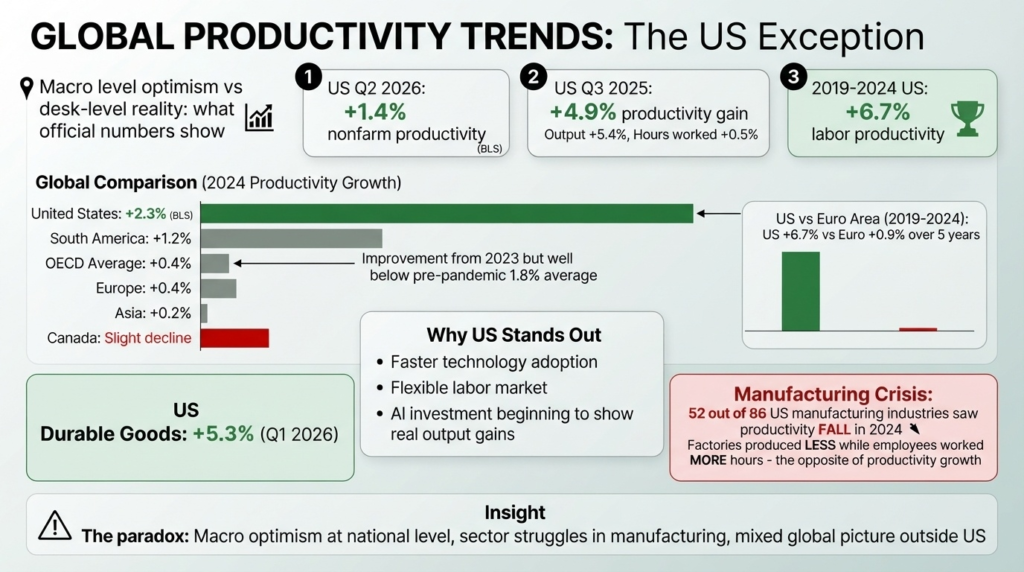
What the official numbers show:
On the macro level, things look more optimistic than at the individual desk level. The US Bureau of Labor Statistics reported that nonfarm business sector labor productivity rose 1.4% in Q2 2026. Q3 2025 saw an even stronger 4.9% gain, with output rising 5.4% while hours worked increased only 0.5%.
Globally, the picture is more mixed. OECD data shows average productivity across 40 countries grew just 0.4% in 2024. That is a slight improvement from 2023 but still well below the pre-pandemic average of 1.8% per year.
Region | Productivity Growth (2024) |
United States | +2.3% (BLS) |
South America | +1.2% |
OECD Average | +0.4% |
Europe | +0.4% |
Asia | +0.2% |
Canada | Slight decline |
The US stands out. Over the full period from 2019 to 2024, US labor productivity grew 6.7%. The Euro area managed just 0.9% over the same five years. The difference comes down to faster technology adoption, a flexible labor market, and AI investment that is beginning to show real output gains.
By sector in the US, the durable goods sector jumped 5.3% in Q1 2026. Manufacturing, however, is struggling. In 2024, 52 out of 86 US manufacturing industries saw productivity fall. Factories produced less while employees worked more hours, which is the opposite of what productivity growth looks like.
Employee Engagement: The $10 Trillion Problem:
Why disengagement is the biggest productivity killer:
Gallup’s 2026 State of the Global Workplace report landed with a very clear warning. Only 20% of employees worldwide were engaged at work in 2025. In the US, the number sits at 31% for H1 2026, which is low by historical standards. US engagement has not recovered to pre-2014 highs.
The financial cost is staggering.
Engagement Cost | Amount |
US annual productivity loss from disengagement | $2 trillion |
Global annual loss from disengagement | $8.9 trillion to $10 trillion |
Potential global GDP gain if engagement hits 70% | $9.6 trillion |
2024 global loss from engagement decline alone | $438 billion |
Disengaged employees do not quit. They stay. They show up and do the bare minimum. This is the quiet-quitting phenomenon that has spread across every industry since 2022.
Manager engagement makes it worse. Managers account for 70% of the variance in team engagement levels. When manager engagement dropped from 30% to 27% in 2024, with workers under 35 seeing a 5-point drop, the knock-on effect on their teams was immediate and significant. Engaged managers see their employees active for 80% of the workday, with 75% of that time spent on productive tasks.
Remote and Hybrid Work: What the Data Actually Shows:
The productivity debate, settled by numbers:
The return-to-office debate has been loud since 2023. The data is less dramatic than the headlines suggest.
Remote workers log 29 more productive minutes per day than in-office workers
90% of hybrid employees say they are as productive or more productive than in a full office setup
70% of managers say hybrid or remote arrangements made their teams more productive
Hybrid workers perform at the same level as office-based colleagues and are 33% less likely to quit
69% of remote workers say their work-life balance has improved in the past 12 months
44% of remote workers also admit they work longer hours from home
The Stanford research finding is especially important. Hybrid workers working from home two days per week showed no productivity loss compared to full-time office workers. They also stayed in their jobs significantly longer, which saves companies enormous amounts on turnover costs.
The CIPD 2025 UK survey found that when employers were asked what hybrid work did to productivity, 41% said it improved, 16% said it went down, and 43% said it made little difference. The net effect is positive.
What is Killing Productivity Every Day:
Meetings, distractions and context-switching:
The top three workplace distractions in 2026 are internet browsing at 47%, social media at 45%, and texting at 44%. YouTube ranks as the number one unproductive website globally, according to WorkTime’s 2026 computer usage research.
The meeting problem is severe. The average employee now spends 11.3 hours per week in meetings, which equals 28% of their entire workweek. That adds up to 392 hours per year, the equivalent of nearly 10 full-time work weeks. Of all that meeting time, 71% is considered unproductive by senior leaders themselves.
Unnecessary meetings waste an estimated 24 billion hours globally each year.
Productivity Drain | Impact |
Meeting time per week | 11.3 hours (28% of workweek) |
Unproductive meeting time | 71% |
Hours wasted on unnecessary meetings (global/year) | 24 billion |
Interruptions per day | Every 3 minutes 5 seconds |
Time to regain focus after interruption | 23 minutes |
Interruption cost per 100 employees/year | $1.7 million |
Workers checking email per day | 121 times |
Days lost per year to repetitive tasks | 50 days |
Social media cost to businesses per year | $650 billion |
Multitasking makes everything worse. Switching between tasks cuts output by 40%. Knowledge workers who rely on deep concentration for complex work are hit hardest. The average knowledge worker also spends 60% of their time on work about work, meaning status updates, finding information, switching between apps, rather than the actual skilled work they were hired to do.
AI and Productivity in 2026:
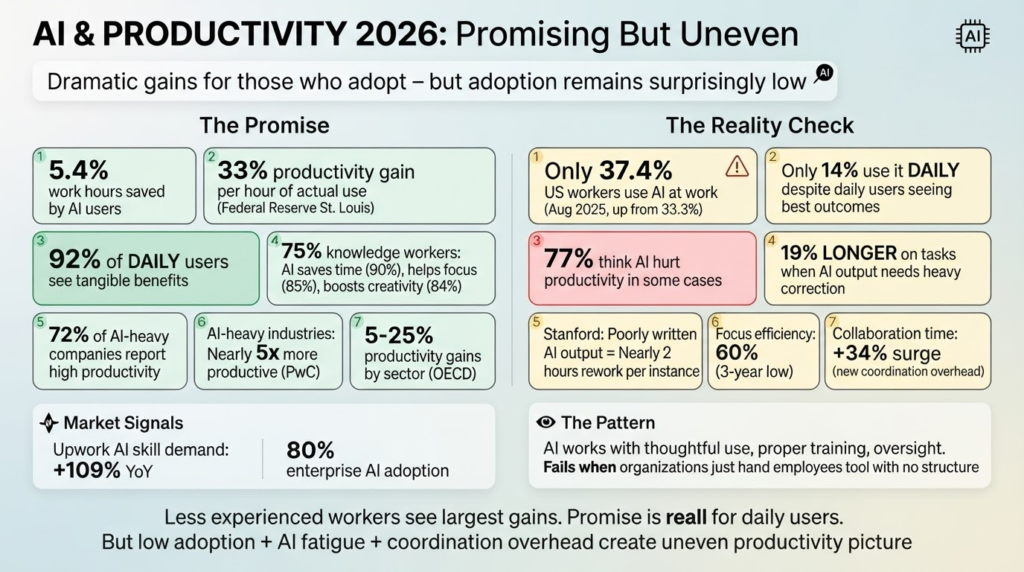
The numbers are promising but uneven:
AI is changing the productivity conversation fast. Workers using generative AI report saving 5.4% of their work hours. Per hour of actual use, AI delivers a 33% productivity gain according to the Federal Reserve Bank of St. Louis.
But adoption is still surprisingly low. Only 37.4% of US workers use generative AI at work as of August 2025, up from 33.3% a year earlier. And only 14% use it daily, despite daily users reporting dramatically better outcomes.
92% of daily AI users see tangible productivity benefits
75% of knowledge workers say AI saves time (90%), helps focus (85%), and boosts creativity (84%)
72% of companies using AI heavily report high productivity
AI-heavy industries are nearly 5x more productive than non-AI industries (PwC)
OECD data shows AI integration delivers 5% to 25% productivity gains depending on sector
Less experienced workers see the largest individual gains from AI tools
However, there is a cautionary stat. AI fatigue is real. 77% of employees think AI has hurt their productivity in some cases, with workers taking 19% longer on tasks when AI-generated output requires heavy correction. Stanford research found that poorly written AI output requires nearly two hours of rework per instance. AI works when it is used thoughtfully with proper training and oversight. It fails when organizations simply hand employees a tool with no structure.
AI-related skill demand on Upwork is up 109% year over year, and AI adoption has hit 80% across enterprise tools, but focus efficiency dropped to a three-year low of 60%. Collaboration time surged 34% alongside AI adoption, suggesting that AI is creating new coordination overhead alongside its gains.
Burnout and Mental Health: The Hidden Productivity Drain:
When people stop caring, numbers drop:
Burnout is not a soft HR issue. It has direct, measurable productivity consequences.
67% of all workers report experiencing burnout symptoms, up from 52% in 2021
43% of employers reported increased employee burnout over the past year
80% of employees experience productivity anxiety; Gen Z is hit hardest at 30% daily
Global organizations lose $322 billion annually from burnout-related turnover and productivity losses
US turnover costs alone: $1 trillion per year
95% of burned-out workers are actively looking for a new job
Organizations excelling at employee experience are 1.6x more likely to report high performance
Workers taking regular breaks show 13% higher productivity
Employees with a strong sense of purpose are 5.6x more likely to stay engaged
Only 33% of global employees rated their wellbeing as “thriving” in 2024, down from 35% in 2022. Stress levels in 2026 are at their highest since 2019. Poor communication alone costs businesses $26,000 per employee per year in duplicated work, missed deadlines, and confusion.
The Four-Day Work Week: Does It Work:
Research from Henley Business School and the 4 Day Week Global trials shows consistent results.
78% of employees feel happier and less stressed on a four-day week
39% reported less stress, 55% reported an increase in work ability
65% experienced reduced absenteeism due to sick leave
92% of companies that trialed a four-day week chose to continue it permanently
22% of US employers offered a four-day work week in 2024, up from 14% in 2022
The key is that output-based measurement replaces time-based measurement. When employees are judged on what they produce rather than how long they sit at a desk, they tend to fill the available time more efficiently. The four-day week is essentially forcing better prioritization.
Productivity Monitoring: What Works and What Backfires:
68% of managers believe productivity software boosts performance
But 72% of employees feel monitoring has no effect or actually lowers their productivity
20% of employees would look for a new job if their employer implemented surveillance-style software
Tracked employees are nearly 2x more likely to fake work when monitoring feels intrusive
Non-invasive monitoring delivered a 46% increase in active time within 3 days at one UK bank
72% of employees accept monitoring when it is transparent and they can see their own data
The conclusion is clear. Surveillance-style monitoring backfires. Outcome-based, transparent monitoring that employees can see themselves produces genuine gains.
Key Stats at a Glance:
Metric | Figure |
Average productive hours per day (office) | 2 hours 53 minutes |
Global employee engagement rate (2025) | 20% |
US employee engagement rate (H1 2026) | 31% |
Global annual cost of disengagement | $8.9 to $10 trillion |
US annual cost of disengagement | $2 trillion |
Meeting hours per week (average) | 11.3 hours |
Interruptions per workday | Every 3 min 5 sec |
AI users (US workers) | 37.4% |
Burnout prevalence | 67% of workers |
Remote worker productive time vs office | +29 minutes/day |
Hybrid workers less likely to quit | 33% |
US labor productivity growth Q2 2026 | +1.4% |
Cost of poor communication per employee/year | $26,000 |
Frequently Asked Questions
In 2026, studies show that the average employee is productive for only about 3 to 4 hours during an 8-hour workday. Remote and hybrid workers have shown a 13-22% productivity increase compared to fully in-office counterparts, according to recent workforce research.
Remote work continues to boost productivity in 2026, with data indicating that flexible workers complete tasks 20% faster than traditional office employees. However, productivity gains depend heavily on factors like management style, digital tool access, and work-life balance policies.
Yes, burnout remains a significant driver behind declining productivity numbers in 2026, with nearly 77% of workers reporting at least occasional burnout symptoms. Organizations with strong mental health support programs report up to 25% higher productivity rates than those without such initiatives.
Most companies struggle because they focus on hours worked rather than output quality, failing to align tasks with employee strengths and motivation. Poor management practices, unnecessary meetings, and outdated technology are consistently ranked as the top three productivity killers in 2026 workforce surveys.
Yes, AI-powered tools are reshaping the numbers in 2026, with companies using AI assistance reporting productivity gains of up to 40% in repetitive and analytical tasks. The key is proper implementation and employee training, as poorly adopted AI tools can actually reduce efficiency and increase frustration.
