
Voice Search Statistics 2026: Everything You Need to Know
You have probably asked Siri, Alexa, or Google something out loud today without even thinking about it. That one small habit, multiplied across billions of people, has turned voice search into one of the biggest forces reshaping the internet right now. If you run a website, a business, or you just want to understand where technology is headed, these numbers are going to matter to you. Let us dig in.
What Is Voice Search and Why Should You Care?
Voice search is simply using your voice to search the internet instead of typing. You speak a question or command into your phone, smart speaker, or laptop, and an AI assistant finds the answer for you. Tools like Siri, Google Assistant, Amazon Alexa, and Cortana all do this.
It sounds simple. But the scale at which people are now doing it is remarkable. Voice search has gone from a novelty to a genuine daily habit for hundreds of millions of people around the world. And the way voice search works is very different from typing, which means it is changing the rules of how the internet needs to be built and written.
The Big Picture: Voice Search Numbers in 2026
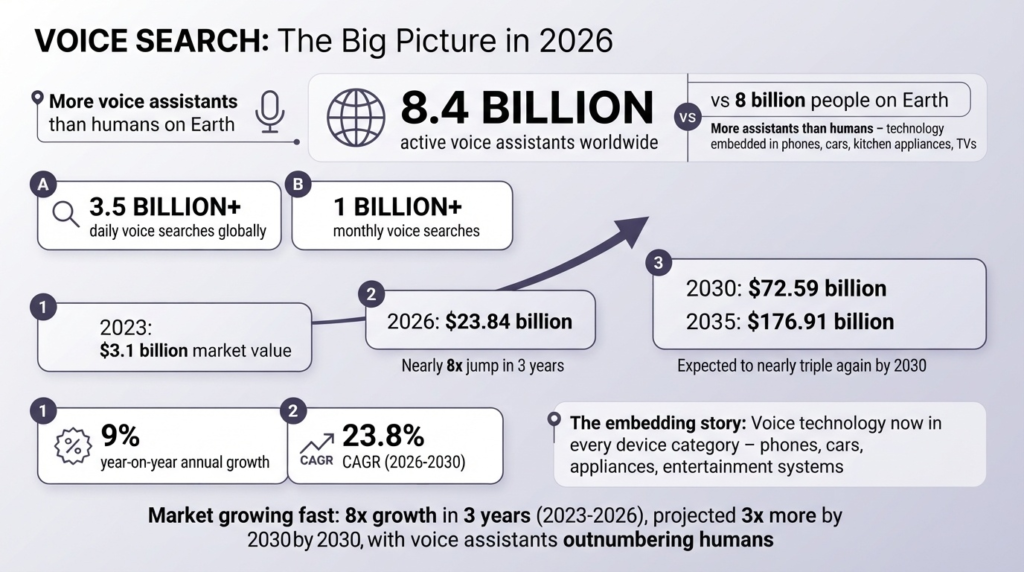
Let us start with the headline numbers that set the scene.
Stat | Number |
Total voice assistants active worldwide | 8.4 billion |
Daily voice searches globally | 3.5 billion+ |
Monthly voice searches | 1 billion+ |
Global voice search market value (2026) | $23.84 billion |
Projected market value by 2030 | $72.59 billion |
Projected market value by 2035 | $176.91 billion |
Year-on-year growth rate | 9% annually |
Voice search market CAGR (2026 to 2030) | 23.8% |
The market is growing fast. In 2023, the voice search market was worth around $3.1 billion. By 2026 it has jumped to $23.84 billion. That is nearly an 8x jump in three years. By 2030 it is expected to nearly triple again.
The 8.4 billion voice assistants active worldwide is the number that really stops you in your tracks. There are only 8 billion people on earth. There are now more voice assistants than there are humans. That tells you just how deep this technology has embedded itself into everyday devices, from phones to cars to kitchen appliances to televisions.
How Many People Actually Use Voice Search?
Adoption numbers vary depending on the country and the survey, but the overall trend is clear. Voice search is mainstream now, not optional.
20.5% of the global population uses voice search regularly
52% of people use voice search daily or almost daily
62% of US adults use voice search at least once per week
41% of US adults and 55% of US teens use voice search every single day
21% of global internet users include voice search in their weekly routine
90% of consumers say voice search is easier than typing
70% of people use voice search because it is faster than typing
Those last two numbers are the most important for understanding why voice search keeps growing. People are not using it because it is trendy. They are using it because it genuinely saves time and feels more natural. When something is easier and faster, people do it more. That is a trend that does not reverse.
Here is how usage breaks down by device type:
Device | Voice Search Usage Share |
Smartphone | 77% of all voice searches |
Smart speaker | 35% of Americans own one |
Desktop or laptop | 38% of 18 to 34 year-olds |
Smart TV | Growing fast, data still emerging |
Car infotainment system | One of the fastest-growing categories |
Who Is Using Voice Search the Most?
Age plays a big role in voice search behavior. Younger people adopted it first and use it most intensively, but older age groups are catching up quickly.
Age Group | Voice Search Behavior |
18 to 34 | Most active users. 77% use it on smartphones. Highest daily usage rate. |
35 to 54 | Growing rapidly. Use it mainly for convenience and local searches. |
55 and above | Fastest-growing segment. Adoption jumped significantly in 2025 to 2026. |
Teens (13 to 17) | 55% use voice search daily. Second highest after adults 18 to 34. |
The growth in the 55 and above age group is particularly significant. Voice search removes the friction of typing for people who may not be comfortable with small smartphone keyboards. It makes technology more accessible. That is a strong reason why adoption in older demographics is accelerating so quickly right now.
Voice Search vs Typing: What Is Actually Different?
This is where it gets really interesting for anyone who runs a website or creates content online. Voice search does not just change how people search. It changes what they search for and how they phrase it.
When you type, you are brief. You might type “best pizza London.” When you speak, you talk naturally. You say “What is the best pizza restaurant near me open right now?” These are very different queries, and they require very different kinds of answers.
Here are the key differences backed by data:
Average typed search: 2 to 3 words
Average voice query: 4 to 7 words (some studies put it as high as 29 words for full conversational queries)
Voice queries are 7x longer than typed searches on average
Voice searches are almost always phrased as questions. They start with who, what, where, when, why, and how.
94% of voice search answers are accurate, according to research across major platforms
Voice results load in an average of 4.6 seconds, and speed matters a lot for voice SEO
The practical implication here is big. If your website answers short keyword queries but does not answer full questions in plain conversational language, voice search is not going to find you. The whole internet is gradually having to adapt to this shift in how people ask for things.
Voice Search and Local Business: A Massive Opportunity
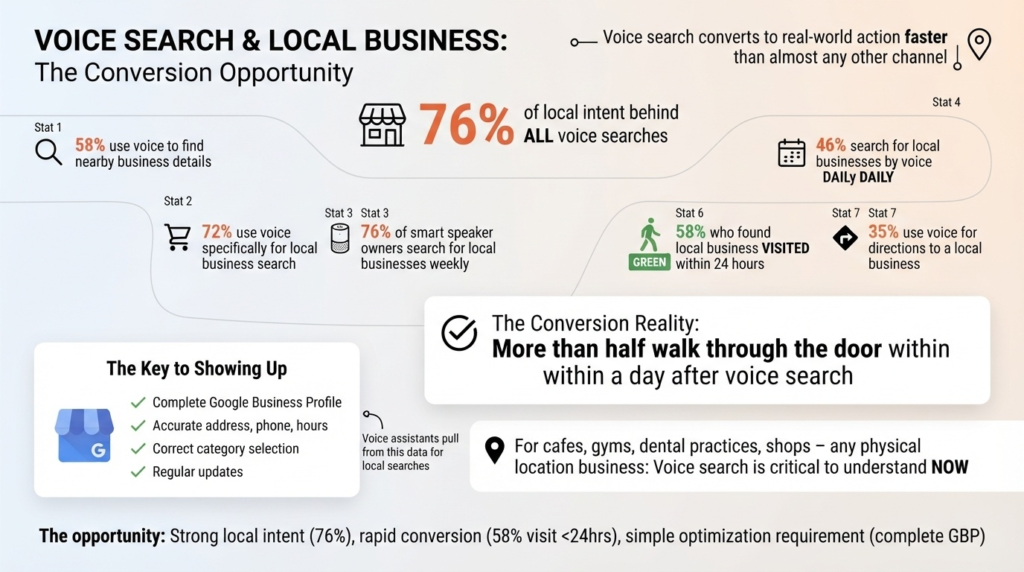
If you run a local business, a cafe, a gym, a dental practice, a shop, anything with a physical location, voice search is one of the most important things you need to understand right now. The connection between voice search and local intent is extremely strong.
76% of local intent is behind all voice searches
58% of people use voice search to find details about nearby businesses
72% of consumers use voice specifically to search for local businesses
76% of smart speaker owners search for local businesses at least once a week
46% of smart speaker users look up local businesses by voice every single day
28% of voice searches for local businesses result in a phone call
58% of voice searchers who found a local business visited it within 24 hours
That last stat is the one that should make every local business owner pay close attention. Someone uses voice search to find a business near them, and more than half of them walk through the door within a day. Voice search converts to real-world action faster than almost any other channel.
The key to showing up in local voice search is simple but requires attention: your Google Business Profile needs to be completely filled out, accurate, and regularly updated. Your address, phone number, opening hours, and category all need to be correct. Voice assistants pull from this data when someone searches for something near them.
Voice Commerce: People Are Buying With Their Voice
Shopping by voice is growing faster than almost anyone predicted two years ago.
Voice Commerce Stat | Figure |
US voice commerce market size (2026) | $22.4 billion |
Global voice commerce market size (2026) | $72.8 billion |
Projected global voice commerce by 2028 | $164 billion |
US consumers using voice for shopping | 49.6% (154 million people) |
Voice commerce market CAGR (2026 to 2030) | 23.9% |
Share of voice searches with shopping intent | 40.7% |
Nearly half of all US consumers have used voice search for shopping. That is not people accidentally triggering their assistant. That is people making an active decision to search for, research, or buy products using their voice. The convenience factor is the main driver. Saying “Alexa, reorder dishwasher tablets” is genuinely faster than opening an app, searching, and clicking.
The categories seeing the biggest voice shopping activity are groceries and household essentials, restaurant orders, electronics, clothing, and entertainment like music and movies.
The Main Voice Assistants: Who Is Winning?
Three names dominate the voice assistant market right now. Google Assistant, Apple Siri, and Amazon Alexa are the giants. But their market positions are not equal.
Google Assistant: Dominant on Android devices. Benefits from Google’s search index, meaning it tends to give the most accurate and up-to-date answers.
Apple Siri: 86.5 million active users in the US. Built into every iPhone and Mac. Strong in the premium device segment.
Amazon Alexa: 77.2 million active users. Dominant in smart home and smart speaker context. Powers the majority of Amazon Echo devices.
Other assistants (Samsung Bixby, Microsoft Cortana, AI-native assistants): Growing at 340% since 2023 as new AI-powered voice tools enter the market.
The growth of AI-native voice assistants is the most important trend to watch here. Traditional assistants like Siri and Alexa were built on older rule-based systems. New AI-powered voice tools understand context, remember previous parts of a conversation, and give much more natural responses. This is changing user expectations fast.
Why Voice Search Keeps Growing: The Simple Reasons
The data tells us why people keep choosing voice over typing, and the reasons are not complicated.
Speed: Voice is faster than typing for most people
Convenience: You can search while driving, cooking, exercising, or doing anything hands-free
Accessibility: Makes technology easier for people with disabilities or limited mobility
Natural language: Speaking feels more natural than writing a search query
Accuracy: Modern voice assistants get the right answer 94% of the time
Habit: Once people start using it, they use it more and more
More than 60% of people use voice search at home alone. More than 50% use it at home with other people around. People have lost their self-consciousness about speaking to devices. It has become as normal as using a keyboard.
What This Means for Websites and Content
If you create content online or run a website, here is what all these stats mean in practical terms.
Voice search is pushing the internet toward conversational, question-based content. The websites that win in voice search are the ones that answer real questions clearly and quickly. Google and other engines pull voice answers from pages that load fast, use plain language, and directly answer the question being asked.
Voice search is projected to exceed 40% of all searches globally. That is a number that no website owner can afford to ignore. The shift is not coming. It is already here.
The Bottom Line
Voice search is not a trend that might happen. It is a shift that is already happening at enormous scale. With 8.4 billion voice assistants active, 3.5 billion daily voice searches, a $23.84 billion market growing at nearly 24% per year, and nearly half of all US consumers already shopping by voice, the numbers all point in one direction.
People want faster, easier, more natural ways to find information and get things done. Voice gives them that. The businesses and websites that understand this early and adapt accordingly are the ones that will win the next decade of the internet.
FAQs
In 2026, over 50% of all online searches are conducted via voice, with smart speaker ownership surpassing 500 million households globally. Mobile voice search continues to dominate, with users performing an average of 3-4 voice queries per day.
Voice search has shifted consumer behavior toward conversational, question-based queries rather than short keyword phrases. Shoppers increasingly use voice to research products, compare prices, and complete purchases hands-free, with voice commerce expected to reach $80 billion in annual transactions.
Absolutely — 76% of voice search users perform local searches at least once a week, making voice optimization critical for small businesses looking to attract nearby customers. Businesses with optimized Google Business Profiles and conversational FAQ content capture significantly more voice-driven foot traffic.
Voice search queries are longer, more conversational, and often phrased as full questions, which causes search engines to prioritize featured snippets and position-zero results. Pages that directly answer specific questions in clear, concise language are far more likely to be read aloud as a voice search result.
Yes, implementing schema markup helps search engines better understand your content context, significantly increasing the likelihood of being selected as a voice answer. FAQ schema and How-To schema in particular are strongly associated with winning voice search result placements in 2026.
