
7 Best Shared Proxy Providers in 2026 : Tested & Ranked
Shared proxies offer lower costs than dedicated IPs, but sharing infrastructure can also mean IP blocks, inconsistent performance, and limited reliability. The right provider can offset these issues with large IP pools, strong bandwidth, geographic coverage, rotation, and effective traffic distribution.
Oxylabs
- Starting at $1.60/IP
- 10 IPs Starter plan
- Unlimited session duration
- Unlimited bandwidth
- 24/7 dedicated support
Decodo

- Starting at $0.27/IP
- 3 IP dedicated minimum
- 99.99% advertised uptime
- Unlimited concurrent sessions
- 14-day money-back guarantee
Webshare
- Starting at $0.23/IP
- 100K+ ISP proxy pool
- 99.97% advertised uptime
- 2Up to 400Mbps speed
- 10 free proxies
This guide compares the best shared proxy providers in 2026, focusing on the factors that matter most when multiple users share the same proxy infrastructure.
Quick Tip: Choosing the Best Shared Proxy Providers
Do not compare shared proxies by price per IP alone.
A $0.02/IP plan and a $0.60/GB plan use different pricing models.
If you need 10,000 addresses for a large scraping workload, an IP-based plan may make more sense. If you only need 50GB of traffic for a short project, a bandwidth-based plan can cost less.
Always calculate the expected monthly cost from your actual traffic and concurrency before choosing a provider.
How We Ranked the Best Shared Proxy Providers
Shared proxies need a different evaluation framework from dedicated proxies.We ranked these services using the following criteria:
Shared-IP availability
We looked for proxy pools explicitly designed to be shared among multiple users or broad rotating pools where customers access the same underlying infrastructure.
Pool size
A larger pool can provide more opportunities to distribute requests and avoid repeatedly using the same IP.
Rotation
We considered whether the provider supports automatic rotation, sticky sessions, or both.
Bandwidth
Shared datacenter proxies are often purchased specifically for high-volume work, so included traffic and bandwidth limits matter.
Geographic coverage
We considered the number of countries and geographic targeting options available.
Speed
Datacenter infrastructure generally has stronger network performance than residential connections. We considered provider-published response-time and network-speed figures where available.
Protocols
HTTP, HTTPS and SOCKS5 support can make a shared proxy network considerably easier to integrate.
Concurrency
High-volume scraping can require hundreds or thousands of simultaneous connections, so connection limits matter.
Pricing model
We compared per-IP and per-GB models separately rather than pretending they represent the same product.
Free trials and testing
A shared proxy should be tested against your actual targets before you commit to a large plan.
Best Shared Proxy Providers at a Glance
Provider | Best for | Starting price | Shared infrastructure |
Webshare | Best overall value | $2.99/month | 100 shared proxies |
Decodo | High-volume shared datacenter traffic | $0.60/GB | 500K+ datacenter IPs |
Oxylabs | Premium shared datacenter infrastructure | $1.20/IP | 36K+ shared-IP pool |
Bright Data | Enterprise scale | $1.40/IP | 1.3M+ datacenter IPs |
DataImpulse | Cheapest pay-as-you-go traffic | $0.50/GB | 20M datacenter IPs |
SOAX | Multi-proxy-type access | $90/month | Shared access across proxy types |
Rayobyte | Low-cost rotating datacenter traffic | $0.45/GB | Rotating datacenter network |
The pricing models are not directly interchangeable. Webshare, Oxylabs and Bright Data offer IP-based shared datacenter plans, while Decodo, DataImpulse and Rayobyte also offer traffic-based models.
7 Best Shared Proxy Providers Compared
We tested and compared 7 shared proxy providers based on the factors that matter most: IP pool size, proxy quality, location coverage, rotation options, bandwidth, concurrency, pricing, and reliability.
1. Webshare: One of the Best Shared Proxy Providers
Webshare is the easiest recommendation for most buyers who specifically want shared proxies. Its shared proxy plan starts with 100 proxies for $2.99/month, while the provider also offers 10 free proxies with no credit card required.
The paid shared plans scale from 100 proxies to 100,000 proxies, and the published pricing reaches $0.0179 per proxy at the 60,000 and 100,000-proxy levels.
Webshare describes its shared proxy servers as being used by more than 2 users. The provider positions them as the lowest-cost option in its shared, private and dedicated hierarchy.
The service also advertises 100+ Gbps, 50+ countries, 99.97% uptime, HTTP and SOCKS5 support, and between 500 and 3,000 threads depending on the configuration.
Best for: Users who want inexpensive shared datacenter proxies, a free starting tier, straightforward management, and predictable IP-based pricing.
Webshare Highlights
Free plan: 10 shared proxies.
Paid starting plan: 100 proxies.
Starting price: $2.99/month.
100 proxies: $2.99/month.
250 proxies: $7.47/month.
500 proxies: $14.20/month after the listed 5% discount.
1,000 proxies: $26.91/month after the listed 10% discount.
2,500 proxies: $63.54/month after the listed 15% discount.
5,000 proxies: $119.60/month after the listed 20% discount.
10,000 proxies: $224.25/month after the listed 25% discount.
15,000 proxies: $313.95/month after the listed 30% discount.
25,000 proxies: $523.25/month after the listed 30% discount.
40,000 proxies: $777.40/month after the listed 35% discount.
60,000 proxies: $1,076.40/month after the listed 40% discount.
100,000 proxies: $1,794/month after the listed 40% discount.
Network bandwidth: 100+ Gbps.
Countries: 50+.
Uptime: 99.97%.
Protocols: HTTP and SOCKS5.
Threads: 500 to 3,000.
Pool: Up to 400,000 fast datacenter IPs.
IP authorization: Supported.
API: Supported.
What You Pay
Proxies | List price | Current displayed price |
100 | $2.99 | $2.99/month |
250 | $7.47 | $7.47/month |
500 | $14.95 | $14.20/month |
1,000 | $29.90 | $26.91/month |
2,500 | $74.75 | $63.54/month |
5,000 | $149.50 | $119.60/month |
10,000 | $299 | $224.25/month |
15,000 | $448.50 | $313.95/month |
25,000 | $747.50 | $523.25/month |
40,000 | $1,196 | $777.40/month |
60,000 | $1,794 | $1,076.40/month |
100,000 | $2,990 | $1,794/month |
Pros
- 10 free shared proxies give users a zero-cost way to test the infrastructure.
- The starting paid plan costs only $2.99/month for 100 proxies.
- The service combines 50+ countries, 99.97% uptime and 100+ Gbps of advertised network capacity.
Cons
- Shared IPs are explicitly used by more than 2 customers, so another user's activity can affect an IP's reputation.
- The cheapest $0.0179/IP figure applies only to the 60,000 and 100,000-IP tiers, not a small account.
Why Webshare: Webshare is the strongest all-around shared proxy choice because you can start with 10 free proxies, pay $2.99/month for 100 proxies, and scale to 100,000 proxies without switching pricing models.
2. Decodo: Best Shared Proxy Providers for High-Volume Traffic
Decodo offers shared datacenter proxies through both IP-based and bandwidth-based pricing. The current provider page lists shared datacenter traffic from $0.45/GB at the 1,000GB tier, while the displayed 10GB starter configuration costs $6/month, or $0.60/GB.
Decodo lists shared datacenter infrastructure at more than 500,000 IPs and supports HTTP(S) and SOCKS5. That pricing model makes Decodo particularly attractive for traffic-heavy scraping.
Instead of buying a fixed number of IPs and worrying about how much data each IP can process, you can buy a defined amount of bandwidth and use the shared pool.
Best for: Developers and scraping teams that need shared datacenter traffic at predictable per-GB prices.
Decodo Highlights
Shared datacenter pool: 500K+ IPs.
Starting displayed package: 10GB.
10GB price: $6/month.
10GB rate: $0.60/GB.
50GB rate: $0.57/GB.
100GB rate: $0.54/GB.
250GB rate: $0.51/GB.
500GB rate: $0.48/GB.
1,000GB rate: $0.45/GB.
10GB total: $6.
50GB total: $28.50.
100GB total: $54.
250GB total: $127.50.
500GB total: $240.
1,000GB total: $450.
Protocols: HTTP(S), SOCKS5.
Average response time: Under 0.3 seconds for datacenter proxies.
Trial: 3-day / 100MB.
Money-back: 14 days.
Country coverage: Global.
Datacenter pricing: Shared and other configurations available.
Pay-as-you-go: Available for some proxy types.
What You Pay
Traffic | Price/GB | Monthly total |
10GB | $0.60 | $6 |
50GB | $0.57 | $28.50 |
100GB | $0.54 | $54 |
250GB | $0.51 | $127.50 |
500GB | $0.48 | $240 |
1,000GB | $0.45 | $450 |
Pros
- The shared datacenter pool contains 500K+ IPs, giving high-volume users substantial address diversity.
- The price falls from $0.60/GB at 10GB to $0.45/GB at 1,000GB, providing a clear scaling curve.
- Decodo advertises under 0.3-second average response time for its datacenter proxies.
Cons
- The $0.45/GB rate requires a 1,000GB purchase, so it does not represent the cost for a small 10GB project.
- Shared datacenter IPs have lower detection resistance than residential IPs. Decodo itself rates datacenter detection resistance below residential and mobile products.
Why Decodo: Decodo is a strong choice for traffic-heavy projects because its shared datacenter pricing drops from $0.60/GB at 10GB to $0.45/GB at 1,000GB, while its pool exceeds 500,000 IPs.
3. Oxylabs: One of the Best Shared Proxy Providers for Premium Infrastructure
Oxylabs is better known for enterprise proxy infrastructure, but its current datacenter pricing page includes a dedicated shared pay-per-IP product.
The shared datacenter plan starts at 10 IPs for $1.20/IP, or $12/month. Oxylabs lists a 36,000+ IP pool across 38 countries for the shared IP-based product. It also offers a separate shared pay-per-GB plan starting at 20GB for $0.59/GB, or $11.80/month.
This gives buyers two different ways to approach shared infrastructure.
The IP-based model works when you need a predictable proxy list. The bandwidth-based model works when traffic volume matters more than a fixed number of addresses.
Best for: Businesses that want premium shared datacenter infrastructure, enterprise support, SOCKS5, and a large established proxy platform.
Oxylabs Highlights
Shared IP-based starting plan: 10 IPs.
Price: $1.20/IP.
Monthly total: $12.
Shared IP pool: 36K+.
Countries: 38.
Shared bandwidth plan: 20GB minimum.
Shared bandwidth price: $0.59/GB.
20GB bandwidth cost: $11.80/month.
Bandwidth range: 20GB to 2TB.
Protocols: HTTP, HTTPS, SOCKS5.
Geo-targeting: Country.
Uptime: 99.9%.
Success rate: 99.9%.
Published response time: 0.222 seconds.
Rotation: Supported.
Static sessions: Supported.
Support: 24/7.
Account management: Dedicated account manager.
Free trial: Available.
Free IPs: 5 free IPs for account signup.
What You Pay
Shared IP plan
10 IPs × $1.20 = $12/month.
The public page currently allows selection of 10, 50, 100, 200, 500, 1K and 3K IPs, but the page’s text output does not expose a separate price for every selected quantity. Those figures should therefore be checked at checkout rather than estimated.
Shared bandwidth plan
Traffic | Rate shown | Monthly total |
20GB | $0.59/GB | $11.80 |
50GB | $0.59/GB | $29.50* |
100GB | $0.59/GB | $59* |
250GB | $0.59/GB | $147.50* |
500GB | $0.59/GB | $295* |
1TB | $0.59/GB | $604.16* |
2TB | $0.59/GB | $1,208.32* |
*Calculated at the displayed $0.59/GB rate. The provider’s page exposes the starting rate but does not separately confirm each selected tier’s final price, so verify the checkout amount before publication or purchase.
Pros
- Oxylabs gives users both IP-based and bandwidth-based shared datacenter pricing, which covers two different purchasing models.
- The shared IP product includes HTTP, HTTPS and SOCKS5, plus 24/7 expert support.
- The provider publishes 99.9% uptime, 99.9% success rate and 0.222-second response time for the datacenter product.
Cons
- The shared IP pool contains 36,000+ IPs across 38 countries, which is substantially smaller than the provider's dedicated datacenter pool of 1.9M+ IPs.
- The starting IP-based plan costs $12/month for only 10 IPs, making it more expensive per address than Webshare's 100-proxy $2.99 plan.
Why Oxylabs: Oxylabs offers a premium shared option with 36K+ shared IPs, 38 countries, three major protocols, 99.9% uptime and 24/7 support, plus both IP-based and traffic-based purchasing.
4. Bright Data: Best Shared Proxy Providers for Enterprise Scale
Bright Data operates one of the largest proxy platforms in this comparison. Its current datacenter page describes a 1.3M+ shared and dedicated datacenter IP network and publishes shared pricing beginning at 10 IPs for $1.40/IP, or $14/month. The shared IP price drops as the purchase grows.
The provider also supports a pay-as-you-go datacenter model beginning at $0.60/GB, with larger monthly plans reaching $0.42/GB at 5TB.
Bright Data is therefore better suited to users who need infrastructure beyond a basic proxy list.
Best for: Large teams that need shared datacenter infrastructure, enterprise tooling, broad targeting, and predictable scaling.
Bright Data Highlights
Datacenter pool: 1.3M+ shared and dedicated IPs.
Shared starting package: 10 IPs.
10 IP rate: $1.40/IP.
10 IP monthly cost: $14.
100 IP rate: $1/IP.
100 IP monthly cost: $100.
500 IP rate: $0.95/IP.
500 IP monthly cost: $475.
1,000 IP rate: $0.90/IP.
1,000 IP monthly cost: $900.
Pay-as-you-go: $0.60/GB.
1TB plan: $0.51/GB, $499/month.
2TB plan: $0.45/GB, $999/month.
5TB plan: $0.42/GB, $1,999/month.
Uptime: 99.99%.
Seats: Unlimited on enterprise plans.
Scale: Unlimited.
Tool: Proxy Manager.
Protocols: HTTP(S), SOCKS5.
Targeting: Country and city, with additional targeting capabilities.
Trial: Free trial.
What You Pay
Shared IPs | Price/IP | Monthly total |
10 | $1.40 | $14 |
100 | $1.00 | $100 |
500 | $0.95 | $475 |
1,000 | $0.90 | $900 |
Traffic-based datacenter pricing:
Traffic | Rate | Monthly cost |
PAYG | $0.60/GB | Usage-based |
1TB | $0.51/GB | $499 |
2TB | $0.45/GB | $999 |
5TB | $0.42/GB | $1,999 |
Pros
- The datacenter network contains 1.3M+ shared and dedicated IPs, giving large organizations substantial infrastructure to work with.
- The shared IP price reaches $0.90/IP at 1,000 IPs, giving high-volume buyers a lower unit price than the 10-IP tier.
- Bright Data combines proxy access with Proxy Manager, unlimited scale, unlimited seats and 99.99% network uptime on enterprise offerings.
Cons
- The cheapest shared IP tier still costs $14/month for 10 IPs, which is far above Webshare's $2.99 entry plan.
- The $0.90/IP price requires 1,000 IPs, creating a $900 monthly commitment.
Why Bright Data: Bright Data is the enterprise shared-proxy choice, with 1.3M+ datacenter IPs, pricing down to $0.90/IP at 1,000 IPs, a $0.60/GB PAYG option and 99.99% enterprise network uptime.
5. DataImpulse: Best Shared Proxy Providers for Low-Cost Traffic
DataImpulse takes a different approach from Webshare and Bright Data. Instead of charging primarily for a fixed number of proxy IPs, DataImpulse sells datacenter traffic by the gigabyte.
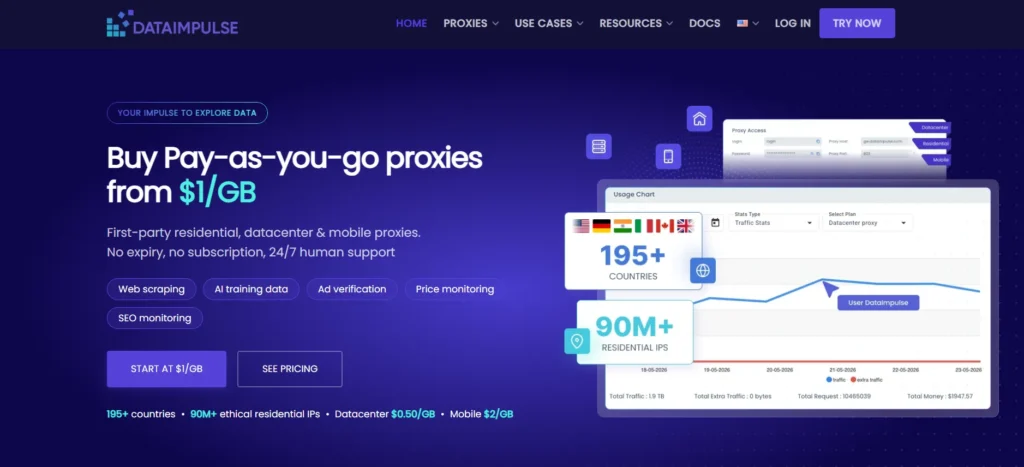
Its current datacenter page starts at $0.50/GB, with a $5 introductory package, a 10GB package for $5, a 100GB package for $50, and a 1TB tier at $0.45/GB for $450. The provider also states that purchased traffic does not expire.
The network contains 20 million datacenter IPs across 195+ countries, with HTTP(S) and SOCKS5 support. DataImpulse advertises 99.9% uptime and sub-100ms latency.
Best for: Users who want the lowest traffic-based cost, non-expiring bandwidth, and pay-as-you-go shared datacenter access.
DataImpulse Highlights
Datacenter pool: 20M IPs.
Countries: 195+.
Starting price: $0.50/GB.
Intro package: $5.
10GB package: $50.
100GB package: $450.
1TB package: Custom tier from $2,250 according to current page.
Traffic expiration: None.
Protocols: HTTP, HTTPS, SOCKS5.
Sessions: Rotating and sticky.
Sticky sessions: Up to 30 minutes on the main product page.
Uptime: 99.9%.
Latency: Sub-100ms advertised.
Country targeting: Included.
Advanced targeting: City, ZIP and ASN options.
Support: 24/7.
Refund period: 7 days.
API: Available.
Billing: Pay-as-you-go.
What You Pay
The current page displays:
Intro: $5.
10GB: $50.
100GB: $450.
1TB: starting from $2,250.
5TB+: Custom pricing.
The headline rate is $0.50/GB, while the larger displayed tier works out to $0.45/GB.
Pros
- DataImpulse offers 20M datacenter IPs across 195+ countries, giving it a very large geographic footprint.
- Purchased bandwidth does not expire, which is useful for seasonal and irregular projects.
- The starting $0.50/GB rate is below Decodo's displayed $0.60/GB 10GB tier and Bright Data's $0.60/GB PAYG rate.
Cons
- The provider's $0.50/GB rate applies to bandwidth usage, not a fixed number of guaranteed exclusive IPs.
- DataImpulse acknowledges that datacenter IPs can be easier for some websites to identify and block than residential IPs.
Why DataImpulse: DataImpulse is the best fit for traffic-first buyers, combining $0.50/GB starting pricing, 20M datacenter IPs, 195+ countries and non-expiring traffic.
6. SOAX: Best Shared Proxy Providers for Multi-Proxy Access
SOAX does not position its current offering around a traditional “shared proxy list” model. Instead, its current platform provides access to residential, mobile, ISP and US datacenter proxies through one credit-based plan. That makes it relevant to shared-proxy buyers who care more about shared network access than about purchasing a fixed shared IP list.
The current pricing page lists $90/month for 25GB, or $3.60/GB, with larger plans at $170/month for 50GB, $740/month for 300GB, and $1,600/month for 800GB.
SOAX also offers a three-day 400MB trial for $1.99, HTTP(S), SOCKS5, UDP and QUIC, sticky and rotating sessions, and country, region, city and ISP targeting.
Best for: Teams that want one account for residential, mobile, ISP and datacenter proxy access instead of maintaining separate proxy subscriptions.
SOAX Highlights
Starter: $90/month.
Starter traffic: 25GB.
Starter rate: $3.60/GB.
Advanced: $170/month.
Advanced traffic: 50GB.
Advanced rate: $3.40/GB.
Professional: $740/month.
Professional traffic: 300GB.
Professional rate: $2.46/GB.
Business: $1,600/month.
Business traffic: 800GB.
Business rate: $2/GB.
Trial: 400MB for 3 days.
Trial cost: $1.99.
Proxy types: Residential, mobile, ISP and datacenter.
Countries: 195+.
Protocols: HTTP(S), SOCKS5, UDP, QUIC.
Sessions: Sticky and rotating.
Targeting: Country, region, city and ISP.
Connections: Unlimited.
Support: 24/7 multi-channel.
What You Pay
Plan | Traffic | Rate | Monthly cost |
Starter | 25GB | $3.60/GB | $90 |
Advanced | 50GB | $3.40/GB | $170 |
Professional | 300GB | $2.46/GB | $740 |
Business | 800GB | $2.00/GB | $1,600 |
Pros
- One subscription provides access to four proxy types, reducing the need to maintain separate accounts.
- The platform supports HTTP(S), SOCKS5, UDP and QUIC, giving developers more transport options.
- Users get 195+ countries, unlimited proxy connections and four geographic targeting levels.
Cons
- The $90 Starter plan costs $3.60/GB, which is substantially higher than DataImpulse's $0.50/GB datacenter starting price.
- SOAX's current pricing is credit-based, so it is not directly comparable with an IP-based shared proxy plan.
Why SOAX: SOAX makes sense when shared proxy access is only one part of the requirement and you want residential, mobile, ISP and datacenter proxies under one $90/month Starter account.
7. Rayobyte: Best Shared Proxy Providers for Rotating Traffic
Rayobyte’s current proxy catalog includes dedicated, semi-dedicated and rotating proxy products.
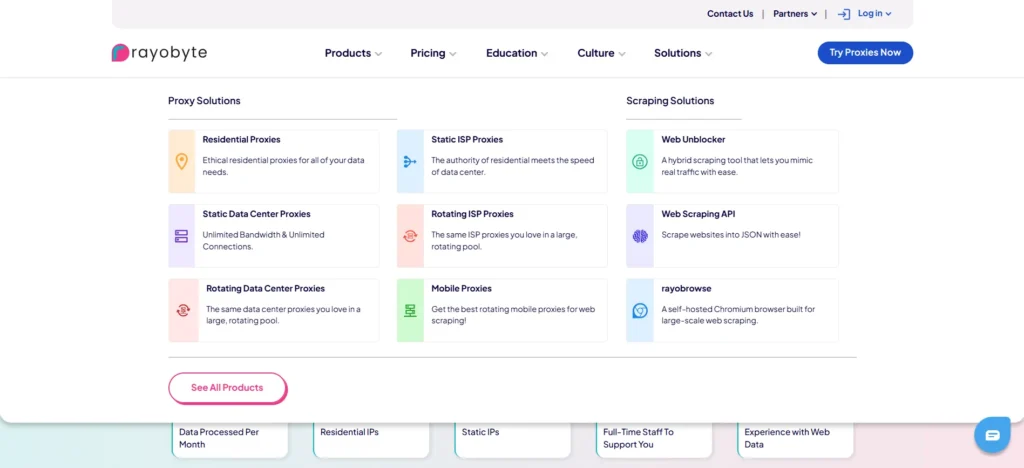
For a shared-proxy comparison, its rotating datacenter proxies are the closest fit because the endpoint automatically routes traffic through a different proxy when you connect to the port. Rayobyte currently lists rotating datacenter proxies from $0.45/GB.
Rayobyte also advertises 1Gbps speeds, 24/7 customer support and API access for the rotating datacenter product.
This is not the same product as a fixed shared proxy list, so buyers who require persistent IP addresses should select a different product.
Best for: Buyers who want low-cost rotating datacenter traffic with 1Gbps speeds and simple usage-based pricing.
Rayobyte Highlights
Rotating datacenter starting price: $0.45/GB.
Network speed: Up to 1Gbps.
Rotation: New proxy automatically routed when connecting to a port.
Support: 24/7.
API: Available.
Product type: Rotating datacenter.
Use cases: High-volume scraping and automated requests.
Dedicated datacenter: From $2/IP/month.
Semi-dedicated datacenter: From $1/IP/month.
Residential PAYG: From $2/GB.
Residential subscription: From $1/GB.
Residential pool: 40M+ IPs.
Residential threads: Unlimited.
Residential bandwidth: Does not expire.
What You Pay
The current Rayobyte purchase page lists:
Rotating datacenter: $0.45/GB.
For comparison, Rayobyte separately lists:
Semi-dedicated datacenter: $1/IP/month.
Dedicated datacenter: $2/IP/month.
Because the rotating datacenter product is billed by traffic rather than by a fixed shared-IP count, there is no honest reason to convert the $0.45/GB figure into a fake per-IP price.
Pros
- The $0.45/GB starting rate puts Rayobyte alongside the lowest published traffic-based prices in this comparison.
- Rayobyte advertises 1Gbps speeds for its rotating datacenter proxies.
- The provider supports 24/7 customer support and API access, which helps when the proxy service is part of an automated workflow.
Cons
- The rotating datacenter product changes the proxy rather than giving you a persistent IP, so it is unsuitable when session identity must remain constant.
- Rayobyte's $0.45/GB price does not tell you how many usable IPs you will receive at any one time.
Why Rayobyte: Rayobyte is a strong traffic-based alternative, offering rotating datacenter proxies from $0.45/GB with 1Gbps speeds, API access and 24/7 support.
Shared vs. Private vs. Dedicated Proxies
The three terms are often confused. The easiest way to understand them is to ask how many customers can use the same IP.
Shared
Multiple customers use the same proxy IP.
Webshare explicitly describes shared proxies as being used by more than 2 customers.
The advantage is price.
The disadvantage is shared reputation.
Private
A private or semi-dedicated proxy is normally shared with a very small number of users.
Webshare defines its private proxies as being shared with 1 or 2 users.
This reduces the number of users affecting the IP while keeping the cost below a fully dedicated proxy.
Dedicated
A dedicated proxy belongs exclusively to one customer.
No other customer uses the same IP during the assignment period.
That makes dedicated proxies better for workflows where IP reputation and persistence matter more than price.
Shared Datacenter vs. Shared Residential Proxies
Shared does not describe the underlying IP type.
It describes how the proxy is allocated.
You can therefore have different combinations:
Shared + Datacenter
Shared + Residential
Private + Datacenter
Private + Residential
Dedicated + Datacenter
Dedicated + ISP
The network origin still matters.
Shared Datacenter
Datacenter IPs normally provide:
High speed
Low latency
High concurrency
Lower cost
Large address pools
But some websites can identify datacenter IP ranges more easily.
Shared Residential
Residential proxies use IP addresses associated with residential internet connections.
They generally provide a different network identity from datacenter proxies, but the traffic usually costs more.
For example, Webshare currently lists rotating residential pricing from $1.40/GB, compared with its shared datacenter proxy plan starting at $2.99/month for 100 proxies.
When Should You Use Shared Proxies?
Shared proxies make sense when the workload does not require exclusive IP ownership.
Use shared proxies for:
1. Large-scale public-data scraping
If you need to collect thousands or millions of public pages, shared datacenter proxies can reduce infrastructure costs.
2. Price monitoring
You can distribute requests across multiple proxy IPs while keeping the cost below a dedicated-IP setup.
3. SEO monitoring
Search-result collection can generate thousands of requests, making inexpensive rotating or shared infrastructure useful.
4. Market research
Shared proxy networks can provide access to multiple geographic markets without requiring a dedicated IP for every location.
5. Testing
Developers can test geo-targeted applications without purchasing a large dedicated proxy pool.
When Should You Avoid Shared Proxies?
Shared proxies are not the best choice for every workload.
Avoid them when:
You need IP allowlisting
If a server only permits specific IP addresses, a dedicated proxy is easier to control.
You need a clean IP reputation
Another user can affect a shared IP’s reputation.
You need a persistent account identity
A dedicated or static proxy is usually more appropriate.
You need guaranteed IP ownership
Shared infrastructure cannot provide exclusive use of an IP.
You are dealing with strict anti-abuse systems
A residential or ISP proxy may be more appropriate than a shared datacenter IP when a target heavily filters hosting-provider addresses.
How to Test a Shared Proxy Provider
Do not judge a shared proxy service from the advertised price alone.
Run a controlled test.
Step 1: Test the IP
curl -x http://USERNAME:PASSWORD@HOST:PORT \
Run it repeatedly.
Record the returned IP addresses.
For a rotating proxy, you should see IP changes according to the provider’s rotation rules.
For a fixed shared proxy list, individual proxy addresses should remain stable until the provider changes or replaces them.
Step 2: Test response time
curl -x http://USERNAME:PASSWORD@HOST:PORT \
-o /dev/null \
-s \
-w “HTTP %{http_code}\nTotal %{time_total}s\n” \
Run the test at least 50 times.
Calculate:
Average response time
Median response time
95th percentile
Timeout count
HTTP error count
Do not confuse proxy response time with total website response time.
A provider can advertise a 100ms proxy response time while your target takes 800ms to generate a page.
Step 3: Test multiple IPs
For each proxy, record:
IP
Country
City
ASN
Organization
Response time
HTTP status
A pool containing 500 addresses is not automatically useful if 400 addresses come from the same small set of networks.
Step 4: Test your real target
A proxy can return a successful response from:
and fail against your actual target.
Your final test should therefore use the website, API or service that your application actually needs to access.
How Much Do Shared Proxies Cost?
The answer depends heavily on the billing model.
IP-based pricing
Webshare starts at $2.99/month for 100 shared proxies.
Oxylabs starts at $12/month for 10 shared datacenter IPs.
Bright Data starts at $14/month for 10 shared datacenter IPs.
Bandwidth-based pricing
Decodo starts at $6 for 10GB, or $0.60/GB.
DataImpulse starts at $0.50/GB.
Rayobyte starts at $0.45/GB for rotating datacenter proxies.
These figures are not interchangeable.
If your workload needs 100 proxy IPs but only 5GB of traffic, compare IP-based and bandwidth-based models separately.
If your workload generates 2TB of traffic, a $0.45/GB plan can be substantially more relevant than the number of IPs included in an IP-based subscription.
Which Shared Proxy Provider Is Cheapest?
For a traditional IP-based shared datacenter plan, Webshare has the lowest clear entry price in this comparison at $2.99/month for 100 proxies.
For traffic-based shared or rotating datacenter proxies, Rayobyte lists $0.45/GB, while DataImpulse starts at $0.50/GB and Decodo’s 1,000GB shared datacenter tier reaches $0.45/GB.
For premium shared datacenter infrastructure, Oxylabs starts at $1.20/IP, while Bright Data starts at $1.40/IP for 10 IPs.
So the cheapest choice depends on whether you buy IPs or bandwidth.
Best Shared Proxy Provider by Use Case
Best overall: Webshare
Choose Webshare if you want a straightforward shared proxy list with 10 free proxies, 100 paid proxies for $2.99/month, 50+ countries and 99.97% uptime.
Best for shared datacenter scraping: Decodo
Choose Decodo when traffic volume matters. Its shared datacenter pricing ranges from $0.60/GB at 10GB to $0.45/GB at 1,000GB, with a 500K+ IP pool.
Best premium shared option: Oxylabs
Choose Oxylabs when you want 36K+ shared IPs across 38 countries, 0.222-second published response time, 99.9% uptime and 24/7 support.
Best for enterprise scale: Bright Data
Choose Bright Data if you need a larger infrastructure platform. Its datacenter network exceeds 1.3M shared and dedicated IPs, with shared pricing reaching $0.90/IP at 1,000 IPs.
Best pay-as-you-go value: DataImpulse
Choose DataImpulse if you want $0.50/GB starting pricing, 20M datacenter IPs, 195+ countries and traffic that does not expire.
Best multi-proxy platform: SOAX
Choose SOAX if you want residential, mobile, ISP and datacenter access under one subscription, starting at $90/month for 25GB.
Best rotating datacenter value: Rayobyte
Choose Rayobyte when you want rotating datacenter traffic from $0.45/GB, with advertised 1Gbps speeds and API access.
Quick Links :
- Best Proxy Providers
- Best Datacenter Proxy Providers
- Best Static Residential Proxies
- Best Residential Proxies
- Best ISP Proxy Providers
Final Verdict on the Best Shared Proxy Providers
Webshare is the best shared proxy provider for most buyers in 2026. Its combination of 10 free proxies, a $2.99/month entry plan for 100 proxies, 50+ countries and 99.97% uptime makes it the easiest low-cost starting point.
For high-volume scraping, Decodo is the stronger traffic-based choice, with shared datacenter pricing from $0.60/GB at 10GB and $0.45/GB at 1,000GB, plus a 500K+ datacenter IP pool.
For premium infrastructure, Oxylabs provides shared datacenter access from $1.20/IP, with 36K+ shared IPs across 38 countries and 24/7 support.
For enterprise-scale deployments, Bright Data provides more than 1.3M shared and dedicated datacenter IPs, with shared pricing down to $0.90/IP at 1,000 IPs.
For users who want the lowest traffic-based pricing, DataImpulse and Rayobyte both reach $0.45 to $0.50/GB, with DataImpulse adding 20M IPs and non-expiring traffic.
For most users, start with Webshare. For heavy scraping, choose Decodo. For enterprise infrastructure, choose Bright Data.
FAQs About the Best Shared Proxy Providers
Shared proxies are IP addresses used by multiple customers rather than assigned exclusively to one user. Their main advantage is cost, as providers can offer shared access at lower prices than dedicated proxies.
Shared proxies can work for legitimate public-data collection, testing, market research, and authorized workflows. The main technical concern is shared IP reputation, since another customer's activity can contribute to blocks or verification requests.
Shared proxies are better when cost and IP quantity matter more than exclusivity. Dedicated proxies are preferable when you need an IP exclusively associated with your workflow. Webshare, for example, states that shared proxies are used by multiple customers while dedicated proxies are assigned to one.
Pricing ranges from $2.99/month for 100 shared proxies at Webshare to traffic-based plans such as $0.45/GB at Rayobyte and $0.50/GB at DataImpulse. The final cost depends on whether you pay by IP, bandwidth, requests, or another unit.
Shared describes how many customers use an IP, while rotating describes whether the IP changes during a connection or between requests. These models can overlap, so always check both the proxy's allocation model and rotation behavior before purchasing.
Yes, particularly when targets do not aggressively filter datacenter IPs. They offer high-speed infrastructure at lower costs than residential proxies. Decodo, for example, lists shared datacenter response times below 0.3 seconds and a 500K+ IP pool. Residential or ISP proxies may suit stricter targets.
