
7 Best ISP Proxy Providers in 2026: Tested & Compared
ISP proxies combine static IP persistence with high-performance server infrastructure, making them useful for logins, checkout flows, monitoring, and account workflows.
Oxylabs
- Starting at $1.60/IP
- 10 IPs Starter plan
- Unlimited session duration
- Unlimited bandwidth
- 24/7 dedicated support
Decodo

- Starting at $0.27/IP
- 3 IP dedicated minimum
- 99.99% advertised uptime
- Unlimited concurrent sessions
- 14-day money-back guarantee
Webshare
- Starting at $0.23/IP
- 100K+ ISP proxy pool
- 99.97% advertised uptime
- 2Up to 400Mbps speed
- 10 free proxies
But performance depends on factors such as ASN quality, IP exclusivity, session duration, geographic targeting, bandwidth limits, replacement policies, and pricing.
This guide compares the best ISP proxy providers specifically for static ISP infrastructure and different use cases.
Quick Tip for Finding the Best ISP Proxy Providers
Do not choose an ISP proxy solely because it has a residential ASN.
Check the ASN, location, exclusivity, session duration, bandwidth policy, and replacement terms before buying.
A dedicated ISP IP that remains unchanged for 30 days is a fundamentally different product from a shared ISP IP that several customers use.
How We Ranked the Best ISP Proxy Providers
We ranked these providers using ISP-specific criteria:
ISP authenticity: Whether IPs are registered to recognizable consumer ISPs.
ASN quality: Availability of major ISP networks rather than generic hosting ASNs.
IP stability: How long an IP can remain assigned to one user.
Exclusivity: Dedicated versus shared allocation.
Speed: Published response time or connection-speed figures.
Bandwidth: Unlimited, fair-use, or metered traffic.
Location targeting: Country, state, city, ISP, or ASN targeting.
Pool size: Number of ISP IPs where the provider publishes the figure.
Protocols: HTTP, HTTPS, SOCKS5 and other supported protocols.
Authentication: Username/password and IP whitelisting.
Replacement: Ability to replace blocked or poor-quality addresses.
Pricing: Current provider-published rates.
Trial: Free trials, paid trials, or money-back periods.
Concurrency: Whether the provider limits threads or sessions.
We did not treat a larger residential proxy pool as automatically better. ISP proxies are usually selected for identity stability, so the quality of the specific ASN and IP matters as much as the headline pool size.
Best ISP Proxy Providers at a Glance
Provider | Best for | Starting price | ISP/IP positioning |
Oxylabs | Best overall | $1.60/IP | Premium ISP infrastructure |
Decodo | Best value | $0.27/IP | Shared and dedicated static ISP |
Webshare | Budget ISP proxies | $0.23/IP | Shared, private and dedicated |
Bright Data | Enterprise scale | $1.30/IP | 1.3M+ ISP network |
IPRoyal | Long-term dedicated IPs | $1.80/IP | Dedicated ISP IPs |
NodeMaven | Stable sessions | $2.99/IP | Quality-verified static IPs |
Rayobyte | ASN/subnet diversity | $2.50/IP | Dedicated and semi-dedicated ISP |
Prices represent the lowest current published entry point we could verify for the relevant ISP product. Some providers show lower promotional or configuration-dependent figures elsewhere, so buyers should check the final checkout price before purchasing.
7 Best ISP Proxy Providers: Detailed Reviews
Compare our top Best ISP Proxy Providers based on speed, IP quality, location coverage, session stability, scalability, and pricing to find the right fit for your use case.
1. Oxylabs – One of the Best ISP Proxy Providers
Oxylabs is the strongest overall ISP proxy choice when performance and infrastructure quality matter more than the lowest possible price.
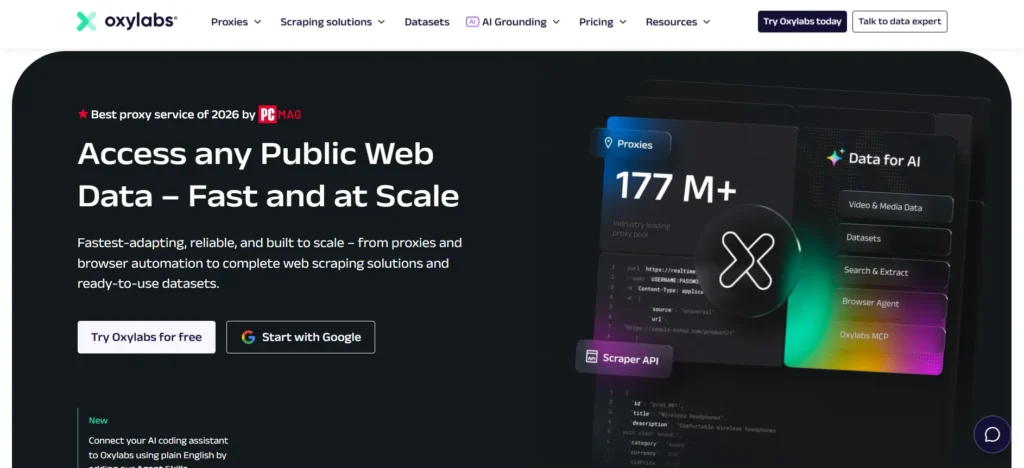
Its ISP proxy network uses IPs associated with premium providers including British Telecom, Comcast, Lumen, Frontier, and other major ISPs. Oxylabs supports unlimited-duration sessions, dynamic rotation, HTTP, HTTPS, SOCKS5, UDP, and TCP.
The current public pricing starts at 10 IPs for $1.60/IP, with the price falling to $1.20/IP at 500 IPs. The service is available in 25 locations, although Oxylabs’ pricing page currently lists 22 locations in the plan summary, so buyers should verify the exact locations available to their account.
Best for: Enterprise scraping and long-running workflows that need premium ISP ASNs, unlimited-duration sessions, high concurrency, and dedicated support.
Oxylabs Highlights
Starter: 10 IPs.
Starter price: $1.60/IP.
Starter monthly cost: $16.
Advanced: 100 IPs.
Advanced price: $1.30/IP.
Advanced monthly cost: $130.
Premium: 500 IPs.
Premium price: $1.20/IP.
Premium monthly cost: $600.
Enterprise: 2,000+ IPs.
Enterprise pricing: Custom.
Locations: 25 listed on product documentation.
ISPs: British Telecom, Comcast, Lumen, Frontier and others.
Protocols: HTTP, HTTPS, SOCKS5.
Transport: UDP and TCP supported.
Sessions: Unlimited duration.
Bandwidth: Unlimited subject to fair-use policy.
Support: 24/7.
Account management: Dedicated account manager.
Integrations: Puppeteer, Selenium, Playwright, Scrapy, AdsPower, GoLogin, Multilogin and Octo Browser.
What You Pay
Plan | IPs | Price/IP | Monthly total |
Starter | 10 | $1.60 | $16 |
Advanced | 100 | $1.30 | $130 |
Premium | 500 | $1.20 | $600 |
Enterprise | 2,000+ | Custom | Custom |
Oxylabs says its pay-per-IP model includes unlimited bandwidth, but the service remains subject to a fair-use policy.
Pros
- Premium ASN sourcing includes BT, Comcast, Lumen and Frontier, giving users access to recognizable ISP networks.
- Unlimited-duration sessions allow the same IP to remain active without a fixed session timeout.
- HTTP, HTTPS, SOCKS5, UDP, TCP, 24/7 support and dedicated account management cover demanding enterprise workflows.
Cons
- The $1.60/IP starting rate requires 10 IPs, so the minimum public commitment is $16/month before taxes.
- Coverage is listed at 25 locations, which is far smaller than the geographic coverage available from rotating residential networks.
Why Oxylabs: Oxylabs combines premium ISP ASNs, unlimited-duration sessions, SOCKS5, unlimited bandwidth subject to fair use, and 24/7 support, making it the strongest choice for demanding long-session workloads.
2. Decodo – Best Value ISP Proxies
Decodo offers one of the broadest pricing structures in the ISP category. The provider describes its ISP proxies as ISP-assigned IPs hosted on high-performance servers, combining residential-style IP identity with datacenter infrastructure.
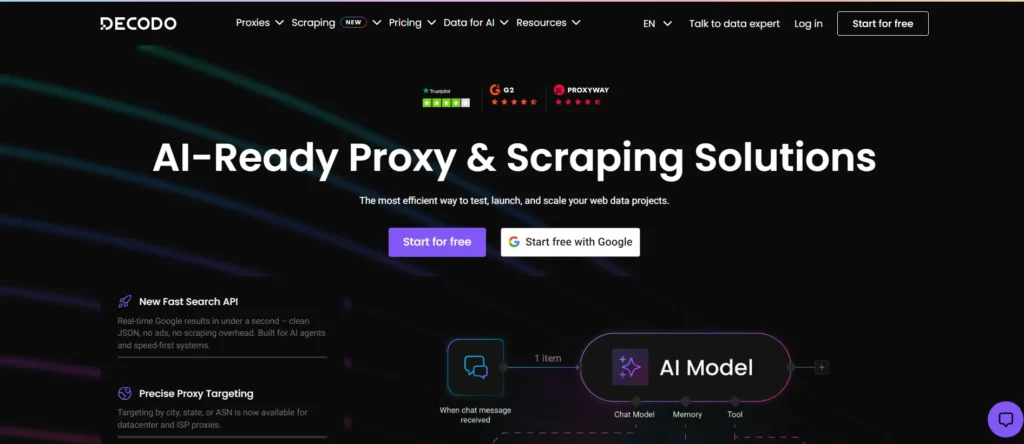
Its current ISP page reports less than 0.2-second response times, 99.99% uptime, premium ASNs, HTTP(S), SOCKS5, and a 3-day free trial with 100MB.
Decodo supports three ISP pricing models: pay per IP, pay per GB, and dedicated IPs. Its dedicated pricing starts at 3 IPs for $3.33/IP, while its general ISP product advertises pricing from $0.27/IP.
Best for: Developers and businesses that want shared or dedicated ISP proxies with low entry pricing and flexible purchasing options.
Decodo Highlights
ISP type: Static residential.
Starting headline: $0.27/IP.
Dedicated minimum: 3 IPs.
Dedicated 3-IP rate: $3.33/IP.
Dedicated 10-IP rate: $2.90/IP.
Dedicated 20-IP rate: $2.80/IP.
Dedicated 50-IP rate: $2.70/IP.
Dedicated 100-IP rate: $2.60/IP.
Dedicated 200-IP rate: $2.50/IP.
Response time: Under 0.2 seconds advertised.
Uptime: 99.99% advertised.
Trial: 3 days.
Trial traffic: 100MB.
Protocols: HTTP(S), SOCKS5.
Authentication: Username/password and IP whitelist.
ASNs: Premium ISP ASNs.
Sessions: Static and persistent.
Concurrency: Unlimited threads and concurrent sessions on the dedicated product.
Money-back: 14 days.
Support: 24/7 technical support.
What You Pay
The current dedicated pricing table lists:
IPs | Price/IP | Monthly total |
3 | $3.33 | $9.99 |
10 | $2.90 | $29 |
20 | $2.80 | $56 |
50 | $2.70 | $135 |
100 | $2.60 | $260 |
200 | $2.50 | $500 |
The broader ISP product displays a $0.27/IP starting figure, so the pricing depends heavily on whether you choose shared pay-per-IP or dedicated ISP IPs.
Pros
- The 3-day, 100MB free trial gives developers a concrete way to test the connection before paying.
- Decodo supports pay-per-IP, pay-per-GB, and dedicated ISP models.
- The provider advertises under 0.2-second response times and 99.99% uptime.
Cons
- The $0.27/IP headline price is not the dedicated-IP price; dedicated IPs start at $3.33/IP for the smallest 3-IP package.
- A 100MB free trial is enough for basic connectivity testing but not a meaningful large-scale scraping benchmark.
Why Decodo: Decodo offers unusually flexible ISP purchasing, with shared and dedicated options, a 3-day/100MB trial, 99.99% advertised uptime, and sub-0.2-second advertised response times.
3. Webshare : Budget-Friendly ISP Proxy Provider
Webshare is the budget-focused option in this comparison. Its current static residential product starts from $0.23/IP, with the public pricing page showing 20 proxies for $6/month, or $0.30/IP. Larger shared packages reduce the unit cost to $0.225/IP at 10,000 proxies.
Webshare separates its static residential products into Premium, Private, and Dedicated tiers. Premium proxies are shared, Private proxies are shared with up to two other customers, and Dedicated proxies are exclusive to one customer.
Best for: Budget-conscious users who need static ISP IPs with simple self-service management.
Webshare Highlights
Starting advertised rate: $0.23/IP.
20-proxy plan: $0.30/IP.
20-proxy monthly total: $6.
500 proxies: $0.285/IP.
1,000 proxies: $0.27/IP.
5,000 proxies: $0.24/IP.
10,000 proxies: $0.225/IP.
Pool: 100K+ ISP proxies.
Uptime: 99.97%.
Aggregate network: 100Gbps.
Maximum speed: Up to 300–400Mbps depending on product.
Protocols: HTTP, SOCKS5.
Free proxies: 10 proxies.
IP types: Premium, Private, Dedicated.
IP identity: Static.
Bandwidth: Plans can include up to unlimited bandwidth subject to fair-use policy.
ISPs: AT&T, Sprint, Cox, Lumen and others.
What You Pay
Package | Price/IP | Monthly total |
20 IPs | $0.30 | $6 |
500 IPs | $0.285 | $142.50 |
1,000 IPs | $0.27 | $270 |
5,000 IPs | $0.24 | $1,200 |
10,000 IPs | $0.225 | $2,250 |
The public page also advertises pricing from $0.23/IP, but the displayed 20-IP package is $0.30/IP, so buyers should treat $0.23 as a configuration-dependent starting figure rather than the price of the smallest plan.
Pros
- The $0.225/IP rate at 10,000 IPs makes Webshare one of the lowest-cost options for large shared ISP allocations.
- Webshare supports Premium, Private, and Dedicated static ISP tiers.
- The network advertises 100Gbps aggregate capacity and 99.97% uptime.
Cons
- The cheapest packages are shared, so they do not provide the same IP exclusivity as dedicated ISP products.
- The lowest advertised price requires 10,000 IPs, producing a $2,250 monthly commitment at the displayed rate.
Why Webshare: Webshare is the price leader for users who need static ISP addresses without enterprise pricing, offering rates down to $0.225/IP at 10,000 IPs and three levels of IP exclusivity.
4. Bright Data – Enterprise ISP Proxy Infrastructure
Bright Data has one of the largest ISP proxy networks in the market. The provider currently advertises 1.3M+ static residential ISP proxies, with ISP IPs available across a broad set of locations. Bright Data’s ISP product includes geo-targeting and both shared and dedicated options.
Its current unlimited ISP pricing starts at $1.80/IP for 10 IPs, falls to $1.30/IP for 1,000 IPs, and supports custom pricing above 1,000 IPs. Bright Data also offers pay-as-you-go ISP traffic at $8/GB.
Best for: Enterprise ISP deployments that need a large network, broad geographic coverage, dedicated IPs, and mature proxy management.
Bright Data Highlights
ISP pool: 1.3M+.
10 IPs: $1.80/IP.
100 IPs: $1.45/IP.
500 IPs: $1.40/IP.
1,000 IPs: $1.30/IP.
10-IP monthly cost: $18.
1,000-IP monthly cost: $1,300.
Pay-as-you-go: $8/GB.
Pay/GB plans: $7/GB, $6/GB and $5/GB at larger commitments.
Fair-use allowance: 100GB/IP/month on unlimited ISP plans.
Uptime: 99.99% network uptime advertised.
Protocols: Proxy protocol options vary by product.
Targeting: Country, city, carrier and ASN capabilities across the broader network.
IP retention: IPs can be kept for life.
Support: 24/7.
Tools: Proxy Manager and broader Bright Data APIs.
Trial: Free trial available.
What You Pay
IPs | Price/IP | Monthly total |
10 | $1.80 | $18 |
100 | $1.45 | $145 |
500 | $1.40 | $700 |
1,000 | $1.30 | $1,300 |
1,000+ | Custom | Custom |
Bright Data’s unlimited ISP plans include a 100GB fair-use allowance per IP per month. Ten IPs therefore provide a combined 1TB allowance under that policy.
Pros
- 1.3M+ ISP IPs gives Bright Data one of the largest dedicated/static ISP infrastructures in the market.
- The price reaches $1.30/IP at 1,000 IPs, giving enterprise buyers a lower unit rate at scale.
- Bright Data combines ISP proxies with Proxy Manager, API tooling, 24/7 support, and enterprise infrastructure.
Cons
- The smallest unlimited package costs $18/month for 10 IPs, which is unnecessary for users who only need one or two addresses.
- "Unlimited" ISP traffic has a 100GB/IP/month fair-use allowance, so 1,000 IPs correspond to 100TB of fair-use traffic rather than unlimited traffic without conditions.
Why Bright Data: Bright Data is the strongest ISP choice for enterprise scale, combining 1.3M+ ISP IPs, 1,000-IP pricing at $1.30/IP, lifetime IP retention, and mature proxy management.
5. IPRoyal : Dedicated ISP Proxies for Long-Term Use
IPRoyal takes a straightforward approach to ISP proxies. Its ISP product provides dedicated IPv4 addresses from premium ISPs, unlimited sessions, HTTP(S), SOCKS5, geo-targeting by country, state and city, and IP-whitelisting support.
The current ISP pricing page lists $1.80/proxy for 24 hours, $2.70/proxy for 30 days, $2.55/proxy for 60 days, and $2.40/proxy for 90 days. The 24-hour product gives short-term users an unusual way to test ISP IPs without immediately purchasing a month.
Best for: Users who need dedicated ISP IPs for stable sessions, account management, automation, and long-running workflows.
IPRoyal Highlights
24 hours: $1.80/proxy.
30 days: $2.70/proxy.
60 days: $2.55/proxy.
90 days: $2.40/proxy.
Product type: Dedicated ISP IPv4.
IP sharing: Not shared.
Sessions: Unlimited.
Threads: Unlimited.
Protocols: HTTP(S), SOCKS5.
Targeting: Country, state, city.
Authentication: IP whitelisting and credentials.
Uptime: 99.9% advertised.
Traffic: Unlimited subject to fair-use policy.
Pool: 500K+ ISP IPs listed by IPRoyal’s general product information.
Support: Available.
Enterprise: Custom plans.
Bulk discounts: Available.
What You Pay
Duration | Starting price |
24 hours | $1.80/IP |
30 days | $2.70/IP |
60 days | $2.55/IP |
90 days | $2.40/IP |
The public pricing page also describes the 24-hour plan as suitable for testing without a long-term commitment.
Pros
- The 24-hour $1.80/IP option provides a short commitment for testing dedicated ISP infrastructure.
- IPRoyal supports country, state, and city targeting, which gives more control than country-only ISP products.
- Dedicated IPs, unlimited sessions, SOCKS5, and IP whitelisting fit long-running account and automation workflows.
Cons
- The 30-day price of $2.70/IP is considerably higher than Webshare's shared $0.30/IP 20-IP configuration.
- The 24-hour rate of $1.80/IP becomes expensive for continuous use if you repeatedly purchase short-duration access.
Why IPRoyal: IPRoyal is a strong choice when you need dedicated ISP IPs with 24-hour, 30-day, 60-day, and 90-day durations, plus unlimited sessions and SOCKS5.
6. NodeMaven – Stable ISP Proxy Sessions
NodeMaven positions its ISP product around quality-verified static residential IPs rather than simply competing on raw pool size.
The provider currently lists ISP proxies from $2.99/IP, with unlimited traffic, HTTP/HTTPS/SOCKS5, UDP support, static residential IPs, a quality guarantee, and included IP swaps.
NodeMaven also describes its broader scraping infrastructure as containing 30M+ clean residential, mobile, and ISP IPs, although that number covers the combined network rather than the ISP pool alone.
Best for: Users prioritizing static ISP identity, IP quality filtering, unlimited traffic, and long-running sessions.
NodeMaven Highlights
Starting ISP price: $2.99/IP.
IP type: Static residential.
Traffic: Unlimited.
Protocols: HTTP, HTTPS, SOCKS5.
UDP: Supported.
Quality filter: Included.
IP swap: Included.
Sessions: Static.
Pricing: Monthly.
Broader proxy network: 30M+ combined residential, mobile and ISP IPs.
Payment: Crypto and card options.
Use cases: Stable sessions, scraping, account management, e-commerce.
Location targeting: Country and city/ISP targeting available.
Quality positioning: Verified IPs.
Support: Professional support.
What You Pay
The current ISP product starts at: $2.99/IP for 30 days.
NodeMaven also displays a discount mechanism for selecting 3+ proxies, but the exact discounted total depends on the quantity and current promotion.
Pros
- NodeMaven includes a quality filter and IP swap with its ISP product.
- Unlimited traffic and UDP support provide more flexibility than traffic-capped static-IP products.
- The provider focuses specifically on quality-verified static residential IPs, which fits long-session workflows.
Cons
- The $2.99/IP starting price is higher than Webshare's shared ISP pricing and Oxylabs' $1.60/IP entry rate.
- The 30M+ number refers to the combined residential, mobile and ISP network, not 30M ISP IPs.
Why NodeMaven: NodeMaven focuses on quality-verified static IPs, unlimited traffic, IP swaps, and UDP, making it a useful option when IP quality and session stability matter more than raw pool size.
7. Rayobyte
Rayobyte stands out because it publishes infrastructure details that many providers leave vague.
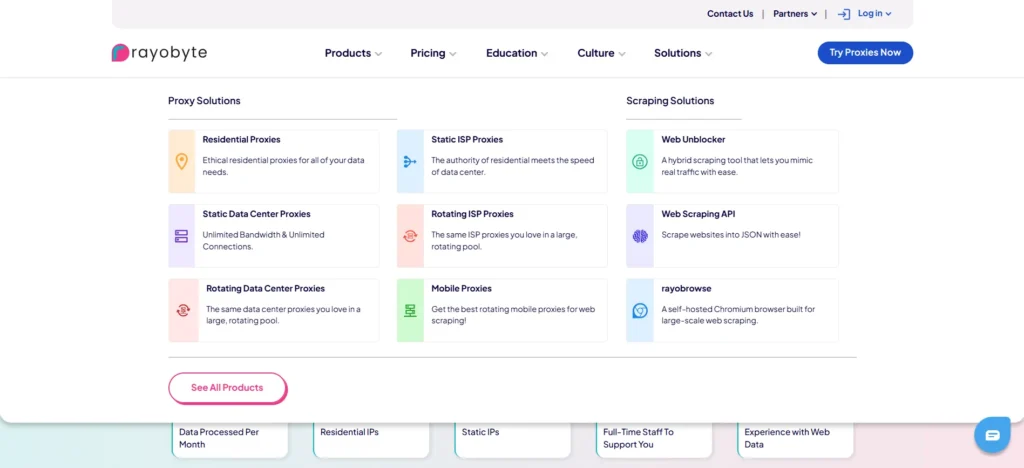
Its current ISP offering includes dedicated ISP proxies from $4.60/IP/month, semi-dedicated ISP proxies from $2.50/IP/month, and rotating ISP proxies from $5/GB. The dedicated product uses real ISP ASNs, while the semi-dedicated product emphasizes C-, A-, and B-class subnet diversity and 1Gbps speeds.
Rayobyte also says its ISP infrastructure can use up to 9 real ISP ASNs, making ASN diversity a core part of its positioning.
Best for: Buyers who need ISP subnet diversity, dedicated or semi-dedicated IPs, and high-speed connections.
Rayobyte Highlights
Dedicated ISP: From $4.60/IP/month.
Semi-dedicated ISP: From $2.50/IP/month.
Rotating ISP: From $5/GB.
ASNs: Up to 9 real ISP ASNs.
Speed: Up to 1Gbps for semi-dedicated ISP.
Subnet types: C-, A-, and B-class.
Protocols: HTTP(S), SOCKS.
Authentication: IP and username/password.
Bandwidth: Unlimited on dedicated ISP.
Connections: Unmetered.
API: Available.
Replacement: Free replacements.
Support: 24/7 live support.
Ethical sourcing: Provider states ISP proxies are ethically sourced.
Location targeting: Available.
Dedicated option: Exclusive IP access.
What You Pay
Product | Starting price |
Dedicated ISP | $4.60/IP/month |
Semi-dedicated ISP | $2.50/IP/month |
Rotating ISP | $5/GB |
Rayobyte’s public pricing therefore varies by the type of ISP access you select.
Pros
- Rayobyte explicitly advertises up to 9 real ISP ASNs, giving buyers a concrete network-diversity metric.
- Semi-dedicated ISP proxies advertise 1Gbps speeds and diversity across C-, A-, and B-class subnets.
- Dedicated ISP plans include unlimited bandwidth and connections, while the platform provides API access and replacements.
Cons
- The $4.60/IP dedicated rate is the most expensive dedicated entry price in this comparison.
- The semi-dedicated product is cheaper at $2.50/IP but sacrifices full exclusivity.
Why Rayobyte: Rayobyte is the specialist choice for ASN and subnet diversity, with up to 9 ISP ASNs, 1Gbps semi-dedicated connections, and dedicated ISP options with unlimited bandwidth.
ISP Proxies vs. Residential Proxies
ISP proxies and rotating residential proxies both use residential-style IP identities, but they solve different problems.
An ISP proxy uses an ISP-assigned IP hosted on a server. The IP generally remains stable, giving you a persistent identity and server-grade performance.
A rotating residential proxy routes requests through IPs associated with real residential devices and changes those IPs between requests or sessions.
The distinction matters.
If your workflow needs:
One stable IP
Persistent logins
Long sessions
Account-specific identity
IP allowlisting
Consistent location
Server-grade speed
then ISP proxies are usually the better fit.
If your workflow needs:
Thousands of different IPs
Frequent rotation
Broad residential diversity
Large-scale collection
Maximum IP variety
then rotating residential proxies are usually more appropriate.
Decodo describes ISP proxies as static IPs that combine ISP identity with datacenter-hosted performance, while Webshare similarly describes static residential proxies as ISP-registered IPs hosted on servers.
ISP Proxies vs. Datacenter Proxies
The easiest way to understand the difference is to look at the IP’s registration.
A conventional datacenter proxy uses an IP associated with a hosting or datacenter network.
An ISP proxy uses an IP associated with an ISP such as AT&T, Comcast, BT, Lumen, or another consumer internet provider, while the actual server hosting the connection remains in a datacenter.
That gives ISP proxies a useful middle ground.
Feature | ISP Proxy | Datacenter Proxy |
IP registration | ISP | Hosting/datacenter |
Hosting | Datacenter | Datacenter |
IP stability | High | High |
Speed | High | Very high |
Residential ASN | Yes | Usually no |
Session persistence | Strong | Strong |
Detection profile | Lower than many datacenter IPs | More recognizable |
Cost | Usually higher | Usually lower |
Best use | Stable identity | High-volume throughput |
Webshare describes this distinction directly: its ISP proxies use residential ISP ASNs while remaining hosted on high-performance servers.
Why ASN Matters for ISP Proxies
An ASN identifies the network responsible for an IP range.
For example, a target can see that an IP belongs to a particular ISP network rather than simply looking at the country.
That makes ASN targeting useful for:
Localized testing
Ad verification
Account workflows
Market research
E-commerce monitoring
Geo-specific QA
Network testing
Bright Data, Oxylabs, Decodo and Rayobyte all emphasize ISP or ASN-level infrastructure in different ways. Oxylabs lists providers including BT, Comcast, Lumen and Frontier, while Rayobyte advertises access to up to 9 real ISP ASNs.
Do not assume that having 100,000 ISP IPs automatically gives you 100,000 independent network identities.
If most IPs belong to the same ASN, your actual network diversity can be much lower.
Dedicated vs. Shared ISP Proxies
This is one of the most important decisions when buying ISP proxies.
Dedicated ISP proxies
A dedicated IP is assigned exclusively to you.
That makes it appropriate for:
Long-term account access
Stable login sessions
IP allowlisting
E-commerce management
Advertising accounts
Persistent automation
Business applications
IPRoyal explicitly describes its ISP addresses as dedicated and not shared.
Shared ISP proxies
Shared ISP proxies can be used by multiple customers.
They generally cost less.
Webshare offers Premium static residential proxies that are shared, Private proxies shared with up to two other customers, and Dedicated proxies that are exclusive to one customer.
The choice is simple:
Need the lowest price? Shared.
Need a consistent identity with no other users? Dedicated.
How to Test ISP Proxies Before Buying
A provider’s advertised uptime or response time does not guarantee the same performance against your target.
Test the actual IPs.
Test 1: Confirm the ASN
Use an IP intelligence service or your own IP database to confirm:
IP
Country
Region
City
ASN
Organization
Connection type
You want the organization and ASN to match the ISP you purchased.
Test 2: Check IP stability
Run the same endpoint repeatedly.
for i in {1..10}; do
curl -x http://USERNAME:PASSWORD@HOST:PORT \
echo
done
A static ISP proxy should normally return the same IP for each request when the endpoint is configured as a sticky/static connection.
Test 3: Measure response time
Use:
curl -x http://USERNAME:PASSWORD@HOST:PORT \
-o /dev/null \
-s \
-w “HTTP %{http_code}\nTotal %{time_total}s\n” \
Run this at least 50 times.
Record:
Average latency
Median latency
95th percentile
Failed connections
HTTP errors
Test 4: Test concurrent connections
If you need 100 concurrent sessions, test 100.
For example:
100 concurrent requests
97 successful
3 failed
Write it in a single line as:
Success Rate = 97 / 100 × 100 = 97%
Do not rely on a provider’s 99.9% advertised success rate if your actual target produces 97%.
How Many ISP Proxies Do You Need?
The answer depends on whether you need identity separation or connection capacity.
For one stable account, 1 dedicated IP may be enough.
For 10 independent accounts, start with:
10 accounts
1 ISP IP per account
= 10 ISP IPs
For 100 independent sessions:
100 sessions
1 IP per identity
= 100 ISP IPs
Do not buy 1,000 IPs simply because the provider offers a lower per-IP price.
If you only need 20 IPs, paying for 1,000 IPs to access a lower unit price can produce a much higher total bill.
For example:
20 IPs × $1.60 = $32
1,000 IPs × $1.30 = $1,300
The unit price falls by $0.30, but the monthly bill increases by $1,268.
Which ISP Proxy Provider Is Cheapest?
The cheapest option depends on whether you want shared or dedicated IPs.
For shared ISP proxies, Webshare currently displays rates as low as $0.225/IP at 10,000 IPs, while its 20-IP configuration is $0.30/IP.
Decodo advertises ISP pricing from $0.27/IP, although its dedicated ISP pricing starts at $3.33/IP for 3 IPs.
For dedicated ISP IPs, Oxylabs starts at $1.60/IP for 10 IPs, while IPRoyal starts at $2.70/IP for 30 days.
NodeMaven starts at $2.99/IP, while Rayobyte’s dedicated ISP product starts at $4.60/IP/month.
So the headline winner depends on the exact product:
Cheapest large shared allocation: Webshare.
Cheapest advertised ISP entry: Decodo.
Lowest dedicated starting price in this comparison: Oxylabs.
Lowest short-term dedicated option: IPRoyal’s $1.80/IP 24-hour product.
Are ISP Proxies Good for Multi-Account Management?
Yes, provided the accounts and activity comply with the relevant platform rules.
The biggest technical advantage is IP persistence.
If an account normally connects from one ISP IP and suddenly moves between 10 countries, that change can create additional security checks.
A static ISP proxy lets an authorized workflow retain one network identity.
For example:
Account A → ISP IP A
Account B → ISP IP B
Account C → ISP IP C
Account D → ISP IP D
This architecture is easier to manage than assigning a rotating residential address to every request.
Decodo specifically describes dedicated static ISP IPs as suitable for managing social media, marketplace, and advertising accounts that require a consistent session identity.
Are ISP Proxies Good for Web Scraping?
ISP proxies work well when the scraper needs stable IP identity plus server-grade performance.
They are particularly useful for:
Long-running crawlers
E-commerce monitoring
Price tracking
SERP workflows
Market research
Ad verification
Logged-in public-data workflows
Repeated requests from a consistent location
However, rotating residential proxies can be better when the target requires a large number of unique residential identities.
The distinction is:
ISP: fewer, more stable identities.
Residential: more diverse, frequently changing identities.
Quick Links :
Final Verdict: Best Shared Proxy Providers
Oxylabs is the best overall ISP proxy provider in 2026. Its current public ISP plans start at $1.60/IP for 10 IPs, fall to $1.20/IP at 500 IPs, support 25 locations, and include premium ISP networks, unlimited-duration sessions, HTTP(S), SOCKS5, UDP and TCP.
Choose Decodo if you want the strongest combination of flexible pricing and developer-friendly features. It advertises under 0.2-second response times, 99.99% uptime, a 3-day/100MB trial, and pricing from $0.27/IP, while dedicated plans start at $3.33/IP.
Choose Webshare if price is your main concern. Its shared ISP pricing reaches $0.225/IP at 10,000 IPs, with Premium, Private, and Dedicated tiers.
Choose Bright Data if you need enterprise scale, with 1.3M+ ISP proxies and pricing from $1.80/IP at 10 IPs down to $1.30/IP at 1,000 IPs.
Choose IPRoyal if you want dedicated IPs with a short-term option, including $1.80/IP for 24 hours and $2.70/IP for 30 days.
Choose NodeMaven if your priority is quality filtering, static identity, unlimited traffic and included IP swaps at $2.99/IP.
Choose Rayobyte if ASN and subnet diversity matter more than the lowest price, with dedicated ISP proxies from $4.60/IP/month and up to 9 real ISP ASNs.
For most buyers starting a new ISP proxy deployment, choose Oxylabs for premium performance, Decodo for value, or Webshare when minimizing cost is the priority.
FAQs About the Best Shared Proxy Providers
Oxylabs is the best overall ISP proxy provider in this comparison, offering premium ISP networks, unlimited-duration sessions, SOCKS5 support, and pricing from $1.60/IP for 10 IPs. Decodo is a strong value alternative, while Webshare offers the lowest shared-IP pricing among the providers reviewed.
An ISP proxy uses an IP address registered to an internet service provider but hosted on server infrastructure. This combines a static IP identity with datacenter-style speed and stability. Decodo and Webshare both describe their ISP products using this model.
ISP proxies are better when you need one stable IP for an extended session, while rotating residential proxies suit workflows requiring multiple changing IPs. ISP proxies can maintain the same identity for weeks or months, whereas residential pools provide greater IP rotation.
ISP proxies can support legitimate multi-account workflows by providing consistent IP identity. Decodo specifically positions dedicated ISP proxies for social media, marketplace, and advertising accounts. However, users should always follow the relevant platform's account and automation policies.
Published prices range from approximately $0.225/IP for large Webshare configurations to $4.60/IP/month for Rayobyte dedicated ISP proxies. Oxylabs starts at $1.60/IP for 10 IPs, IPRoyal at $1.80/IP for 24 hours, and NodeMaven at $2.99/IP. Pricing varies by IP type and allocation.
Yes. Static ISP proxies are designed to provide persistent IP addresses rather than changing after every request. IPRoyal provides dedicated ISP IPv4 addresses, while Decodo describes its static residential IPs as fixed addresses that can remain available as long as required.
