
7 Best Static Residential Proxies in 2026: Providers Compared
Best Static residential proxies are built for one core requirement: consistent IP identity. That makes them useful for account management, long-running sessions, e-commerce workflows, SEO monitoring, ad verification, and allowlisted services.
Decodo

- 115M+ residential IPs
- 195+ global locations
- HTTP(S) & SOCKS5
- Rotating and sticky sessions
- Advanced location targeting
Oxylabs

- 175M+ residential IPs
- 195+ country coverage
- HTTP3 & SOCKS5 support
- Unlimited concurrent sessions
- 24/7 customer support
Bright Data

- 400M+ monthly IPs
- Coverage across 195 countries
- Residential and mobile proxies
- HTTP(S) & SOCKS5
- 99.99% network uptime
This comparison ranks providers based on dedicated IP availability, static duration, bandwidth, IP pool, geographic coverage, protocols, targeting, replacement policies, pricing, and scalability.
Quick Tip for Choosing the Best Static Residential Proxies
Do not compare static residential proxies using $/GB alone.
Static residential services usually charge per IP rather than per gigabyte. A $3/IP provider with unlimited bandwidth can cost less than a $1/GB rotating residential network when a single workflow consumes 50GB.
Before buying, test three things:
Whether the IP remains unchanged for your required session duration.
Whether the IP belongs to the requested ISP and location.
Whether the provider replaces a blocked IP without charging another full monthly fee.
How We Ranked the Best Static Residential Proxies
Static residential proxies require a different ranking system from rotating residential proxies.
For this comparison, we weighted fixed-IP stability, dedicated versus shared allocation, ISP authenticity, bandwidth limits, geographic availability, protocol support, session duration, IP replacement, pricing per IP, concurrency, and ease of management.
We also considered whether the provider publishes enough information for buyers to understand exactly what they are purchasing.
A provider advertising 1M static IPs does not automatically beat a provider with 100K IPs. If the smaller provider offers dedicated IPs, unlimited bandwidth, better location coverage, and a lower monthly cost, it can be the better choice for a fixed-IP workflow.
Best Static Residential Proxies at a Glance
Provider | Best for | Starting price | Static IP pool | Bandwidth |
Decodo | Best overall | $3.33/IP | ISP-origin static pool | Unlimited |
Oxylabs | Enterprise stability | $1.60/IP | 100K+ | Unlimited, fair use |
Bright Data | Largest static network | $1.80/IP | 1.3M+ | Unlimited |
Webshare | Low-cost scaling | $0.30/IP | 100K+ | Up to unlimited |
NodeMaven | Long sessions | $2.99/IP | Location-dependent | Unlimited |
IPRoyal | Flexible durations | $1.80/IP/day | 500K+ class network | Included |
ProxyEmpire | Predictable flat pricing | $3.50/IP | 27 countries | 100GB/IP soft cap |
Prices are based on provider pricing pages checked in September 2026. Promotional discounts, taxes, location availability, and fair-use policies can change.
Here Are the 7 Best Static Residential Proxies in 2026
1. Decodo
Decodo is the strongest overall static residential proxy option when you want a fixed IP without moving into a large enterprise contract.
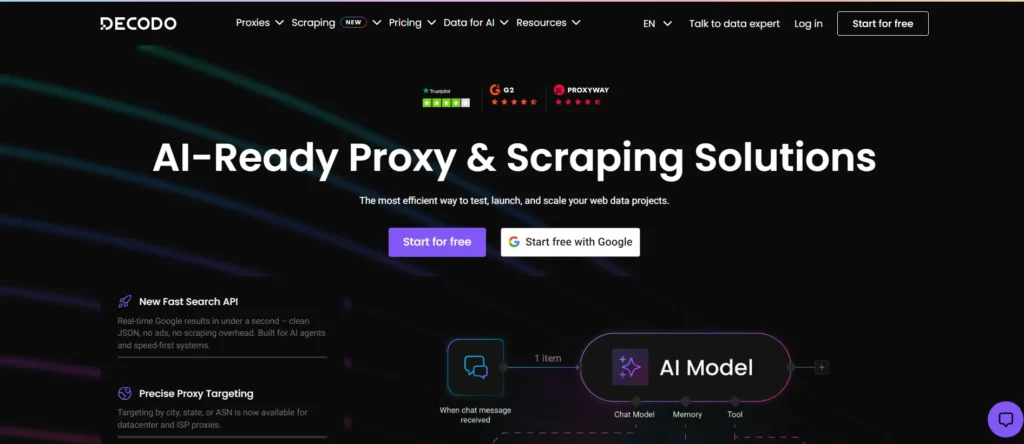
The provider’s current static residential product offers dedicated IPs, ISP-origin addresses, HTTP(S) and SOCKS5 support, unlimited threads and concurrent sessions, and IPs that remain assigned to the customer for as long as needed. Decodo currently lists dedicated plans beginning with 3 IPs at $3.33/IP, while the price falls to $2.50/IP at 200 IPs.
Decodo also offers shared static residential options, including pay-per-IP and pay-per-GB models, which gives smaller users more flexibility than a provider offering only large dedicated packages.
Best for: The best overall combination of dedicated static IPs, pricing, protocols, geographic coverage, and predictable monthly billing.
Decodo Highlights
Static model: Dedicated and shared static residential/ISP.
Starting dedicated plan: 3 IPs.
Entry price: $3.33/IP.
10 IP plan: $2.90/IP, $29/month.
20 IP plan: $2.80/IP, $56/month.
50 IP plan: $2.70/IP, $135/month.
100 IP plan: $2.60/IP, $260/month.
200 IP plan: $2.50/IP, $500/month.
Protocols: HTTP(S) and SOCKS5.
Bandwidth: High bandwidth with unlimited threads and concurrent sessions.
IP ownership: 100% dedicated on dedicated plans.
Locations: US, Canada, UK, Germany, France, Netherlands, Italy, Belgium, Poland, Sweden, Spain, Australia, Hong Kong, Japan, South Korea, and India are among the listed locations.
Support: 24/7 technical support.
Refund: 14-day money-back policy.
IP duration: IPs can be retained indefinitely under the static model.
What You Pay
Decodo’s current dedicated static residential pricing is:
IPs | Price/IP | Monthly total |
3 | $3.33 | $9.99 |
10 | $2.90 | $29 |
20 | $2.80 | $56 |
50 | $2.70 | $135 |
100 | $2.60 | $260 |
200 | $2.50 | $500 |
VAT may apply. Decodo also displays static shared plans from $0.27/IP and bandwidth-based options from $1.30/GB, but those are different products from the dedicated static plan.
Pros
- 3 dedicated IPs for $9.99/month creates a lower entry commitment than many enterprise-focused static providers.
- HTTP(S) and SOCKS5 support covers the two most common proxy connection methods.
- 100% dedicated IPs remove the reputation-sharing problem associated with multi-user static addresses.
Cons
- The $3.33/IP entry price is higher than Webshare's displayed $0.30/IP rate for 20 to 250 IPs.
- The dedicated product currently lists a relatively small set of specific static locations compared with Bright Data's 195-country network.
Why Decodo: Decodo gives most users the cleanest balance between dedicated static IPs, predictable pricing, SOCKS5, HTTP(S), unlimited concurrency, and geographic options without requiring a large enterprise purchase.
2. Oxylabs
Oxylabs is the premium choice for buyers who prioritize infrastructure over the lowest entry price.
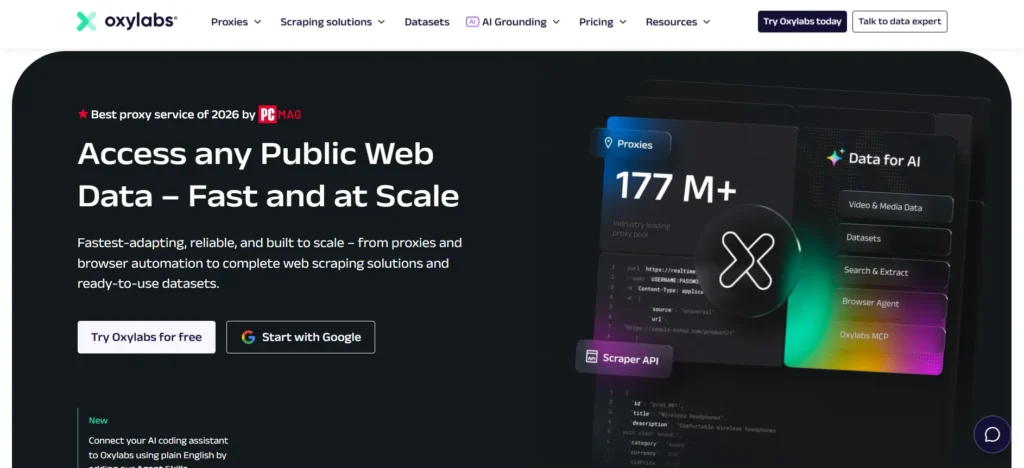
Its static residential product currently advertises 100K+ static residential IPs and supports HTTP, HTTPS, and SOCKS5. The service provides unlimited-duration sessions, unlimited bandwidth subject to fair-use rules, premium ASN providers, and dedicated account managers.
The provider’s current public pricing starts at 10 IPs for $16/month, which works out to $1.60/IP. The 100-IP plan costs $130/month, while 500 IPs cost $600/month.
Best for: Enterprise workloads that need a large static residential pool, unlimited-duration sessions, and dedicated account support.
Oxylabs Highlights
Static pool: 100K+ IPs.
Starting package: 10 IPs.
Starter: $1.60/IP, $16/month.
Advanced: 100 IPs at $1.30/IP, $130/month.
Premium: 500 IPs at $1.20/IP, $600/month.
Enterprise: 2,000+ IPs with custom pricing.
Locations: 25 listed locations on the public plans.
Protocols: HTTP, HTTPS, SOCKS5.
Bandwidth: Unlimited subject to fair-use policy.
Sessions: Unlimited duration.
Support: 24/7 support.
Account management: Dedicated account manager.
Pool sourcing: ISP-assigned IPs.
Shared model: Some IPs may be shared with up to 3 users.
What You Pay
Plan | IPs | Price/IP | Monthly total |
Starter | 10 | $1.60 | $16 |
Advanced | 100 | $1.30 | $130 |
Premium | 500 | $1.20 | $600 |
Enterprise | 2,000+ | Custom | Custom |
Oxylabs states that the static residential plans include unlimited bandwidth subject to fair usage.
Pros
- 100K+ static residential IPs gives enterprise users substantially more inventory than a small fixed-IP provider.
- Unlimited-duration sessions remove an artificial session timeout from long-running workflows.
- The 500-IP plan at $1.20/IP gives high-volume buyers a predictable per-IP cost.
Cons
- The public plans cover 25 locations, so the available geography is narrower than Bright Data's 195-country network.
- The smallest purchase is 10 IPs for $16/month, which can be unnecessary for someone who needs only one or two addresses.
Why Oxylabs: Oxylabs is the stronger choice when you need 100K+ static IPs, unlimited-duration sessions, 24/7 support, and dedicated account management rather than the lowest possible monthly price.
3. Bright Data
Bright Data operates at the largest scale in this comparison. Its current ISP proxy network contains 1.3M+ static residential proxies across 195 countries.
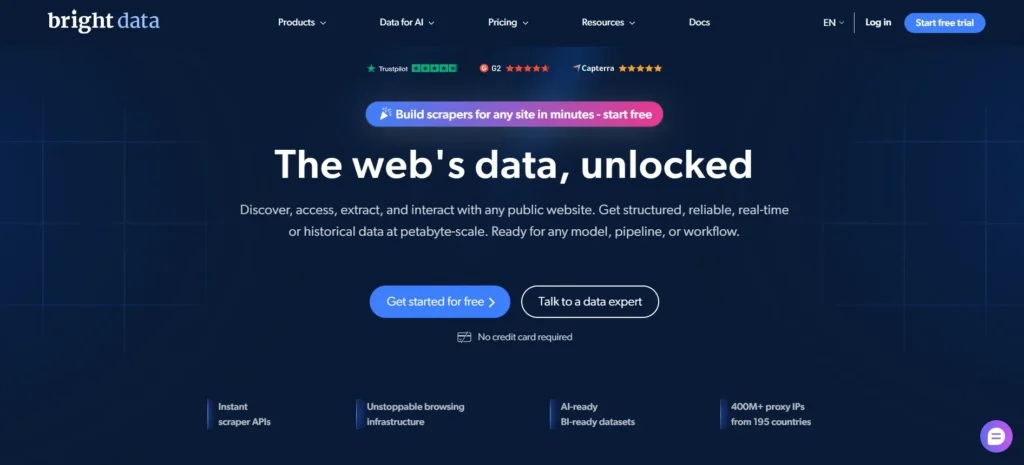
Bright Data offers both shared and dedicated models, country targeting, SOCKS5 support through Proxy Manager, extended session control, API access, and a real-time network status page.
The pricing structure is also unusual because Bright Data offers unlimited static residential proxies priced by IP rather than bandwidth. The current public page lists 10 IPs at $1.80/IP, 100 IPs at $1.45/IP, 500 IPs at $1.40/IP, and 1,000 IPs at $1.30/IP.
Best for: Large organizations that need the biggest static residential/ISP network and broad geographic infrastructure.
Bright Data Highlights
Static pool: 1.3M+ IPs.
Coverage: 195 countries.
10 IPs: $1.80/IP, $18/month.
100 IPs: $1.45/IP, $145/month.
500 IPs: $1.40/IP, $700/month.
1,000 IPs: $1.30/IP.
Model: Shared and dedicated.
Bandwidth: Unlimited plans available.
Targeting: Country-level targeting.
Protocols: HTTP(S), SOCKS5.
Tooling: Proxy Manager and API.
Session control: Extended sessions.
Network monitoring: Real-time status page.
Trial: Free trial available.
Claimed uptime: 99.99% network uptime on the unlimited ISP product.
What You Pay
IPs | Price/IP | Monthly total |
10 | $1.80 | $18 |
100 | $1.45 | $145 |
500 | $1.40 | $700 |
1,000 | $1.30 | $1,300 |
Pros
- 1.3M+ static residential IPs across 195 countries gives Bright Data the largest advertised network in this comparison.
- The $1.30/IP rate at 1,000 IPs makes the platform more competitive for large deployments.
- Proxy Manager, API access, network monitoring, and extended session controls provide tools for teams managing thousands of connections.
Cons
- The $18 minimum public plan requires 10 IPs, which is unnecessary for a one-IP project.
- Bright Data's broader platform includes extensive compliance and configuration requirements that can make onboarding slower than simpler self-service providers.
Why Bright Data: Bright Data is the clear scale leader if your requirement is hundreds or thousands of static residential IPs across a large number of countries.
4. Webshare
Webshare has one of the lowest published static residential prices in this comparison.The current product page lists static residential proxies from $0.30/IP for packages between 20 and 250 IPs.
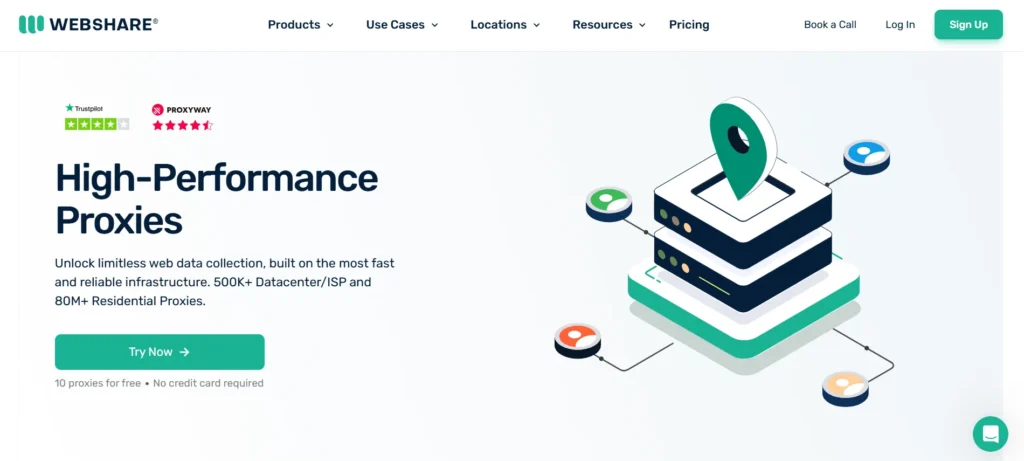
The price drops to $0.285/IP at 500 IPs, $0.27/IP at 1,000 IPs, and $0.225/IP at 10,000 IPs after the displayed discounts.
Webshare says its static residential proxies can reach 1Gbps+, provide up to unlimited bandwidth under its Fair Usage Policy, support 500 to 3,000 threads, and use IPs associated with providers such as Comcast, RCN, AT&T, Sprint, and Lumen.
Best for: Budget-conscious users who want static residential IPs with a low per-IP cost and a simple self-service dashboard.
Webshare Highlights
Static IP pool: 100K+ proxies advertised.
Starting package: 20 IPs.
20 IPs: $0.30/IP, $6/month.
50 IPs: $0.30/IP, $15/month.
100 IPs: $0.30/IP, $30/month.
250 IPs: $0.30/IP, $75/month.
500 IPs: $0.285/IP, $142.50/month after discount.
1,000 IPs: $0.27/IP, $270/month after discount.
2,000 IPs: $0.255/IP, $510/month after discount.
3,000 IPs: $0.24/IP, $720/month after discount.
5,000 IPs: $0.24/IP, $1,200/month after discount.
10,000 IPs: $0.225/IP, $2,250/month after discount.
Speed: Up to 1Gbps+.
Threads: 500 to 3,000.
Protocols: HTTP and SOCKS5.
Bandwidth: Up to unlimited under fair-use terms.
Uptime: 99.97% advertised.
Network: 100Gbps aggregate capacity.
What You Pay
IPs | Base price/IP | Displayed monthly total |
20 | $0.30 | $6 |
50 | $0.30 | $15 |
100 | $0.30 | $30 |
250 | $0.30 | $75 |
500 | $0.285 | $142.50 |
1,000 | $0.27 | $270 |
2,000 | $0.255 | $510 |
3,000 | $0.24 | $720 |
5,000 | $0.24 | $1,200 |
10,000 | $0.225 | $2,250 |
Pros
- The 20-IP plan costs $6/month, giving Webshare one of the lowest published entry prices in this comparison.
- The $0.225/IP rate at 10,000 IPs is dramatically below premium providers charging $1 to $3/IP.
- HTTP and SOCKS5, API access, 500 to 3,000 threads, and up to 1Gbps+ speeds cover common technical workflows.
Cons
- The smallest listed package is 20 IPs, so Webshare does not make sense if you need exactly one static residential IP.
- "Up to unlimited" bandwidth is subject to a Fair Usage Policy, so the headline bandwidth claim is not an unlimited-use guarantee.
Why Webshare: Webshare is the strongest budget choice when you need 20 or more static residential IPs and care more about low monthly cost than enterprise account management.
5. NodeMaven
NodeMaven focuses heavily on the stability advantage of static ISP proxies. Its static residential product starts at $2.99/IP and includes unlimited traffic, HTTP and SOCKS5 support, UDP support, long-lasting sessions, and IP quality checks.
NodeMaven says each static proxy is quality-checked using Scamalytics and includes 1 IP swap in the dashboard.
The provider also advertises 99.9% uptime, less than 0.3-second average speed, and a 95% IP clean rate for its static residential service. These are provider-reported figures, so they should be treated as service claims rather than independent benchmark results.
Best for: Long-running sessions, account workflows, and users who want dedicated static IPs with unlimited traffic.
NodeMaven Highlights
Starting price: $2.99/IP.
Billing: Per IP.
Duration: 30 or 90 days.
Bandwidth: Unlimited.
Protocols: HTTP and SOCKS5.
Additional protocol: UDP.
Uptime claim: 99.9%.
Average speed claim: Under 0.3 seconds.
IP clean-rate claim: 95%.
IP replacement: 1 IP swap included.
Quality testing: Scamalytics.
Locations: US, Germany, UK, Poland, Hong Kong, Brazil, and additional locations.
Trial: $3.50 paid trial is advertised for NodeMaven’s proxy products.
Custom plans: Available for 1,000+ GB plans across its proxy portfolio.
What You Pay
NodeMaven currently lists:
Static ISP: From $2.99/IP.
Duration: 30 or 90 days.
Traffic: Unlimited.
IP swap: 1 included.
The exact price for larger IP quantities varies according to country and quantity, so the $2.99/IP figure should be treated as the entry price rather than a universal price.
Pros
- Unlimited traffic removes per-GB accounting from static proxy budgeting.
- 1 included IP swap gives users a replacement mechanism if an allocated IP becomes unusable.
- NodeMaven explicitly quality-checks static IPs using Scamalytics before allocation.
Cons
- The $2.99/IP starting rate is higher than Webshare's $0.30/IP starting package.
- NodeMaven's static proxy coverage is more location-dependent, so buyers should confirm availability for their required country before purchasing.
Why NodeMaven: NodeMaven is a good fit when a workflow needs a stable IP for extended periods and the buyer values unlimited traffic, IP quality checks, and an included IP replacement.
6. IPRoyal
IPRoyal approaches static residential proxies with unusually flexible duration choices. Its current ISP proxy product offers 24-hour, 30-day, 60-day, and 90-day options.
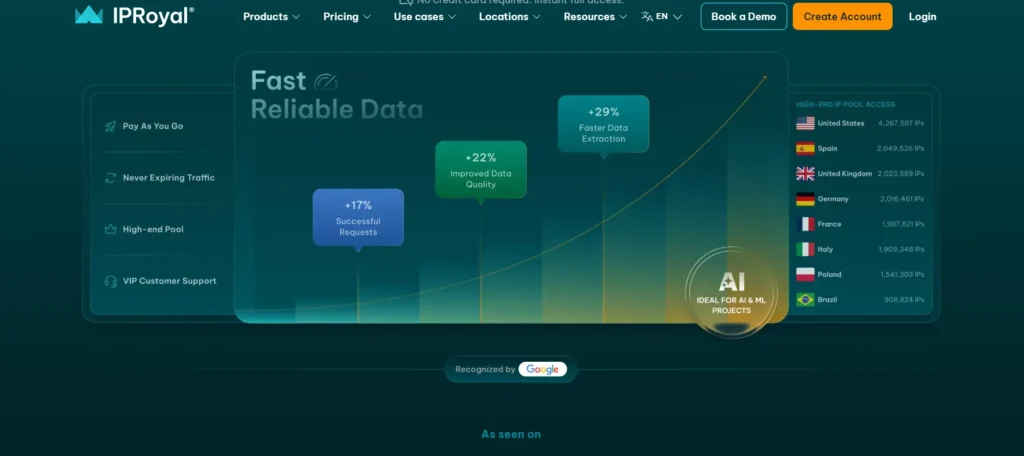
Pricing starts at $1.80/proxy for 24 hours, $2.70/proxy for 30 days, $2.55/proxy for 60 days, and $2.40/proxy for 90 days.
The provider also lists detailed IP counts by country. For example, its current page shows 135,681 US IPs, 77,724 UK IPs, 45,921 French IPs, and 45,488 German IPs.
That makes IPRoyal particularly useful when the user knows the exact duration required rather than wanting an indefinite monthly subscription.
Best for: Buyers who want static ISP proxies with multiple duration options and a low-cost short-term testing period.
IPRoyal Highlights
24-hour: From $1.80/proxy.
30-day: From $2.70/proxy.
60-day: From $2.55/proxy.
90-day: From $2.40/proxy.
Locations: 31+.
US pool: 135,681 IPs listed.
UK pool: 77,724 IPs listed.
France: 45,921 IPs listed.
Germany: 45,488 IPs listed.
Australia: 17,097 IPs listed.
Japan: 8,402 IPs listed.
Protocols: HTTP(S) and SOCKS5.
Sessions: Unlimited.
Success-rate claim: Up to 99.99%.
Dashboard: Self-service.
Bulk discounts: Available.
Documentation: Quick-start guides and API documentation.
What You Pay
Duration | Starting price |
24 hours | $1.80/IP |
30 days | $2.70/IP |
60 days | $2.55/IP |
90 days | $2.40/IP |
Enterprise pricing is available for larger deployments.
Pros
- The 24-hour $1.80/IP option makes IPRoyal useful for short-term static IP tests.
- The 90-day $2.40/IP rate gives users a lower daily effective cost for longer deployments.
- IPRoyal publishes individual country pool counts, including 135,681 US IPs and 77,724 UK IPs, which gives buyers more visibility into available inventory.
- Regular updates
Cons
- The $2.70/IP 30-day rate is considerably higher than Webshare's $0.30/IP entry rate.
- The public static network lists 31+ locations, far fewer than Bright Data's 195-country footprint.
Why IPRoyal: IPRoyal is the strongest choice when static IP duration matters. Its 24-hour, 30-day, 60-day, and 90-day options let you buy the exact commitment period instead of automatically committing to a longer plan.
7. ProxyEmpire
ProxyEmpire is particularly straightforward about what its static residential product provides.
Its current static residential network covers 27 countries, with each IP assigned exclusively to the customer during the subscription. Pricing starts at $3.50/IP/month for a single IP and drops to $2/IP/month at 2,000 IPs.
ProxyEmpire advertises unlimited traffic with an important qualification: the service applies a 100GB monthly soft cap per IP under its Fair Use Policy. That qualification matters because the headline “unlimited traffic” should not be interpreted as unlimited high-volume traffic without conditions.
Best for: Users who want dedicated static residential IPs, flat monthly pricing, and predictable traffic costs.
ProxyEmpire Highlights
Coverage: 27 countries.
Dedicated: Each static IP is exclusively assigned to the customer.
1 IP: $3.50/month.
5 IPs: $3/IP, $15/month.
10 IPs: $2.90/IP, $29/month.
20 IPs: $2.80/IP, $56/month.
50 IPs: $2.70/IP, $135/month.
100 IPs: $2.60/IP, $260/month.
200 IPs: $2.50/IP, $500/month.
300 IPs: $2.40/IP, $720/month.
500 IPs: $2.30/IP, $1,150/month.
1,000 IPs: $2.20/IP, $2,200/month.
1,500 IPs: $2.10/IP, $3,150/month.
2,000 IPs: $2/IP, $4,000/month.
Traffic: Unlimited under Fair Use Policy.
Soft cap: 100GB/month/IP.
Billing: Monthly.
Protocols/tooling: cURL, Python, Node.js, PHP, Java, Go and other integrations are documented.
Use cases: Account continuity, QA, SEO monitoring, market research, and long-running business workflows.
What You Pay
IPs | Price/IP | Monthly total |
1 | $3.50 | $3.50 |
5 | $3.00 | $15 |
10 | $2.90 | $29 |
20 | $2.80 | $56 |
50 | $2.70 | $135 |
100 | $2.60 | $260 |
200 | $2.50 | $500 |
300 | $2.40 | $720 |
500 | $2.30 | $1,150 |
1,000 | $2.20 | $2,200 |
1,500 | $2.10 | $3,150 |
2,000 | $2.00 | $4,000 |
ProxyEmpire explicitly states that its unlimited traffic is subject to a 100GB monthly soft cap per IP and its Fair Use Policy.
Pros
- One dedicated static residential IP costs $3.50/month, so users can start with a single address.
- Every IP remains exclusively assigned to the customer during the subscription.
- The price falls to $2/IP at 2,000 IPs, creating predictable costs for larger deployments.
Cons
- The network covers only 27 countries, which is significantly narrower than Bright Data's 195-country static network.
- The 100GB/IP monthly soft cap means the "unlimited" traffic claim has a concrete fair-use threshold.
Why ProxyEmpire: ProxyEmpire makes the most sense when you want one or more dedicated static residential IPs, a flat monthly price, and a clearly stated 100GB/IP soft-cap framework.
Static Residential Proxy Decision Matrix
The best static residential proxy depends heavily on how many IPs you need.
If you need 1 IP, ProxyEmpire is one of the simplest choices because it explicitly sells a single dedicated IP for $3.50/month. IPRoyal can also work if you only need the IP for 24 hours, with its starting price of $1.80/IP/day.
If you need 3 to 10 dedicated IPs, Decodo is particularly attractive. Its 3-IP plan costs $9.99/month, while 10 dedicated IPs cost $29/month.
If you need 20 to 250 IPs at the lowest possible monthly cost, Webshare deserves the first test. Its public pricing starts at $0.30/IP, with 20 IPs costing $6/month and 250 IPs costing $75/month.
If you need 100 to 500 IPs with enterprise support, Oxylabs becomes more attractive. Its 100-IP plan costs $130/month, while 500 IPs cost $600/month, with unlimited-duration sessions and 24/7 support.
If you need hundreds or thousands of IPs across many countries, Bright Data has the strongest network scale. Its ISP network exceeds 1.3M static residential IPs across 195 countries.
If you need long sessions and unlimited traffic, NodeMaven and Oxylabs are particularly relevant. NodeMaven starts at $2.99/IP with unlimited traffic, while Oxylabs provides unlimited-duration sessions with unlimited bandwidth subject to fair use.
Static Residential vs. Rotating Residential Proxies
The fundamental difference is IP continuity.
A rotating residential proxy can change the IP between requests or sessions. This makes it useful when you want a large number of different residential identities.
A static residential proxy keeps the same IP assigned to you for an extended period. This makes it useful when changing IPs would cause the target to treat the connection as a new device or user.
Choose static residential proxies when you need:
Stable account access
Consistent login sessions
IP allowlisting
Long-running browser sessions
E-commerce account workflows
SEO monitoring from a fixed location
Ad verification from a consistent IP
Persistent business applications
Choose rotating residential proxies when you need:
Large IP diversity
High-volume independent requests
Frequent IP changes
Broad residential coverage
Scraping workloads where each request can use a different identity
Webshare explicitly describes static residential proxies as fixed IP addresses suitable for workflows such as logged-in portals, gated catalogs, cart simulation, and multi-step checkout simulations.
Dedicated vs. Shared Static Residential Proxies
Not every static residential IP is dedicated.
A dedicated static IP is assigned to one customer.
A shared static IP can be used by multiple customers.
The difference matters because reputation is attached to the IP.
With a dedicated address, another customer’s activity cannot directly affect the IP’s reputation. With a shared address, multiple users contribute to the IP’s history.
Decodo’s dedicated plans provide 100% dedicated IPs, while Oxylabs states that some of its static residential IPs can be shared with up to 3 users. Webshare also distinguishes private static residential proxies from dedicated static residential proxies.
For account-sensitive workflows, dedicated IPs are generally the safer choice.
For high-volume testing where reputation is less important, shared IPs can reduce cost.
How to Test Static Residential Proxies
Do not buy 100 static IPs before testing the provider.
Start with the smallest available package.
1. Check IP persistence
Use cURL:
curl -x http://USERNAME:PASSWORD@PROXY_HOST:PROXY_PORT \
https://api.ipify.org?format=json
Record the IP.
Repeat the request five times.
A properly configured static endpoint should return the same address during the intended allocation period.
2. Check the ISP
Do not stop at the IP address.
Check the returned IP using an independent IP intelligence database and record:
Country
State
City
ISP
ASN
Organization
Proxy classification
The objective is to confirm that the IP has the expected residential or ISP characteristics.
3. Test latency
Run 20 requests and calculate:
Average latency =
Total request time / 20
Do not compare only the fastest response.
Record the:
Minimum
Maximum
Average
Median
95th percentile
A provider reporting a 0.3-second average does not mean every request will finish in 0.3 seconds. NodeMaven, for example, currently advertises less than 0.3-second average speed for its static product.
4. Test bandwidth
Static residential proxies are often sold with unlimited or high bandwidth.
Run a controlled download and upload test.
For example:
curl -x http://USERNAME:PASSWORD@PROXY_HOST:PROXY_PORT \
-o /dev/null \
https://speed.hetzner.de/100MB.bin
Repeat the test at different times.
Record:
Download speed
Connection time
Transfer time
Proxy IP
Timestamp
This gives you a practical speed measurement rather than relying exclusively on the provider’s marketing number.
5. Test IP reputation
A static IP that has already been flagged can be worse than a rotating residential address.
Test at least 5 IPs before purchasing a larger block.
For every IP, record:
Proxy detection
ASN
ISP
Country
Reputation score
CAPTCHA frequency
HTTP errors
Target response
If 2 out of 5 IPs fail your target, investigate the provider’s replacement policy before scaling.
How Many Static Residential IPs Do You Need?
The answer depends on the number of identities your workflow requires.
If one business account requires one persistent IP, start with 1 IP.
If you operate 10 independent account sessions, a logical starting test is 10 IPs.
If you operate 100 sessions, test a pool of at least 100 IPs if every session must maintain a unique IP identity.
Do not automatically buy one IP for every browser tab. The correct ratio depends on whether the target ties identity to IP, cookies, browser fingerprints, accounts, or multiple signals.
For account-sensitive workflows, maintaining a stable mapping such as:
Account A → IP 01
Account B → IP 02
Account C → IP 03
is usually easier to troubleshoot than allowing the same static IP to serve unrelated identities.
What Does “Unlimited Bandwidth” Actually Mean?
This is one of the most important questions to ask before buying static residential proxies.
“Unlimited” can mean different things.
Oxylabs states that its static residential plans include unlimited bandwidth subject to fair usage.
Webshare describes its static residential bandwidth as up to unlimited, also subject to a Fair Usage Policy.
ProxyEmpire goes further by explicitly stating a 100GB monthly soft cap per IP despite describing traffic as unlimited.
That distinction matters.
If you use 5GB/IP/month, a 100GB soft cap is unlikely to matter.
If you use 150GB/IP/month, it becomes a critical purchasing consideration.
Always read the fair-use terms before assuming an unlimited static plan supports unlimited high-volume traffic.
Are Static Residential Proxies Worth the Higher Price?
For some workloads, yes.
Suppose you need one IP for an application that checks the source address every time you log in.
A rotating residential plan could change the IP and trigger another verification step.
A static IP avoids that specific problem.
The calculation is therefore not:
Static proxy price vs. rotating proxy price
It is:
Cost of static proxy
vs.
Cost of interruptions caused by changing IPs
If a fixed IP prevents repeated authentication, session resets, or account verification, the additional monthly cost can be justified.
For independent web requests where IP continuity has no value, paying for a static address may simply waste money.
Static Residential Proxy Pricing Comparison
The current entry prices show why there is no single “cheapest” provider for every deployment size.
Webshare is the lowest-cost option for larger fixed-IP quantities, starting at $0.30/IP for 20 to 250 IPs and reaching $0.225/IP at 10,000 IPs.
Bright Data starts at $1.80/IP for 10 IPs and reaches $1.30/IP at 1,000 IPs.
Oxylabs starts at $1.60/IP for 10 IPs and reaches $1.20/IP for 500 IPs.
IPRoyal starts at $1.80/IP for 24 hours, $2.70/IP for 30 days, and $2.40/IP for 90 days.
NodeMaven starts at $2.99/IP with unlimited traffic.
Decodo starts at $3.33/IP for 3 dedicated IPs and falls to $2.50/IP at 200 IPs.
ProxyEmpire starts at $3.50/IP/month for one dedicated static residential IP and reaches $2/IP at 2,000 IPs.
The cheapest headline price therefore belongs to Webshare, while Decodo has the most attractive small dedicated-IP package among the providers with clearly published dedicated pricing.
Final Verdict: The Best Static Residential Proxies in 2026
Decodo is the best overall static residential proxy provider for most users. Its dedicated plans start at 3 IPs for $9.99/month, support HTTP(S) and SOCKS5, provide 100% dedicated IPs, and offer unlimited threads and concurrent sessions.
Choose Bright Data if you need the largest network. Its 1.3M+ static residential IPs across 195 countries give it a clear advantage for large geographic deployments.
Choose Oxylabs if enterprise support, unlimited-duration sessions, and a 100K+ static IP pool matter more than the lowest possible price.
Choose Webshare if price is your primary concern. Its static residential plans start at $0.30/IP and fall to $0.225/IP at 10,000 IPs.
Choose NodeMaven if long-running sessions and unlimited traffic are the priority. Choose IPRoyal if you want to buy static IPs for exactly 24 hours, 30 days, 60 days, or 90 days. Choose ProxyEmpire if you want a single dedicated IP with a transparent $3.50/month starting price.
If you are starting a new static residential project today, test Decodo first, then benchmark Webshare if your workload requires 20 or more IPs.
FAQs About the Best Static Residential Proxies
Decodo is the best overall choice for most static residential workloads, with dedicated plans from $3.33/IP and support for HTTP(S), SOCKS5, unlimited concurrency, and dedicated ISP-origin IPs. For larger deployments, Bright Data offers 1.3M+ static residential IPs across 195 countries, while Oxylabs offers 100K+.
Webshare has the lowest published per-IP pricing among the providers compared, starting at $0.30/IP for 20–250 IPs and dropping to $0.225/IP at 10,000 IPs. However, the lowest rate requires purchasing at least 20 IPs, so it may not be cheapest for smaller requirements.
Static residential proxies are better when you need the same IP for an extended period, while rotating proxies suit workflows that benefit from changing IPs. Static proxies are commonly used for stable account access, long sessions, IP allowlisting, and workflows where IP changes trigger additional verification.
Duration varies by provider and product. Oxylabs advertises unlimited-duration sessions, while IPRoyal offers 24-hour, 30-day, 60-day, and 90-day periods. NodeMaven provides 30- or 90-day plans. Check whether the provider guarantees IP persistence throughout the subscription or only during individual sessions.
Some providers advertise unlimited bandwidth, but fair-use policies can apply. Oxylabs and Webshare both have fair-use conditions, while ProxyEmpire lists a 100GB monthly soft cap per IP despite offering unlimited traffic. If your workload exceeds 100GB/IP/month, verify the provider's limits before purchasing.
Decodo, Oxylabs, NodeMaven, IPRoyal, and ProxyEmpire all offer static ISP/residential products suited to persistent IP workflows. The best choice depends on IP quantity, location, duration, and replacement policy. IPRoyal offers 24-hour to 90-day periods, while NodeMaven offers 30- or 90-day plans.
