
7 Best Datacenter Proxy Providers in 2026: Providers Compared
The Best Datacenter Proxy Providers can deliver high speed and concurrency, but their real value depends on IP diversity, geographic coverage, subnet separation, session control, and bandwidth. Pricing can also be misleading when comparing per-IP and per-GB models.
Oxylabs
- 175M+ residential IPs
- 195+ country coverage
- HTTP3 & SOCKS5 support
- Unlimited concurrent sessions
- Unlimited concurrent sessions
Decodo

- 115M+ residential IPs
- 195+ global locations
- HTTP(S) & SOCKS5
- Rotating and sticky sessions
- 24/7 customer support
Bright Data

- 400M+ monthly IPs
- Coverage across 195 countries
- Residential and mobile proxies
- HTTP(S) & SOCKS5
- 99.99% network uptime
This guide compares 7 best datacenter proxy providers across IP allocation, rotation, protocols, targeting, concurrency, replacement policies, pricing, and developer tooling to identify the best options for different workloads.
Quick Tip for Choosing the Best Datacenter Proxy Providers
Choose the billing model before choosing the provider.
If you need a fixed list of IPs for SEO tools, account management, or allowlisting, a pay-per-IP dedicated datacenter plan is usually easier to budget.
If you need millions of requests and do not care which IP handles each request, a pay-per-GB rotating pool can be cheaper.
If you need both, compare the same workload under both models before committing.
How We Ranked the Best Datacenter Proxy Providers
Datacenter proxies have a different performance profile from residential proxies, so the ranking focuses on factors that matter specifically to server-hosted IPs.
We evaluated:
IP pool size: Number of available datacenter IPs.
Subnet diversity: Number of networks and C-class ranges available.
Dedicated IP availability: Whether an IP belongs exclusively to one customer.
Rotation: Automatic rotation, sticky sessions, and static sessions.
Bandwidth: Unlimited, pay-per-GB, or traffic-capped models.
Concurrency: Maximum threads or concurrent sessions.
Geographic coverage: Countries, cities, states, and ASNs available.
Protocols: HTTP, HTTPS, SOCKS5, and other supported protocols.
Replacement policy: Whether blocked or unusable IPs can be replaced.
Tooling: APIs, browser extensions, proxy managers, and integrations.
Price: Actual published pricing rather than generic “starting from” claims.
We did not rank providers simply by IP count. A 2M-IP network is not automatically better than a 300K-IP network if the smaller pool offers more useful subnet diversity for your target.
Best Datacenter Proxy Providers at a Glance
Provider | Best for | Starting price | IP pool | Pricing model |
Oxylabs | Best overall | $1.20/IP | 2M+ | Per IP / GB |
Decodo | Best price/features balance | $0.02/IP* | 100K+ shared | Per IP / GB |
Webshare | Budget users | $0.018/IP | Large shared pool | Per IP / GB |
Bright Data | Enterprise scale | $0.90/IP at 1,000 | 1.3M+ | Per IP / GB |
Rayobyte | Dedicated IP control | $2.50/IP | 300K+ | Per IP |
IPRoyal | Dedicated datacenter IPs | $1.39/IP | 60+ locations | Per IP |
DataImpulse | Pay-as-you-go traffic | $0.50/GB | 20M | Per GB |
*Decodo’s $0.02/IP headline is the current starting rate shown on its datacenter pricing page. The actual pay-per-IP configuration depends on IP quantity and traffic requirements.
The 7 Best Datacenter Proxy Providers in 2026
Below is our list of the Best Datacenter Proxy Providers, compared based on IP quality, geographic coverage, pricing, protocols, targeting, concurrency, and scalability.
1. Oxylabs
Oxylabs is the strongest overall choice for organizations that want datacenter infrastructure without sacrificing control.
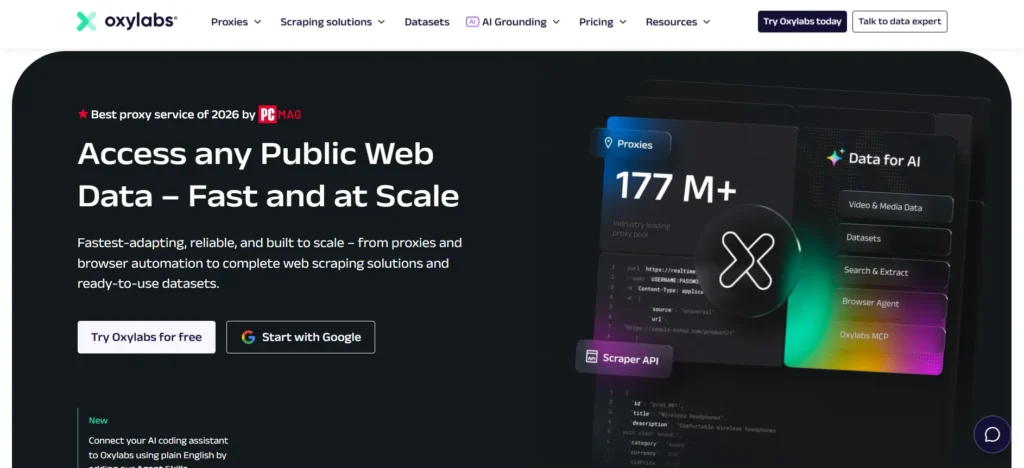
Its current datacenter network contains 2M+ IPs across 188 countries, with dedicated, shared, and pay-per-GB products. Oxylabs reports a 0.222-second response time, 99.9% success rate, and 99.9% uptime for the datacenter portfolio.
The provider separates its products into dedicated datacenter proxies, shared pay-per-IP proxies, and shared pay-per-GB proxies. That makes it possible to choose a billing model based on workload rather than forcing every customer into the same type of proxy.
Best for: Large-scale scraping that needs a combination of dedicated IPs, broad geographic coverage, high concurrency, and enterprise support.
Oxylabs Highlights
Total pool: 2M+ IPs.
Coverage: 188 countries.
Dedicated pool: 1.9M+ IPs.
Dedicated starting price: $2.25/IP on the public calculator.
Dedicated minimum: 3 IPs.
Dedicated minimum total: $6.75/month.
Shared pay-per-IP pool: 36K+ IPs.
Shared pay-per-IP: $1.20/IP.
Shared pay-per-GB pool: 56K+ IPs.
Shared pay-per-GB: $0.59/GB.
Dedicated bandwidth: Unlimited with fair-use terms.
Protocols: HTTP, HTTPS, SOCKS5.
Response time: 0.222 seconds advertised.
Success rate: 99.9% advertised.
Uptime: 99.9% advertised.
Support: 24/7 expert support.
Account management: Dedicated account manager.
Integrations: Selenium, Puppeteer, Playwright, Scrapy, Multilogin, AdsPower, Octoparse, SwitchyOmega and others.
What You Pay
Oxylabs currently displays these public starting points:
Product | Starting quantity | Starting price |
Dedicated | 3 IPs | $2.25/IP |
Shared pay-per-IP | 10 IPs | $1.20/IP |
Shared pay-per-GB | 20GB | $0.59/GB |
Enterprise | Custom | Custom |
The dedicated product’s public calculator allows quantities from 3 to 3,000 IPs. The shared pay-per-IP product starts at 10 IPs, while the pay-per-GB product starts at 20GB.
Pros
- 2M+ IPs across 188 countries gives Oxylabs one of the broadest datacenter networks in this comparison.
- 0.222-second advertised response time gives the service a strong performance profile for latency-sensitive workloads.
- The ability to choose dedicated, shared per-IP, or shared per-GB products lets teams match the proxy architecture to the workload.
Cons
- Dedicated proxies start at $2.25/IP, making Oxylabs considerably more expensive than Decodo or Webshare for budget deployments.
- The public shared pay-per-IP product has only 36K+ IPs across 38 countries, much smaller than the dedicated pool.
Why Oxylabs: Oxylabs is the safest all-round choice when a datacenter deployment needs 2M+ IPs, 188-country coverage, 0.222-second advertised response times, dedicated options, and enterprise support.
2. Decodo
Decodo has one of the most flexible datacenter pricing structures in this comparison.
The provider offers pay-per-GB, pay-per-IP shared, and dedicated datacenter proxies. Its public pricing page currently lists starting rates of $0.60/GB, $0.10/IP for shared pay-per-IP, and $2.50/IP for dedicated datacenter proxies.
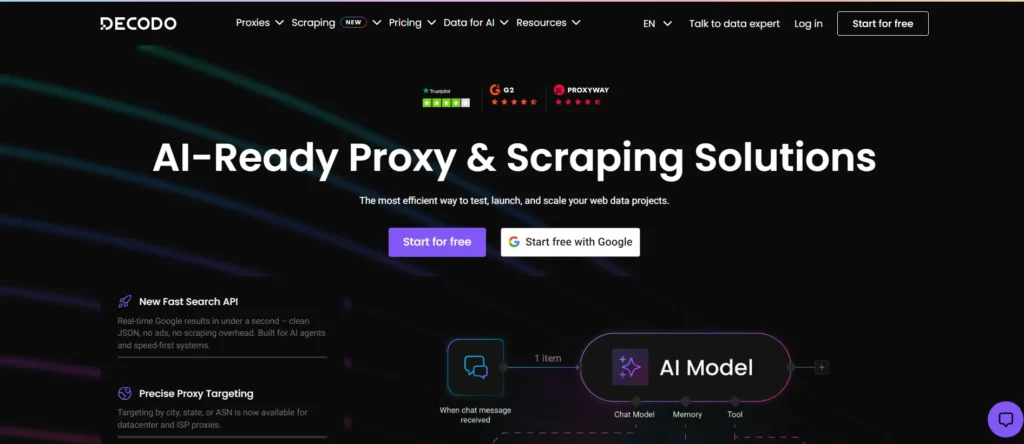
Its broader product page also displays a $0.02/IP starting figure, which appears to represent the lowest available configuration rather than the standard dedicated rate.
That distinction is important for buyers. Decodo’s cheapest headline number should not be interpreted as the standard price for dedicated IPs.
Best for: Developers and data teams looking for a strong feature-to-price ratio across shared and dedicated datacenter proxies.
Decodo Highlights
Shared IP pool: 100K+ rotating and static shared IPs.
Pay-per-GB starting rate: $0.60/GB.
Pay-per-IP starting rate: $0.10/IP.
Dedicated starting rate: $2.50/IP.
Pay-per-IP minimum: 100 IPs.
Pay-per-GB minimum: 10GB.
Locations: US, Canada, Brazil, UK, Germany, Italy, Netherlands, Romania, France, Turkey, Israel, Australia, Japan, Hong Kong, China, India, South Korea, and Singapore are listed for the standard datacenter products.
Protocols: HTTP(S), SOCKS5.
Response time: Under 0.3 seconds advertised.
Uptime: 99.99% advertised.
Support: 24/7 technical support.
Money-back: 14 days.
Tooling: Chrome, Firefox, FoxyProxy, SwitchyOmega, API and integration guides.
Clients: 135K+ claimed.
Dedicated model: Private IP addresses.
Traffic: Dedicated plans include unlimited traffic.
Concurrent sessions: Unlimited.
What You Pay
Product | Starting price |
Pay per GB | $0.60/GB |
Shared pay per IP | $0.10/IP |
Dedicated | $2.50/IP |
The pay-per-IP product starts from 100 IPs, while pay-per-GB starts from 10GB.
The public pay-per-GB plans currently show:
250GB: $0.51/GB, $127.50/month
500GB: $0.48/GB, $240/month
1,000GB: $0.45/GB, $450/month
These rates are monthly and may have VAT added.
Pros
- Decodo supports three billing models, allowing users to choose between traffic-based, shared-IP, and dedicated-IP pricing.
- Its shared network contains 100K+ rotating and static shared IPs, while the platform advertises under 0.3-second response times.
- HTTP(S), SOCKS5, browser extensions, API tools, and 14-day money-back protection make the service accessible to developers and smaller teams.
Cons
- The $0.02/IP headline rate can create unrealistic expectations because the standard pricing table currently starts at $0.10/IP for shared pay-per-IP and $2.50/IP for dedicated IPs.
- Its shared network contains 100K+ rotating and static shared IPs, while the platform advertises under 0.3-second response times.
Why Decodo: Decodo stands out because it lets users choose traffic-based, shared-IP, or dedicated-IP pricing, with 100K+ shared IPs, SOCKS5, under 0.3-second advertised response time, and 99.99% advertised uptime.
3. Webshare
Webshare is one of the easiest providers to recommend when price is the first constraint.
Its current pricing page lists datacenter proxies from $0.018/IP, while its datacenter product offers 10 free premium proxies to new users. Webshare also advertises 1Gbps dedicated uplink, 99.97% uptime, customizable plans, HTTP and SOCKS5 support, and a large global IP pool.
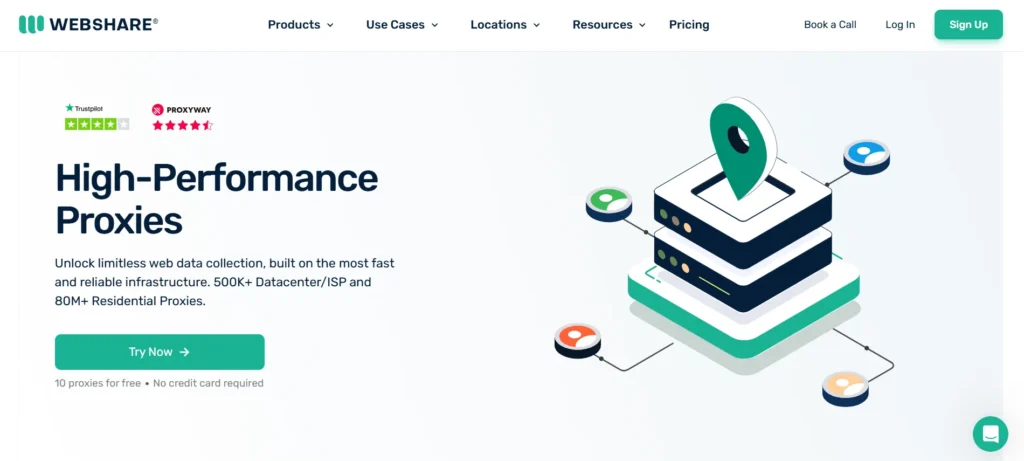
The biggest advantage is that you can test the service without immediately committing to a paid package.
Best for: Budget-conscious developers who need inexpensive datacenter IPs and a simple self-service setup.
Webshare Highlights
Starting price: $0.018/IP.
Free allocation: 10 premium proxies.
Free bandwidth: 1GB.
Uptime: 99.97% advertised.
Uplink: 1Gbps dedicated.
Protocols: HTTP, SOCKS5.
Pool: Large datacenter network.
Plans: Customizable.
Authentication: Username/password and IP-based options.
Dashboard: Self-service.
Proxy API: Available.
Location targeting: Available.
Use cases: Web scraping, market research, automation, price monitoring.
Residential alternatives: Available under the same account.
What You Pay
The current public pricing page shows datacenter proxy pricing from $0.018/IP. Webshare also provides 10 premium proxies with 1GB of bandwidth free, with no credit card required for the free allocation.
Because Webshare presents multiple proxy-server configurations, the exact price depends on the number of IPs, bandwidth, and plan type selected.
Pros
- 10 premium proxies and 1GB of bandwidth are available free, making testing almost frictionless.
- The advertised $0.018/IP entry price is one of the lowest in this comparison.
- Webshare advertises 1Gbps dedicated uplink and 99.97% uptime.
Cons
- The cheapest $0.018/IP figure is not enough information to calculate the cost of a specific large deployment without selecting the exact plan.
- Webshare provides fewer enterprise-specific infrastructure controls than Oxylabs or Bright Data.
Why Webshare: Webshare is the best starting point for developers who want very low datacenter proxy pricing, 10 free premium IPs, 1GB free bandwidth, and a self-service dashboard before committing money.
4. Bright Data
Bright Data is the scale-focused option in this list.
Its current datacenter network contains 1.3M+ proxies, with both shared and dedicated pools. The provider’s unlimited datacenter pricing currently starts at 10 IPs for $1.40/IP, falls to $1/IP at 100 IPs, $0.95/IP at 500 IPs, and $0.90/IP at 1,000 IPs.
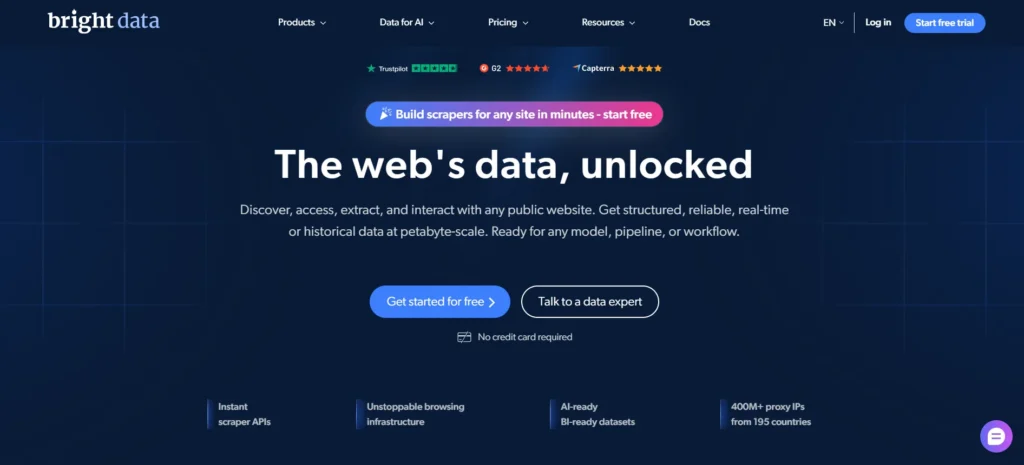
Bright Data also offers a pay-per-GB option starting at $0.077/GB, although the per-IP unlimited product is often easier to budget for workloads that repeatedly transfer large amounts of data.
Best for: Enterprise-scale datacenter proxy deployments requiring a large IP pool, broad infrastructure, and extensive platform tooling.
Bright Data Highlights
Datacenter pool: 1.3M+ IPs.
10 IPs: $1.40/IP.
100 IPs: $1/IP.
500 IPs: $0.95/IP.
1,000 IPs: $0.90/IP.
Bandwidth: Unlimited plan with fair-use allowance.
Fair-use allowance: 100GB/IP/month.
Pay-per-GB: From $0.077/GB.
Pool: Shared and dedicated.
Targeting: Global location targeting.
Tooling: Proxy Manager and API.
Network: Datacenter infrastructure.
Enterprise: Custom solutions.
Trial: Free trial available on eligible plans.
Compliance: Extensive enterprise controls.
What You Pay
IPs | Price/IP | Monthly total |
10 | $1.40 | $14 |
100 | $1.00 | $100 |
500 | $0.95 | $475 |
1,000 | $0.90 | $900 |
Bright Data’s unlimited datacenter plan includes a 100GB fair-use allowance per IP per month. For example, 10 IPs provide a combined 1TB monthly allowance under that policy. Additional usage can incur charges.
Pros
- 1.3M+ datacenter proxies gives Bright Data enough infrastructure for large-scale deployments.
- The price falls to $0.90/IP at 1,000 IPs, making the service more competitive at enterprise volume.
- Proxy Manager and API tooling make it easier to manage a large proxy infrastructure program.
Cons
- The smallest unlimited plan requires 10 IPs and $14/month, which is more than a developer needs for a one-IP test.
- The unlimited plan has a concrete 100GB/IP/month fair-use allowance, so heavy users cannot treat the service as genuinely unlimited without reviewing overage rules.
Why Bright Data: Bright Data is the enterprise-scale choice when 1.3M+ datacenter IPs, $0.90/IP pricing at 1,000 IPs, and sophisticated proxy management matter more than simplicity.
5. Rayobyte
Rayobyte takes a more infrastructure-oriented approach to datacenter proxies.
Its current network advertises 300,000+ IPs, 9 ASNs, 20,000 unique C-class subnets, HTTP(S) and SOCKS support, unlimited bandwidth and threads, 24/7 support, automatic 30-day replacements, and individual IP replacement.
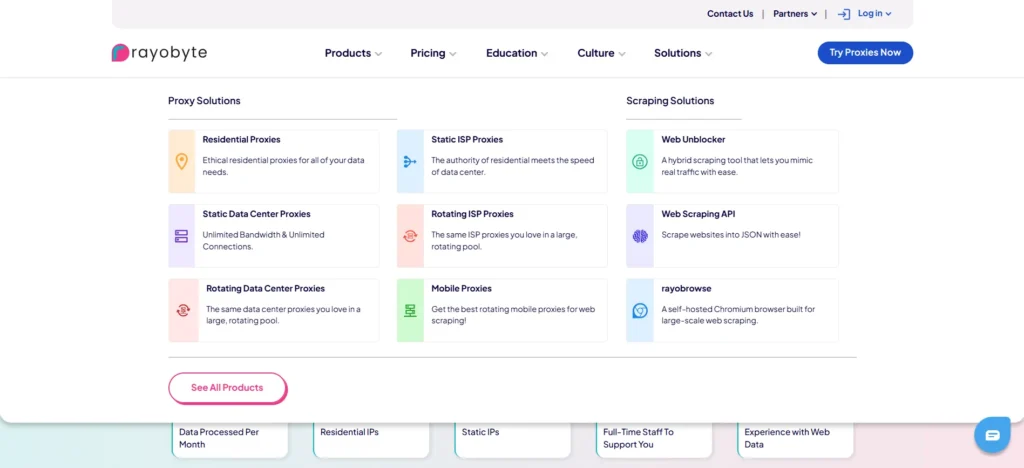
The subnet information is particularly relevant for datacenter buyers. Large IP pools can still become ineffective if thousands of addresses sit inside a small number of related networks.
Best for: Buyers who want dedicated datacenter IPs, subnet diversity, flexible subscription periods, and direct technical support.
Rayobyte Highlights
Pool: 300,000+ IPs.
ASNs: 9.
C-class subnets: 20,000 unique.
Starter: 5 to 99 IPs.
Starter price: $2.50/IP.
Personal: 100 to 999 IPs.
Personal price: $2.13/IP.
Corporate: 1,000 to 4,999 IPs.
Corporate price: $1.88/IP.
Enterprise: 5,000+ IPs.
Protocols: HTTP(S), SOCKS.
Bandwidth: Unlimited.
Threads: Unlimited.
Support: 24/7.
Replacement: Automatic 30-day replacements.
Individual replacement: Available.
API: Available.
Subscription: 1, 3, 6, or 12 months.
What You Pay
Plan | IP quantity | Price/IP |
Starter | 5–99 | $2.50 |
Personal | 100–999 | $2.13 |
Corporate | 1,000–4,999 | $1.88 |
Enterprise | 5,000+ | Custom |
Rayobyte also offers discounts of 5%, 10%, and 15% depending on the subscription period shown on its pricing interface.
Pros
- 20,000 unique C-class subnets provide more network diversity than simply advertising a large raw IP count.
- Unlimited bandwidth and threads remove per-GB accounting from dedicated datacenter deployments.
- Automatic 30-day replacements plus individual replacements provide a practical way to deal with IP failures.
Cons
- The $2.50/IP starting price is higher than Bright Data's $1.40/IP 10-IP plan.
- The public Starter tier requires 5 IPs, so it is not designed around single-IP purchases.
Why Rayobyte: Rayobyte earns its place through 20,000 C-class subnets, 300K+ IPs, unlimited bandwidth, and explicit replacement policies, making it particularly useful when network diversity matters more than the absolute cheapest IP.
6. IPRoyal
IPRoyal focuses on dedicated datacenter IPs rather than trying to compete solely on raw pool size.
The provider currently lists 60+ datacenter proxy locations, state and city targeting, HTTP(S) and SOCKS5, unlimited sessions, unlimited threads, API support, dual authentication, and 99.9% uptime.
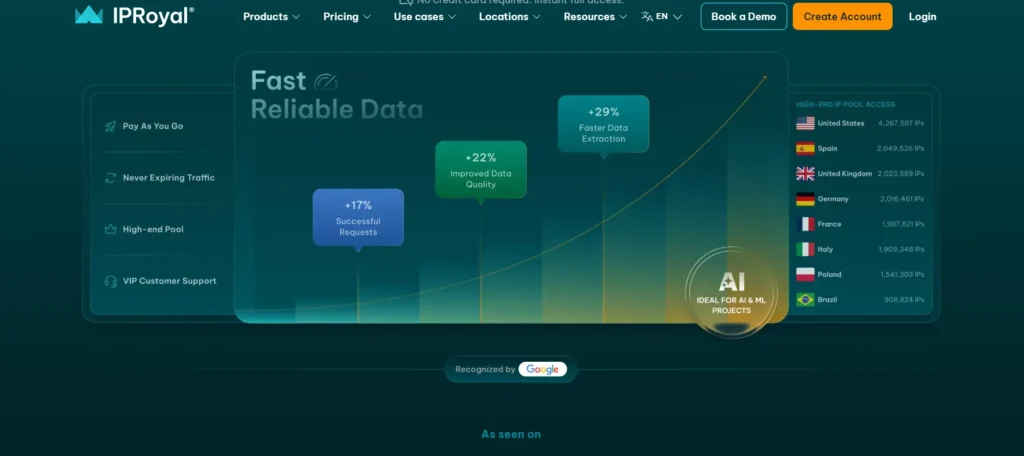
The current public pricing is especially straightforward: $1.57/proxy for 30 days, $1.48/proxy for 60 days, and $1.39/proxy for 90 days.
Best for: Users who want dedicated IPv4 datacenter proxies with state and city targeting, unlimited threads, and straightforward duration-based pricing.
IPRoyal Highlights
Proxy type: Dedicated datacenter IPv4.
Locations: 60+.
30 days: $1.57/proxy.
60 days: $1.48/proxy.
90 days: $1.39/proxy.
Protocols: HTTP(S), SOCKS5.
Targeting: Country, state, city.
Sessions: Unlimited.
Threads: Unlimited.
Uptime: 99.9%.
Latency claim: Around 10ms.
Throughput claim: Around 2Gbps.
Concurrency: 10,000+.
Authentication: Username/password and IP whitelist.
Support: 24/7.
Dashboard: Full proxy management.
API: Supported.
What You Pay
Duration | Starting price |
30 days | $1.57/IP |
60 days | $1.48/IP |
90 days | $1.39/IP |
Enterprise-scale pricing is available by contacting IPRoyal.
Pros
- The $1.39/IP 90-day rate provides a simple long-duration pricing model.
- 60+ locations with state and city targeting gives IPRoyal useful geographic control for a dedicated-IP product.
- The provider advertises 10,000+ concurrency, unlimited threads, and approximately 2Gbps throughput.
Cons
- The public network is much smaller than Oxylabs' 2M+ IP pool.
- IPRoyal's public pricing is duration-based rather than offering the same broad range of per-GB models found at Decodo or DataImpulse.
Why IPRoyal: IPRoyal is a strong dedicated-IP option if you want 60+ locations, city/state targeting, unlimited threads, and a $1.39/IP 90-day price without navigating a complicated enterprise contract.
7. DataImpulse
DataImpulse takes a fundamentally different approach from dedicated-IP providers.
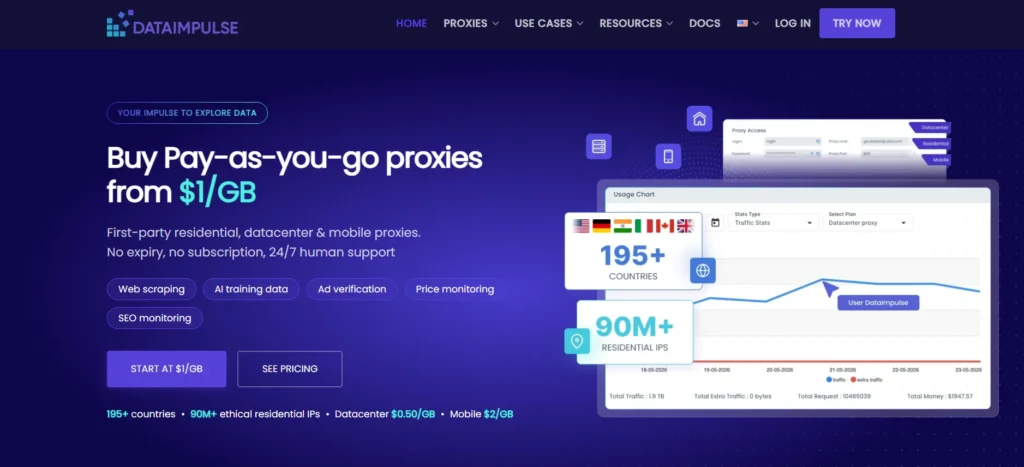
Instead of charging primarily for the number of IPs you reserve, DataImpulse charges for traffic consumed. Its current datacenter product starts at $0.50/GB, and unused traffic does not expire. The provider advertises 20M datacenter IPs, 195+ countries, 99.9% uptime, HTTP(S) and SOCKS5, rotating sessions, sticky sessions, and API access.
That model is particularly useful for teams with unpredictable demand.
Best for: Pay-as-you-go datacenter traffic where you want to avoid monthly IP subscriptions.
DataImpulse Highlights
IP pool: 20M datacenter IPs.
Coverage: 195+ countries.
Starting rate: $0.50/GB.
Intro: 10GB for $5.
Basic: 100GB for $50.
Advanced: 1TB for $450.
Custom: 5TB+ from $2,250.
Traffic: Does not expire.
Protocols: HTTP(S), SOCKS5.
Sticky sessions: Up to 30 minutes.
Rotation: Available.
Uptime: 99.9%.
Response time: Sub-100ms advertised.
Success rate: 99.51% advertised.
Country targeting: Included.
City/state/ZIP/ASN targeting: Available.
Support: 24/7 human support.
API: Available.
Integrations: Scrapy, Selenium, Puppeteer, Playwright, Postman, Proxifier, GoLogin, AdsPower and others.
What You Pay
Plan | Traffic | Price | Effective rate |
Intro | 10GB | $5 | $0.50/GB |
Basic | 100GB | $50 | $0.50/GB |
Advanced | 1TB | $450 | $0.45/GB |
Custom | 5TB+ | From $2,250 | Custom |
DataImpulse states that traffic never expires, so unused gigabytes remain available instead of disappearing at the end of a monthly billing period.
Pros
- $0.50/GB pay-as-you-go pricing eliminates the need for a recurring IP subscription.
- The advertised 20M-IP pool across 195+ countries provides unusually broad geographic coverage for a traffic-priced datacenter product.
- Unused traffic never expires, which makes the model attractive for projects with irregular demand.
Cons
- The service is traffic-priced, so a workload transferring 1TB/month costs $450 at the current Advanced rate rather than providing unlimited bandwidth.
- Sticky sessions last up to 30 minutes, so DataImpulse is not the right choice when you need a single IP to remain fixed for days.
Why DataImpulse: DataImpulse is the strongest option when your workload needs 195+ countries, 20M advertised IPs, $0.50/GB pay-as-you-go pricing, and traffic that never expires.
Dedicated vs. Rotating Datacenter Proxies
The first technical decision is whether you need a dedicated IP or a rotating pool.
Dedicated datacenter proxies
A dedicated proxy gives you a specific IP address that remains assigned to you.
This works well for:
SEO software
Allowlisted applications
API testing
Long-running connections
Account-specific workflows
Stable browser profiles
Projects where IP continuity matters
Providers such as Oxylabs, Rayobyte, and IPRoyal offer dedicated datacenter options. Oxylabs describes its dedicated IPs as 100% exclusive, while IPRoyal states that each datacenter proxy is reserved for the customer during the order period.
Rotating datacenter proxies
A rotating datacenter pool changes the IP used for requests.
This works better for:
High-volume scraping
Price monitoring
SERP collection
Market research
Large request batches
Automated data collection
The advantage is that you do not need to manually manage every IP.
The disadvantage is that the IP can change between requests, which makes the model unsuitable for workflows that require persistent IP identity.
Datacenter Proxy Billing Models Explained
Datacenter providers generally use three pricing models.
1. Pay per IP
You purchase a fixed number of IP addresses.
For example:
100 IPs × $1.00/IP
= $100/month
This is predictable.
It is also easy to budget when your application requires exactly 100 addresses.
Bright Data and Oxylabs both offer this model.
2. Pay per GB
You purchase traffic instead of a fixed IP quantity.
For example:
500GB × $0.45/GB
= $225
The provider handles the IP pool behind the endpoint.
This model works well when your application needs many IPs but the amount of traffic varies.
DataImpulse uses this approach and currently starts at $0.50/GB.
3. Unlimited per-IP plans
You pay for a number of IPs and receive unlimited traffic subject to the provider’s fair-use rules.
For example, Bright Data currently gives each IP a 100GB monthly fair-use allowance on its unlimited datacenter plan.
This model is useful when bandwidth consumption is high and predictable.
How to Choose the Right Datacenter Proxy
Start with the workload rather than the provider.
If you need the cheapest possible IPs, start with Webshare or Decodo. Webshare currently advertises datacenter pricing from $0.018/IP, while Decodo’s public pricing page lists a $0.10/IP shared pay-per-IP starting point and $0.60/GB pay-per-GB pricing.
If you need enterprise-scale infrastructure, test Oxylabs and Bright Data. Oxylabs currently advertises 2M+ IPs across 188 countries, while Bright Data lists 1.3M+ datacenter proxies.
If you need network diversity, Rayobyte deserves attention because its datacenter network contains 20,000 unique C-class subnets across 9 ASNs.
If you need dedicated IPs with a simple duration model, IPRoyal starts at $1.57/IP for 30 days and falls to $1.39/IP for 90 days.
If your traffic is irregular, DataImpulse is the logical first test because its traffic starts at $0.50/GB and never expires.
Datacenter Proxy Testing Guide
Never judge a datacenter provider using a single request.
A proper test should use at least 100 requests against your actual target or a representative public endpoint.
Test 1: Latency
Measure at least:
50 requests
Median latency
95th percentile
Maximum latency
Connection failures
For example:
curl -x http://USERNAME:PASSWORD@HOST:PORT \
-o /dev/null \
-s \
-w “HTTP: %{http_code}\nTime: %{time_total}s\n” \
Run the test from the same machine and network when comparing providers.
Test 2: IP rotation
Run:
for i in {1..10}; do
curl -x http://USERNAME:PASSWORD@HOST:PORT \
echo
done
Record the returned IPs.
If you requested rotating behavior, you should see multiple addresses.
If you requested a static endpoint, the address should remain consistent.
Test 3: Error rate
Send 100 requests and calculate:
Error rate =
Failed requests / Total requests × 100
For example:
7 failed requests
100 total requests
7 / 100 × 100
= 7% error rate
A provider advertising 99.9% success is making a much stronger claim than one reporting 97%.
However, provider-wide success rates do not predict the exact result for your target. Target-specific blocking can still produce a different number.
Test 4: Subnet diversity
For large datacenter purchases, collect the ASN and subnet information for every IP.
If you have:
10,000 IPs
but most addresses come from:
1 ASN
3 C-class ranges
you have far less network diversity than the headline IP count suggests.
Rayobyte explicitly publishes 9 ASNs and 20,000 C-class subnets, which is why subnet diversity should be considered separately from total IP count.
Are Datacenter Proxies Faster Than Residential Proxies?
Usually, yes, because datacenter IPs operate from server infrastructure rather than consumer connections.
The practical advantage is particularly noticeable when the workflow sends large numbers of requests.
Oxylabs currently advertises a 0.222-second response time for its datacenter proxy infrastructure, while IPRoyal advertises approximately 10ms latency and DataImpulse advertises sub-100ms response times. These numbers come from the providers and should not be treated as apples-to-apples independent benchmarks.
The tradeoff is detection.
A datacenter IP belongs to a hosting or cloud network, which makes its infrastructure easier for websites to classify.
Residential IPs originate from ISP-connected consumer devices and therefore generally provide a different network identity.
If your target rarely blocks datacenter ranges, using residential proxies can simply add unnecessary cost.
Are Datacenter Proxies Good for Web Scraping?
Yes, particularly for targets with moderate anti-bot protection.
Datacenter proxies are useful when you need:
High request volume
Low latency
Large concurrency
Stable server connections
Low cost per request
Country-level access
Automated IP rotation
They become less attractive when the target aggressively blocks hosting-provider IP ranges.
In that situation, switching to a residential or ISP proxy can reduce the detection problem.
The correct approach is not to assume residential proxies are always better.
Run the target-specific test.
For example:
Datacenter:
100 requests
6 blocked
Residential:
100 requests
2 blocked
If the residential service costs 5 times more, the decision depends on whether the additional successful requests justify the additional cost.
Which Datacenter Proxy Is Cheapest?
The answer depends on the billing model.
For per-IP pricing, Webshare currently advertises datacenter proxies from $0.018/IP, while Decodo’s standard public pay-per-IP pricing starts at $0.10/IP.
For pay-per-GB pricing, DataImpulse starts at $0.50/GB, while Oxylabs currently lists shared pay-per-GB datacenter proxies at $0.59/GB.
For dedicated IPs, IPRoyal starts at $1.57/IP for 30 days, while Oxylabs’ dedicated public calculator starts at $2.25/IP.
These prices are not directly interchangeable.
A $0.018/IP plan and a $0.50/GB plan charge for different resources.
Final Verdict: The Best Datacenter Proxy Providers in 2026
Oxylabs is the best overall datacenter proxy provider in 2026. Its current network exceeds 2M IPs across 188 countries, with dedicated pricing from $2.25/IP, shared pricing from $1.20/IP, and pay-per-GB pricing from $0.59/GB. It also reports 0.222-second response times and a 99.9% success rate.
Choose Decodo if you want the strongest balance between features and price across shared and dedicated models.
Choose Webshare if your priority is the lowest entry price and you want to test 10 premium proxies plus 1GB of bandwidth for free.
Choose Bright Data if you need enterprise scale and 1.3M+ datacenter IPs, with pricing falling to $0.90/IP at 1,000 IPs.
Choose Rayobyte if subnet diversity matters, with 300K+ IPs, 9 ASNs, and 20,000 C-class subnets.
Choose IPRoyal for straightforward dedicated IP subscriptions starting at $1.57/IP for 30 days and $1.39/IP for 90 days.
Choose DataImpulse when you want $0.50/GB pay-as-you-go traffic that never expires and coverage across 195+ countries.
For a new datacenter scraping project, start with Oxylabs and Decodo, then benchmark Webshare if price becomes the deciding factor.
FAQs About the Best Datacenter Proxy Providers
Oxylabs is the best overall choice for large-scale datacenter workloads, advertising 2M+ IPs across 188 countries, with dedicated proxies from $2.25/IP, shared proxies from $1.20/IP, and pay-per-GB options from $0.59/GB. For budget users, Webshare and Decodo offer lower entry prices.
Webshare advertises datacenter proxies from $0.018/IP, one of the lowest published rates in this comparison. For low-volume users, DataImpulse may be cheaper with its traffic-based model starting at $0.50/GB and no subscription. Actual costs depend on IP quantity and bandwidth.
Yes. Datacenter proxies are well suited to high-volume scraping because they typically offer high bandwidth, low latency, and lower costs than residential proxies. However, they may be less effective against heavily protected websites that identify and block cloud or hosting-provider IP ranges.
Choose dedicated proxies when you need a consistent IP for an account, allowlist, application, or long-running session. Choose rotating proxies when distributing requests across multiple IPs is more important. DataImpulse supports rotating and sticky sessions up to 30 minutes, while Oxylabs offers both static and rotating products.
Published pricing ranges from around $0.018/IP at Webshare to $2.50/IP for Decodo's dedicated datacenter proxies. Traffic-based options start around $0.50/GB at DataImpulse, while Oxylabs shared datacenter proxies start at $0.59/GB. Compare pricing based on whether you need IPs, bandwidth, or both.
Datacenter proxies generally offer lower latency because they use server infrastructure. Oxylabs reports 0.222-second response times, while IPRoyal reports around 10ms latency for its datacenter infrastructure. These are provider-reported figures, not independent head-to-head benchmarks.
