
Adobe Statistics 2026: The Complete Data Guide
Adobe is one of the most important software companies on earth. From Photoshop to PDFs to AI image generation, billions of people touch Adobe products every single day without even realizing it. But how big is Adobe really? How fast is it growing? And what do the numbers tell us about where it is headed?
This article puts all the key Adobe statistics in one place, written in plain English so anyone can understand what is actually going on with this company.
Adobe at a Glance: The Fast Facts
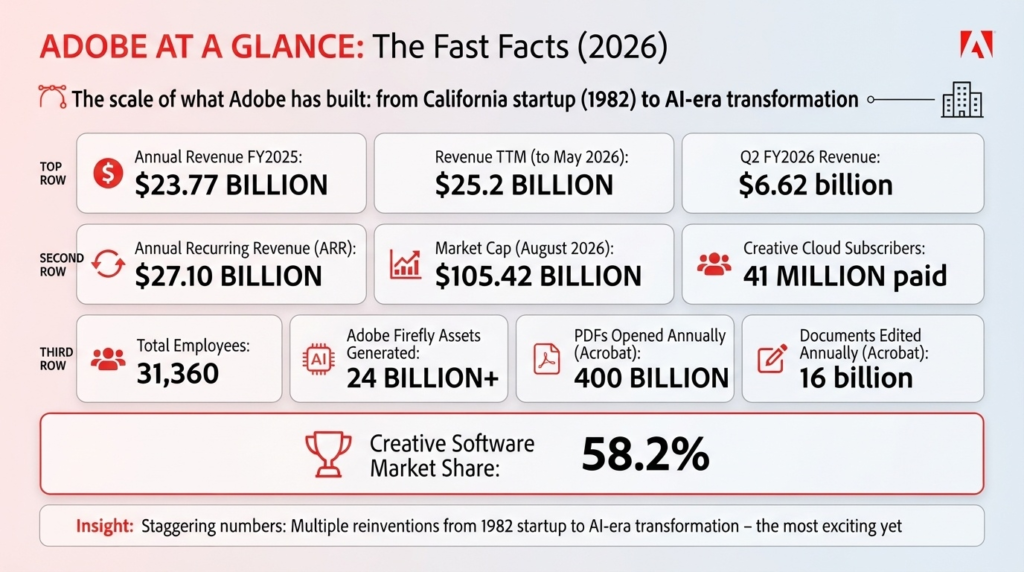
Before we dig into the detail, here are the numbers that tell you the scale of what Adobe has built.
Metric | Figure (2026) |
Annual Revenue (FY2025) | $23.77 billion |
Revenue (trailing 12 months to May 2026) | $25.2 billion |
Q2 FY2026 Revenue | $6.62 billion |
Annual Recurring Revenue (ARR) | $27.10 billion |
Market Capitalization (August 2026) | $105.42 billion |
Creative Cloud Subscribers | 41 million paid subscribers |
Total Employees | 31,360 |
Adobe Firefly Assets Generated | 24 billion plus |
PDFs Opened Annually via Acrobat | 400 billion |
Documents Edited via Acrobat Annually | 16 billion |
58.2% |
These are staggering numbers for a company that started as a small software firm in California in 1982. Adobe has reinvented itself multiple times, and the AI era is proving to be its most exciting transformation yet.
Adobe Revenue: How the Money Flows
Adobe’s revenue story is one of the most consistent growth stories in the software industry. The company moved from selling boxed software to a subscription model in 2013, and that decision turned out to be one of the smartest pivots in tech history. Today nearly all of Adobe’s revenue is recurring, which means predictable, stable, and compounding.
Adobe reported $23.77 billion in revenue for FY2025, up 10.53% year on year. In the 12 months ending May 2026, that number climbed to $25.2 billion, a further 11.49% increase. For Q2 FY2026 alone, Adobe pulled in $6.62 billion, beating analyst expectations of around $5.82 adjusted earnings per share.
Adobe’s business splits into two main segments. Here is how the money breaks down:
Segment | Revenue (FY2025) | Year-on-Year Growth |
Digital Media (Creative Cloud + Document Cloud) | Majority of revenue | 11% growth |
Digital Experience (Experience Cloud) | $5.86 billion | 9.28% growth |
Total Subscription Revenue | Approx. 94% of all revenue | Consistent growth |
The Digital Media segment is where Photoshop, Illustrator, Premiere Pro, Acrobat, and all the creative tools live. This is Adobe’s biggest engine. The Digital Experience segment is where Adobe sells marketing and analytics tools to enterprises under the Adobe Experience Cloud brand.
The Annual Recurring Revenue figure of $27.10 billion is particularly important. ARR is the best measure of how healthy a subscription business is. It tells you how much money is locked in for the next 12 months from existing customers. At $27.1 billion, Adobe’s ARR is one of the highest of any software company in the world.
AI is becoming a meaningful revenue driver too. ARR tied specifically to AI products has surpassed $500 million and tripled year over year. Firefly-specific ending ARR is approaching $300 million.
Adobe Creative Cloud: Subscribers and Reach
Creative Cloud is the product most people associate with Adobe. It is the subscription that gives access to Photoshop, Illustrator, Premiere Pro, After Effects, InDesign, Lightroom, and dozens of other tools. It is the industry standard for designers, photographers, video editors, and creative professionals worldwide.
Adobe Creative Cloud now has an estimated 41 million paid subscribers, up from around 37 million in 2024 and roughly 22 million in 2017. That is 85% subscriber growth since 2017.
Here is the subscriber growth trajectory:
Year | Estimated Creative Cloud Paid Subscribers |
2017 | 22 million |
2020 | 26 million |
2022 | 31 million |
2023 | 33 million |
2024 | 37 million |
2026 | 41 million |
The growth has been steady and consistent. Adobe adds roughly 1 million new subscribers per year, and churn (people cancelling) remains low because Creative Cloud tools are deeply embedded into professional workflows. Once a designer or video editor builds their entire process around Adobe tools, switching costs are very high.
Creative Cloud targets three types of users. Individual professionals and freelancers form the base. Students and educators get heavily discounted rates. Enterprises and large businesses take out team or enterprise licenses that often cover hundreds or thousands of seats at once.
Adobe Acrobat and PDF: Bigger Than You Think
Most people do not think of Adobe as a PDF company, but the numbers here are extraordinary.
400 billion PDFs are opened annually through Adobe Acrobat
200 million PDFs are sent via Acrobat every year
16 billion documents are edited through Acrobat annually
Acrobat now has an AI assistant built in that can summarize, answer questions about, and help users navigate long documents
The PDF was invented by Adobe in 1993. More than 30 years later, it remains the global standard for document sharing, and Adobe controls the dominant platform for creating, editing, and signing PDFs. Acrobat is a core part of Document Cloud, which sits within the larger Digital Media segment.
Adobe launched a new productivity agent for Acrobat in May 2026, powered by AI, that redefines how people interact with large documents. It can answer questions about 100-page contracts, extract key information, and generate summaries in seconds. For law firms, accountants, and enterprises dealing with massive volumes of documents, this is genuinely transformative.
Adobe Firefly: The AI Powerhouse
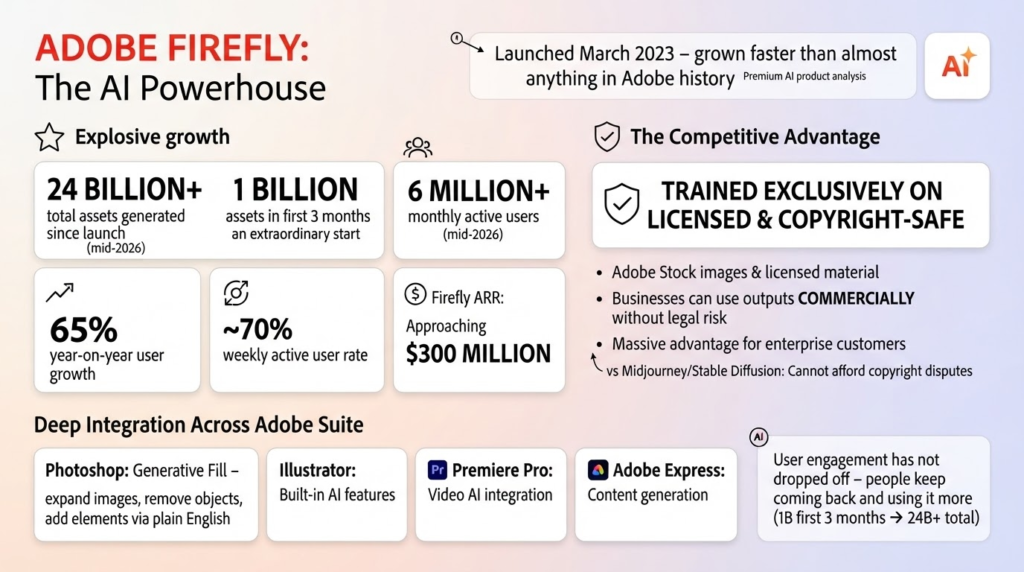
Adobe Firefly is Adobe’s family of AI image and content generation tools. It launched in March 2023 and has grown faster than almost anything else in Adobe’s history.
Firefly Stat | Figure |
Total assets generated since launch | 24 billion plus |
Assets generated in first 3 months | 1 billion |
Monthly active users (mid-2026) | 6 million plus |
Year-on-year user growth | 65% |
Weekly active user rate among users | ~70% |
Firefly ARR | Approaching $300 million |
Generating 1 billion assets in its first 3 months was already extraordinary. Reaching 24 billion total by mid-2026 shows that user engagement has not dropped off. People keep coming back and using it more.
What makes Firefly different from competitors like Midjourney or Stable Diffusion is that it was trained exclusively on licensed and copyright-safe content. Adobe trained Firefly on Adobe Stock images and other licensed material, which means businesses can use Firefly outputs commercially without legal risk. That is a massive competitive advantage for enterprise customers who cannot afford to deal with copyright disputes.
Firefly is deeply integrated into Photoshop through features like Generative Fill, which lets users expand images, remove objects, and add new elements by simply describing what they want in plain English. It is also built into Illustrator, Premiere Pro, and Adobe Express.
Adobe Experience Cloud: The Enterprise Business
Adobe Experience Cloud is the less talked-about but enormously important side of Adobe. It is a suite of marketing, analytics, commerce, and customer experience tools used by large enterprises to run their digital marketing operations.
The Digital Experience segment brought in $5.86 billion in FY2025, up 9.28% from the previous year. Subscription revenue from this segment alone reached $1.27 billion in Q4, growing 12% year on year.
Adobe’s own 2026 Digital Trends report, based on a survey of 4,000 customers globally, revealed some telling statistics about how enterprises are using AI within this ecosystem:
76% of organizations report improved content speed and volume from generative AI
89% of organizations say they have the technical infrastructure to support AI
74% of marketing technology leaders say data integration is the top barrier to implementing agentic AI
49% of customers say AI saves them money
1 in 4 customers now start their product research using an AI tool instead of a search engine
50% of customers say brands have just 2 to 5 seconds to grab their attention
These findings matter because they shape how Adobe builds its products. The shift toward agentic AI, AI that can take actions on behalf of users rather than just answer questions, is a key theme in Adobe’s roadmap for Experience Cloud going into 2027.
Adobe Market Share: Dominant but Facing Pressure
Adobe holds a commanding position in creative software, but the competitive landscape is shifting.
Player | Market Position |
Adobe | 58.2% share of creative software market |
Canva | 265 million users. Strongest in simple design for non-professionals |
Figma | 80 to 90% share of UI and UX design space. 86% adoption rate among designers |
Corel | Approximately 11.4% of creative software market |
Adobe dominates broadly across the creative software category, but Canva and Figma have carved out specific territories where they are genuinely stronger. Canva is winning among non-professional users, small businesses, and social media creators who want simple, fast design tools without a steep learning curve. Figma owns the UI and UX design space, holding 80 to 90% market share among product and interface designers.
Adobe attempted to acquire Figma for $20 billion in 2022, but the deal was blocked by European regulators in late 2023. That means Figma remains an independent and growing competitor, which is a genuine threat to Adobe’s long-term position in design tooling.
In the CRM market, Adobe holds a 3.4% share, competing against Salesforce, HubSpot, and Microsoft in the marketing and customer experience software space.
Adobe Stock and Workforce Stats
Adobe’s stock (NASDAQ: ADBE) has had a challenging few years relative to the broader AI stock boom. As of August 9 to 10, 2026, shares were trading between $260 and $270, with a market cap of approximately $105.42 billion. The stock is down roughly 58% over a five-year period, which is unusual for a company posting consistent double-digit revenue growth.
The disconnect between Adobe’s strong fundamentals and weak stock performance reflects investor concerns about AI disruption. Some worry that tools like Midjourney, Stable Diffusion, and newer AI-native design platforms could eventually chip away at Creative Cloud’s dominance. Adobe’s own AI investments are partly designed to address this concern head-on.
On the workforce side:
31,360 employees worldwide as of the close of FY2025
Adobe had 3,349 active job postings in 2026, a 26.9% increase from 2025
Workforce has grown 26.7% since 2023
The company is clearly hiring aggressively into AI-focused roles
Adobe’s AI Revenue: A New Growth Engine
The most exciting financial development at Adobe right now is AI becoming a real revenue line item, not just a feature.
AI product ARR exceeded $500 million and tripled year on year
Firefly ARR is approaching $300 million
Adobe’s FY2026 total revenue target is now $26.50 billion to $26.60 billion
ARR target for FY2026 has been revised up to reflect AI-driven growth of 10.2%
Adobe is monetizing AI in several ways. Firefly credits are included in Creative Cloud subscriptions up to a monthly limit, with the option to buy more. Adobe is also selling Firefly API access to enterprises that want to integrate AI generation into their own workflows and products. The Firefly Services API is becoming a meaningful B2B revenue stream that did not exist two years ago.
The Bottom Line
Adobe is a genuinely enormous business. $25 billion in revenue, 41 million Creative Cloud subscribers, 400 billion PDF opens per year, 24 billion AI-generated assets, and a market cap of over $100 billion. These are not the numbers of a company struggling. These are the numbers of a company that has successfully navigated multiple technology shifts and is now embedding AI at the core of everything it does.
The stock may be under pressure, and the competition from Canva, Figma, and AI-native tools is real. But Adobe’s deep integration into professional creative workflows, its copyright-safe AI approach, and its sheer scale of user data and distribution give it advantages that most competitors cannot easily replicate. The next two years will be the most important in Adobe’s recent history, and the statistics suggest the foundation is very strong.
FAQs
Key Adobe statistics for 2026 include its revenue surpassing $23 billion, over 30 million Creative Cloud subscribers worldwide, and Adobe Experience Cloud serving more than 85% of Fortune 500 companies. These figures highlight Adobe's dominant position in creative software and digital experience platforms.
Adobe has grown to over 40 million active users globally across its suite of products in 2026, with Creative Cloud and Document Cloud accounting for the majority of subscriptions. This represents a significant increase driven by demand for AI-powered creative tools.
Yes, Adobe remains the undisputed leader in creative software in 2026, holding over 70% market share in professional design, video editing, and PDF solutions. Its continued investment in AI through Adobe Firefly has strengthened its competitive advantage over rivals.
Adobe's revenue growth by 2026 is largely attributed to the rapid adoption of its AI-powered tools, expansion into enterprise digital experience solutions, and a successful shift to a subscription-based model that generates predictable recurring income. The integration of generative AI into its core products has attracted millions of new users.
Absolutely, 2026 data shows that small and medium-sized businesses make up nearly 35% of Adobe's total subscriber base, utilizing tools like Adobe Express and Acrobat for everyday business needs. Adobe's tiered pricing and free-tier offerings have made its products increasingly accessible to businesses of all sizes.
