
Upwork Statistics 2026: The Complete Data Guide
Upwork is the world’s largest freelance marketplace. It connects businesses with independent talent for everything from writing and design to software development, AI work, legal services, and finance. If you want to understand the future of work, understanding Upwork’s numbers is one of the best places to start. This guide breaks down every major Upwork statistic for 2026 in plain, simple language, with full context so the numbers actually mean something.
Upwork at a Glance: The Fast Facts
Here is every key number in one place before we dig into the detail.
Metric | Figure (2026) |
Annual Revenue (FY2025) | $787.8 million |
Q1 2026 Revenue | $195.5 million |
Full Year 2026 Revenue Guidance | $760 million to $790 million |
Gross Services Volume (GSV) FY2025 | $4.03 billion |
GSV per Active Client (Q1 2026) | $5,138 |
Active Clients (Q1 2026) | 784,000 |
AI-related GSV growth (Q1 2026 YoY) | 40% plus |
Upwork Market Share (freelance platforms) | ~61.25% |
Average Freelancer Hourly Rate on Upwork | $39 per hour |
Median Income (full-time skilled freelancers) | $85,000 per year |
Upwork Employees | ~630 (pre-layoffs) |
Employees after May 2026 restructuring | ~480 |
Market Capitalization (August 2026) | $1.19 billion |
Stock Price (August 8, 2026) | $9.66 |
Upwork is a platform under real pressure. Revenue growth is slow at 1.4% in Q1 2026. The company just cut 24% of its workforce. Active client numbers are declining year on year. And yet the freelance economy it serves is growing faster than ever, and AI is creating a new wave of demand that Upwork is positioning itself to capture. The tension between those two realities is the defining story of Upwork in 2026.
Upwork Revenue: Slow Growth in a Fast Market
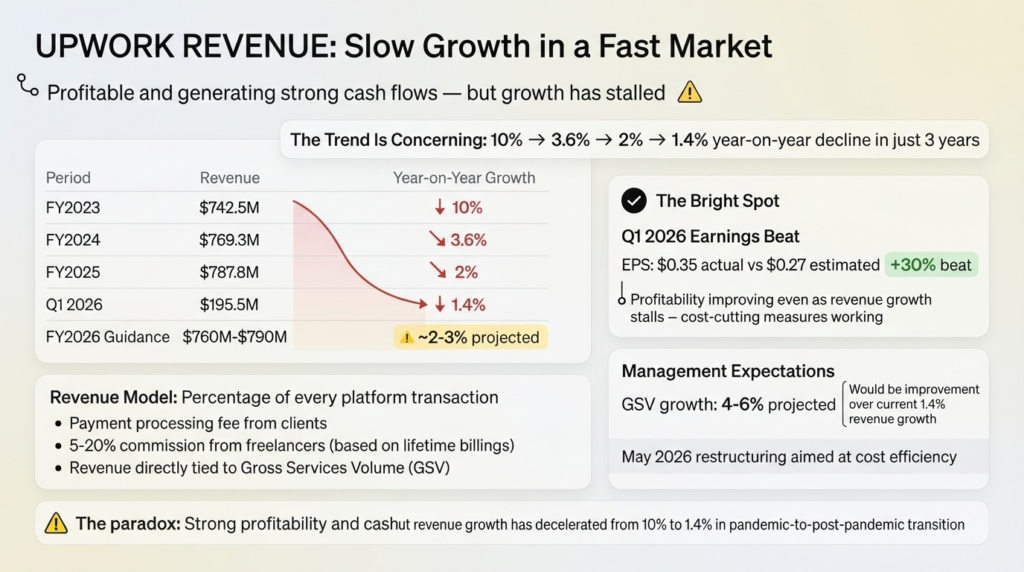
Upwork’s revenue story is one of the more complicated ones in tech right now. The company is profitable and generating strong cash flows, but growth has slowed dramatically compared to its pandemic-era surge.
Period | Revenue | Year-on-Year Growth |
FY2023 | $742.5 million | 10% |
FY2024 | $769.3 million | 3.6% |
FY2025 | $787.8 million | 2% |
Q1 2026 | $195.5 million | 1.4% |
FY2026 Guidance | $760M to $790M | ~2 to 3% projected |
The revenue growth trend is concerning. Upwork grew at 10% in 2023, 3.6% in 2024, 2% in 2025, and just 1.4% in Q1 2026. The company’s full-year 2026 guidance of $760 million to $790 million implies continued slow growth, though management expects GSV growth of 4% to 6% which would be an improvement.
Despite slow top-line growth, Upwork beat Q1 2026 earnings expectations significantly. The company reported earnings per share of $0.35, beating analyst estimates of $0.27 by nearly 30%. Profitability is improving even as revenue growth stalls, which reflects the company’s cost-cutting measures including the major May 2026 restructuring.
Upwork’s revenue model takes a percentage of every transaction on the platform. The company charges clients a payment processing fee and takes between 5% and 20% from freelancers depending on their lifetime billings with a specific client. This model means Upwork’s revenue is directly tied to the total value of work flowing through the platform, which is measured as Gross Services Volume.
Gross Services Volume: The Real Measure of Platform Health
GSV is the total dollar value of all work transacted through Upwork. It is the most important measure of the platform’s actual economic activity.
Period | Gross Services Volume |
FY2019 | ~$2.1 billion |
FY2024 | ~$4.0 billion |
FY2025 | $4.03 billion |
First 9 months of 2025 | $3.01 billion |
Q4 2025 | $1.02 billion |
Q1 2026 GSV per active client | $5,138 |
GSV almost doubled between 2019 and 2024, reflecting the explosive growth of remote work and freelancing during and after the pandemic. Growth has slowed more recently, with Q4 2025 GSV growing just 2.8% year on year.
The GSV per active client figure is worth paying close attention to. At $5,138 per active client per quarter, Upwork is seeing clients spend more per transaction even as the total number of active clients declines. This suggests the platform is retaining its highest-value clients while losing smaller or occasional users, possibly to competitors or to direct hiring relationships that bypass the platform.
AI-related GSV grew more than 40% year on year in Q1 2026, which is by far the fastest-growing category on the platform. GSV from AI Integration and Automation, the largest AI-related category on Upwork, is growing at a particularly strong rate. This is the bright spot in Upwork’s financial story and the area management is most focused on.
Active Clients: A Declining Number That Needs Context
The number of active clients on Upwork has been declining, and this is the statistic critics point to most often when questioning the platform’s health.
Period | Active Clients |
Q3 2024 | 855,000 |
Q4 2024 | 832,000 |
Q3 2025 | 794,000 |
Q4 2025 | 785,000 |
Q1 2026 | 784,000 |
Active clients dropped from 855,000 in Q3 2024 to 784,000 in Q1 2026, a decline of roughly 8% over six quarters. This looks alarming on the surface. But the context matters enormously.
The clients who remain are spending more. GSV per active client grew from around $4,700 to $5,138 over the same period. Upwork is losing its smallest and most occasional clients while retaining and growing its most valuable enterprise and mid-market relationships. This is a deliberate strategic shift toward higher-value clients rather than pure user volume growth.
Clients on Upwork spend a combined $4 billion annually on the platform. The average Upwork project value is $800, with 32% of jobs in 2026 valued at $1,000 or more, reflecting the platform’s tilt toward complex, higher-value professional engagements.
The May 2026 Restructuring: What Happened
On May 7, 2026, Upwork CEO Hayden Brown announced a significant restructuring of the company. This is important context for understanding where Upwork is headed.
24% of the corporate workforce was eliminated, cutting approximately 150 positions
Upwork had approximately 630 full-time employees before the restructuring
Headcount dropped to approximately 480 employees following the cuts
The restructuring was framed as a shift toward AI-driven operations and a leaner operating model
Q1 2026 revenue rose just 1.4%, providing the financial context for why cuts were deemed necessary
The irony of Upwork, a platform built on flexible human talent, laying off nearly a quarter of its own workforce is not lost on anyone. The company is doing exactly what its enterprise clients are doing: using AI to automate tasks that previously required human employees, then restructuring the workforce accordingly.
For a company generating nearly $800 million in annual revenue with only around 480 employees, the revenue per employee figure is actually very high. This lean structure is one of Upwork’s competitive advantages going forward.
The Freelance Economy: The Bigger Picture Around Upwork
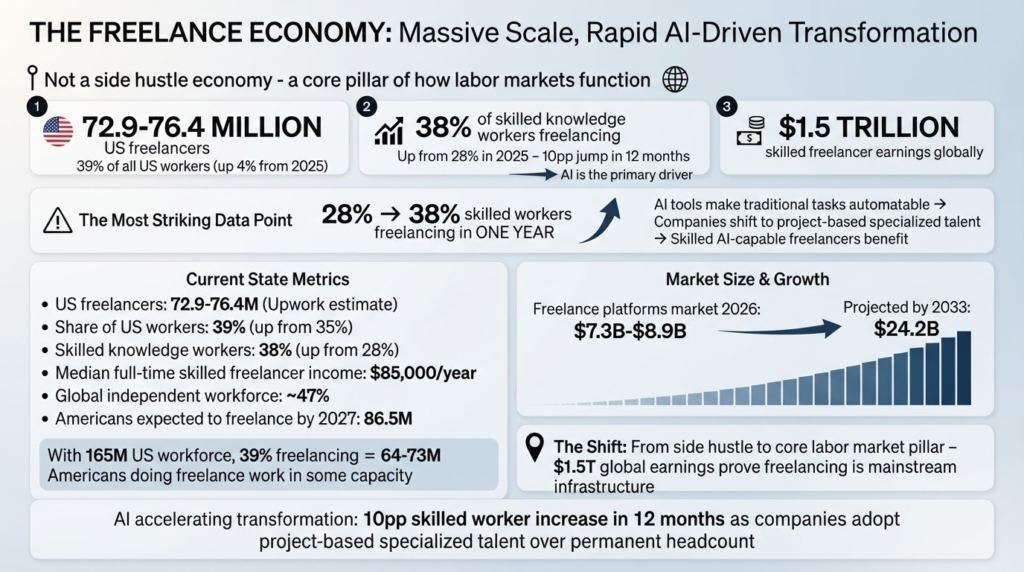
Upwork does not operate in isolation. It sits at the center of a massive and growing freelance economy that is reshaping how work happens globally.
Freelance Economy Metric | Figure (2026) |
US freelancers (Upwork estimate) | 72.9 to 76.4 million |
Share of US workers who freelance | 39% (up from 35% in 2025) |
Share of skilled knowledge workers freelancing | 38% (up from 28% in 2025) |
Total skilled freelancer earnings globally | $1.5 trillion |
Median income of full-time skilled freelancers | $85,000 per year |
Americans expected to freelance by 2027 | 86.5 million |
Global workforce that is independent | ~47% |
Freelance platforms market size (2026) | $7.3 billion to $8.9 billion |
Freelance platforms projected market by 2033 | $24.2 billion |
The jump from 28% to 38% of skilled knowledge workers freelancing in a single year is the most striking data point in Upwork’s 2026 Future Workforce Index. That is a 10 percentage point increase in 12 months. The primary driver identified in the research is AI. As AI tools make certain traditional employment tasks automatable, companies are shifting toward project-based hiring of specialized talent rather than maintaining large permanent headcounts. Skilled freelancers who can work with and around AI are the beneficiaries of this shift.
39% of all US workers now freelance in some capacity, up 4% from 2025. With the US workforce numbering around 165 million people, that translates to roughly 64 to 73 million Americans doing some form of freelance work.
The $1.5 trillion in skilled freelancer earnings globally reflects how substantial the economic contribution of independent workers has become. This is no longer a side hustle economy. It is a core pillar of how labor markets function.
AI and Upwork: The Platform’s Biggest Opportunity
AI is simultaneously the biggest threat to Upwork’s traditional freelance categories and the biggest growth opportunity the platform has ever seen. The data shows both sides of this clearly.
Demand for AI Skills is Exploding:
Demand for skills that explicitly reference AI grew 109% year on year on Upwork, far outpacing the 23% growth of other in-demand skills
AI-related jobs on Upwork grew 25% year on year overall
The Prompt Engineering category alone grew 52% year on year
AI video generation and editing grew 329%
AI integration grew 178%
AI-related GSV grew more than 40% year on year in Q1 2026
Freelancers performing AI work earn 34% more per hour than those not doing AI work
The Flip Side: Simple AI Tasks Are Losing Value:
Not all AI-related freelancing is thriving. Upwork’s own research shows that simple, execution-level AI tasks saw earnings fall 28% year on year. The market is splitting into two tracks. Freelancers who can direct, supervise, and improve AI outputs are earning more. Freelancers doing basic tasks that AI can now handle are earning less or losing work entirely.
This bifurcation is the defining trend of the Upwork platform in 2026. High-value AI work is booming. Low-value execution work is being automated away. The platform’s long-term health depends on whether it can position itself as the marketplace for the former rather than the latter.
What Freelancers Earn on Upwork
Money is what ultimately determines whether Upwork works for freelancers. Here is a detailed breakdown of earnings across different skill levels and categories.
Average and Median Rates:
Average hourly rate across all Upwork freelancers: $39 per hour
Median income for full-time skilled freelancers: $85,000 per year (roughly $41 per hour at 40 hours per week)
Entry-level freelancers: $10 to $30 per hour
Experienced mid-level freelancers: $30 to $75 per hour
Expert-level senior freelancers: $75 to $150 per hour or more
Expert-Vetted tier (top 1% of Upwork talent): $100 to $250 plus per hour
US average freelancer hourly rate (all platforms): $47.71 per hour
By Skill Category:
Skill Category | Typical Upwork Hourly Rate |
Web and mobile development | $30 to $150 per hour |
AI integration and automation | $50 to $200 per hour |
Data science and analytics | $40 to $150 per hour |
Graphic design | $20 to $80 per hour |
Content writing | $15 to $75 per hour |
Accounting and finance | $25 to $120 per hour |
Customer service | $10 to $30 per hour |
Video editing | $20 to $90 per hour |
Legal services | $50 to $300 per hour |
Expert-level freelancers with 11 or more years of experience show a median rate of $135 per hour versus $35 per hour for entry-level workers. The experience premium is enormous and growing as AI reduces demand for basic execution tasks while increasing demand for high-judgment work.
Freelancers doing AI work earn 34% more per hour than the platform average. This is the clearest financial signal of where the market is heading. Learning to work with AI is not just a career preference. On Upwork in 2026, it is a significant pay raise.
Upwork vs Competitors: How the Platform Stacks Up
Upwork dominates the freelance platform market but faces real competition from Fiverr, Freelancer.com, Toptal, and a growing number of specialized platforms.
Platform | Market Share | Average Project Value | Best For |
Upwork | ~61.25% | $800 average (32% at $1,000+) | Complex, long-term professional work |
Fiverr | ~14.85% | $342 per buyer per year | Quick, defined creative tasks |
~8% | Varies widely | Competitive bidding on broad projects | |
Toptal | Small but growing | Premium rates | Top 3% vetted technical talent only |
Specialized platforms | Growing | Varies by niche | Specific industry or skill verticals |
Upwork’s 61.25% market share in the freelance platform category is genuinely dominant. No competitor comes close in terms of total transaction volume, client base, or breadth of available talent. Fiverr is the closest meaningful competitor at around 15% market share, but it operates in a fundamentally different segment: quick, fixed-price gig work rather than ongoing professional engagements.
The key differentiator between Upwork and Fiverr is project complexity. The average Upwork project is $800 with 32% of jobs valued at $1,000 or more. The average Fiverr order is $50 to $500 with an average buyer spend of $342 per year. These are different markets serving different needs. Upwork is for hiring a developer to build a product. Fiverr is for getting a logo designed.
Most In-Demand Skills and Categories on Upwork in 2026
Upwork publishes its own data on which skills and job categories are growing fastest. Here is where the demand is.
Top Categories by Demand:
Web, mobile and software development (consistently the largest category)
Design and creative
Writing and content
Sales and marketing
Admin support
Customer service
Data science and analytics
Accounting and consulting
AI and machine learning (fastest growing)
Fastest Growing Specific Skills in 2026:
AI video generation and editing: +329% year on year
AI integration: +178% year on year
Prompt engineering: +52% year on year
General AI-related skills: +109% year on year
All other in-demand skills combined: +23% year on year
The gulf between AI skill growth (109% to 329%) and everything else (23%) tells you everything you need to know about where Upwork’s growth is coming from and where freelancers should be focusing their development efforts.
Upwork’s Stock and Financial Position
Upwork is publicly traded on the NASDAQ under the ticker UPWK. Its stock performance reflects the mixed picture of its business.
Current stock price (August 8, 2026): $9.66
Market capitalization: $1.19 billion
Stock range: Traded between $9.33 and $9.86 on August 8
Analyst target price: $9.00 (Hold rating)
Upwork is classified as a small-cap company with a market cap between $300 million and $2 billion
The stock price of around $9.66 reflects investor uncertainty about Upwork’s growth trajectory. A $1.19 billion market cap for a company generating nearly $800 million in annual revenue is actually quite modest, reflecting a price-to-revenue ratio of about 1.5x. That is cheap by tech company standards, but the market is pricing in continued slow growth and competitive pressure from AI automation.
Some analysts see Upwork as undervalued given its dominant market position and the overall growth of the freelance economy. Others worry that AI will ultimately reduce the need for the platform itself as companies find ways to hire talent more directly or replace certain types of freelance work with AI tools altogether.
The Bottom Line
Upwork is a platform at a crossroads. It dominates the freelance marketplace with 61% market share and processes over $4 billion in work annually. It serves a freelance economy that now includes 39% of all US workers and generates $1.5 trillion in global skilled freelancer earnings. The demand for AI skills on its platform is growing at 109% per year, faster than anything else in the gig economy.
At the same time, revenue growth has slowed to barely 1% to 2% annually. Active client numbers are declining. The company just cut 24% of its staff. And AI is a double-edged sword that creates demand for high-end talent while automating away demand for lower-skilled work.
The freelance economy itself is unambiguously growing. 38% of skilled knowledge workers now freelance, up from 28% just one year ago. That 10-point jump in a single year is extraordinary and reflects a fundamental shift in how companies and workers relate to each other. Upwork sits at the center of this shift. Whether it can translate that macro tailwind into stronger financial performance is the central question of its next three years.
FAQs
Key Upwork statistics for 2026 include its total freelancer count, gross services volume, active client numbers, and top earning skill categories. These metrics help businesses and freelancers understand platform growth trends and earning potential.
Upwork hosts millions of registered freelancers globally, with active users numbering in the tens of millions as of 2026. The platform continues to grow as remote work demand increases across industries worldwide.
Yes, Upwork remains one of the largest and most widely used freelance platforms in 2026, competing closely with Fiverr and Freelancer.com. Its enterprise-focused offerings and high-skilled talent pool help it maintain a leading market position.
Businesses choose Upwork because it offers faster access to vetted global talent, flexible contract options, and significant cost savings compared to full-time hiring. Data shows companies can reduce hiring costs by a substantial margin while scaling teams quickly.
Yes, a growing percentage of Upwork freelancers report earning a full-time income on the platform, particularly those specializing in high-demand fields like AI, software development, and digital marketing. Top earners can make six-figure annual incomes through consistent client relationships and premium pricing.
