
YouTube vs TikTok Statistics 2026: The Ultimate Comparison
Two platforms. Two very different ideas about how video should work. One has been around since 2005 and built an empire on long-form content. The other launched in 2016, took over the world with 60-second clips, and nearly got banned in the United States. YouTube and TikTok are the two most dominant video platforms on the planet right now, and the battle between them is one of the most fascinating rivalries in the history of the internet.
This article puts every major stat side by side so you can see exactly where each platform stands, who wins what, and what it all means for creators, marketers, and everyday users.
The Big Picture: Side by Side at a Glance
Before anything else, here is the head-to-head snapshot of where both platforms stand in 2026.
Metric | YouTube | TikTok |
Monthly Active Users | 2.7 billion | 2.04 billion |
Daily Active Users | 122 million plus | Not officially disclosed |
Annual Revenue (2025) | $36.1 billion (ads alone) | $34.1 billion (all revenue) |
Ad Revenue (2026 projected) | $40 billion plus | $34.8 billion |
Time Spent Per Day (average user) | 48.7 minutes | 95 minutes |
Daily Video Views (short form) | 200 billion (Shorts) | Not officially disclosed |
Creator Payouts (2025) | $20 billion plus to creators | $2.1 billion to date (Creator Fund) |
Market Cap / Ownership | Part of Alphabet (Google) | ByteDance (China) with US deal |
Launched | 2005 | 2016 |
The two numbers that immediately jump out are users and time spent. YouTube has more users. TikTok wins on time spent by a massive margin. Users spend nearly twice as long per day on TikTok as they do on YouTube. That gap is the central tension of this rivalry and it explains why YouTube built YouTube Shorts.
Users and Reach: Who Has the Bigger Audience?
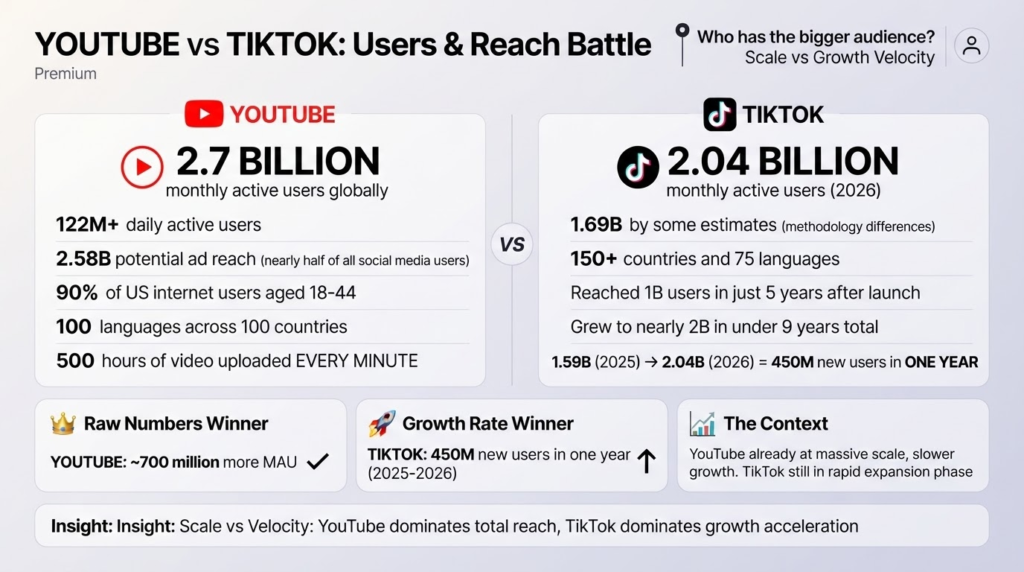
YouTube:
YouTube is the second most visited website in the world, behind only Google Search. Its user numbers are extraordinary.
2.7 billion monthly active users globally
122 million plus daily active users
Potential advertising reach of 2.58 billion people, nearly half of all social media users on earth
YouTube reaches 90% of US internet users aged 18 to 44
Available in 100 languages across 100 countries
500 hours of video uploaded every single minute
TikTok:
TikTok’s rise from zero to 2 billion users in under a decade is one of the fastest growth stories in social media history. It took Facebook nearly a decade longer to reach similar scale.
2.04 billion monthly active users globally as of 2026
1.69 billion users by some other estimates reflecting different measurement methodologies
Available in 150 plus countries and 75 languages
Reached 1 billion users in just five years after launch
Grew to nearly 2 billion in under nine years total
The Verdict on Users:
YouTube wins on raw numbers with roughly 700 million more monthly active users. But TikTok’s growth rate is faster. TikTok grew from 1.59 billion users in 2025 to 2.04 billion in 2026. That is roughly 450 million new users in one year. YouTube’s growth is slower at this stage because it is already one of the largest platforms in the world. TikTok is still in a phase of rapid expansion.
Demographics: Who Is on Each Platform?
Understanding who uses each platform is crucial for anyone trying to reach a specific audience.
YouTube Age Breakdown:
Age Group | Share of YouTube Users |
18 to 24 | 15.8% |
25 to 34 | 21.7% (largest group) |
35 to 44 | 18.5% |
45 to 54 | Approx. 12% |
55 and above | 9 to 10% |
Gen Z (born 1997 to 2012) | 25.1% |
Millennials (born 1981 to 1996) | 25.5% |
YouTube skews toward Millennials and Gen Z but has meaningful penetration across all age groups. 90% of US teens use YouTube, making it genuinely cross-generational in a way no other video platform can match.
TikTok Age Breakdown:
Age Group | Share of TikTok Users |
18 to 24 | 23.5% |
25 to 34 | 41.6% (largest group) |
35 to 44 | 21.8% |
45 to 54 | 9.2% |
55 and above | 8.4% |
TikTok used to be known as a teenage platform. That is no longer accurate. The 25 to 34 age group is now TikTok’s largest segment globally. The platform has grown up with its early users and simultaneously attracted older demographics. Usage among 45 to 54 year-olds jumped from 7.9% to 9.2% in a single year. The 55 plus group grew from 6.2% to 8.4%.
Gender Split:
YouTube: 54.4% male, 45.6% female
TikTok: 54.5% male, 45.5% female
The gender split is almost identical on both platforms. Neither platform skews strongly toward one gender.
Time Spent: TikTok Wins This One Easily
This is where TikTok’s dominance is most clear and most alarming for YouTube.
TikTok: Users spend an average of 95 minutes per day on the platform
YouTube: Users spend an average of 48.7 minutes per day on the platform
US teens on TikTok: Average 90 minutes per day
YouTube users in a month: Watch over 1 billion hours of video daily in aggregate
TikTok users spend almost exactly twice as long on the app as YouTube users. That is a massive gap. The reason is not hard to understand. TikTok’s algorithm is exceptionally good at keeping people watching. Every swipe delivers something new, and the algorithm learns your preferences extremely fast. You never have to actively choose what to watch. It chooses for you, and it is very good at it.
YouTube’s counter to this has been YouTube Shorts, its short-form video format. Shorts generates 200 billion daily views, which is a huge number. But it has not closed the time-spent gap with TikTok because YouTube users also come for longer, intentional viewing sessions. They subscribe to channels, they follow creators over years, and they come back for content they deliberately choose. The two platforms are satisfying different consumption habits.
Revenue: A Very Close Race
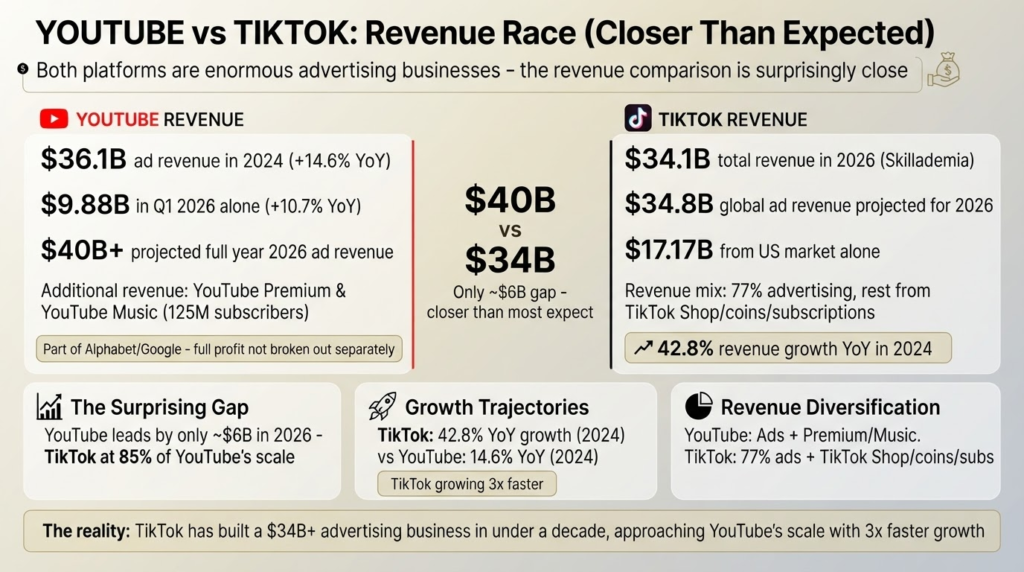
Both platforms are enormous advertising businesses. The revenue comparison is closer than most people expect.
YouTube Revenue:
$36.1 billion in ad revenue in 2024, up 14.6% year on year
$9.88 billion in Q1 2026 alone, up 10.7% year on year
Full year 2026 ad revenue projected to exceed $40 billion
Additional revenue from YouTube Premium and YouTube Music (125 million subscribers)
YouTube is part of Alphabet/Google, which does not break out YouTube’s full profit separately
TikTok Revenue:
$34.1 billion in total revenue in 2026 according to Skillademia
$34.8 billion in global ad revenue projected for 2026
$17.17 billion from the US market alone
Revenue breakdown: 77% from advertising, rest from TikTok Shop, coins, and subscriptions
42.8% revenue growth year on year in 2024
Revenue Metric | YouTube | TikTok |
2024 Ad Revenue | $36.1 billion | $23 billion |
2026 Projected Ad Revenue | $40 billion plus | $34.8 billion |
Revenue Growth Rate | ~11% YoY | ~43% YoY |
Primary Revenue Source | Advertising | Advertising (77%) |
YouTube still earns more in total. But TikTok is growing its revenue nearly four times faster. At TikTok’s current growth rate, it will close the gap significantly over the next two to three years.
TikTok Shop: The Commerce Wildcard
One area where TikTok has no comparison on YouTube is commerce. TikTok Shop is becoming a genuinely transformative ecommerce platform.
TikTok Shop Gross Merchandise Value was $64.3 billion in 2025, nearly double the previous year
US TikTok Shop sales reached $15.82 billion in 2025, accounting for 18.2% of all US social commerce
15 million active sellers globally on TikTok Shop
500,000 plus merchants registered in the United States
TikTok Shop sales are projected to exceed $20 billion in 2026
YouTube does not have a direct equivalent to TikTok Shop yet. YouTube has shopping integrations and links, but nothing that matches the seamless watch-to-buy experience TikTok has built. This is a significant strategic gap that YouTube is aware of and working to close, but TikTok has a meaningful head start in social commerce.
Creator Economy: Who Pays Creators More?
This is the question every creator asks when choosing where to focus their energy. The answer depends heavily on what kind of creator you are.
YouTube Creator Earnings:
YouTube paid out $20 billion plus to creators through the YouTube Partner Program in 2025
Creators earn between $0.50 and $6 per 1,000 views (RPM) after YouTube takes its 45% cut
In high-value niches like finance or technology, RPMs can reach $10 to $30 per 1,000 views
Creators posting both Shorts and long-form videos grow 3x faster than those doing only one format
YouTube Partner Program requires 1,000 subscribers and 4,000 watch hours to join
TikTok Creator Earnings:
TikTok has paid out $2.1 billion to date through its Creator Fund and Creator Rewards Program
Creator Rewards Program pays $0.40 to $1.00 per 1,000 views for videos over 1 minute
Earlier Creator Fund paid only $0.02 to $0.04 per 1,000 views (much lower)
Top 10,000 TikTok creators average $8,400 per month from the platform
4.7 million creators participate in the Creator Fund globally
Average brand payment to a TikTok creator reached $2,049 per deal in early 2025, up 23% in one year
Creator Earnings Metric | YouTube | TikTok |
Total paid to creators (2025) | $20 billion plus | $2.1 billion (to date, all time) |
Per 1,000 views (platform payment) | $0.50 to $30 (varies by niche) | $0.40 to $1.00 |
Brand deal average | Higher (established market) | $2,049 per deal |
Monetization threshold | 1,000 subs + 4,000 hours | 10,000 followers + eligibility |
YouTube pays creators significantly more per view through its ad revenue sharing model. The gap is enormous. YouTube distributes $20 billion per year to creators. TikTok has distributed $2.1 billion in total across its entire history. For creators whose goal is to make sustainable income from platform revenue, YouTube is the stronger choice by a wide margin.
TikTok’s advantage for creators is growth speed and brand deal potential. Getting a video to go viral on TikTok can happen to anyone, anytime, regardless of how many followers they have. On YouTube, the algorithm favors established channels with large subscriber bases for most content types.
Engagement Rates: TikTok Leads on Pure Engagement
Engagement rate measures how actively audiences interact with content through likes, comments, and shares relative to the size of the audience.
TikTok median engagement rate: 8% across all creator tiers in 2026
TikTok range: 7.4% to 8.1% depending on follower count
YouTube Shorts engagement rate: 3.00% to 5.91%
YouTube long-form engagement rate: 3.5% to 5.5% average
YouTube Shorts viewer retention: 73% average
TikTok has a higher raw engagement rate than YouTube across the board. But YouTube’s engagement, while lower in percentage terms, comes from a more loyal and intentional audience. A YouTube subscriber who watches multiple videos from a channel and leaves a comment is often a more valuable relationship for a creator than a TikTok follower who watches a viral video and moves on.
The TikTok US Ban: What Actually Happened
No article about TikTok in 2026 is complete without addressing the ban situation. Here is a clear timeline of what happened.
In January 2025, a US law came into effect requiring ByteDance to divest TikTok’s US operations or face a ban. President Trump extended the enforcement deadline multiple times through executive orders, giving TikTok breathing room while a deal was negotiated. By January 24, 2026, TikTok finalized a deal structure that created a new US-based version of TikTok with American investors holding a controlling stake. The app remained available in the US throughout this period and user numbers did not significantly decline.
The legal and ownership situation remains complex. Harvard Law School noted that the new US TikTok structure raises ongoing questions about data security and the true degree of separation from ByteDance. But for practical purposes, TikTok is operating normally in the US in August 2026, and its growth trajectory has not been meaningfully disrupted by the political turbulence.
YouTube Shorts vs TikTok: The Short-Form Battle
YouTube built Shorts specifically to compete with TikTok. Here is how the two compare in the short-form space specifically.
Short-Form Metric | YouTube Shorts | TikTok |
Monthly Active Users | 2 billion | 2.04 billion |
Daily Views | 200 billion | Not disclosed |
Engagement Rate | 3.00% to 5.91% | 7.4% to 8.1% |
Average Viewer Retention | 73% | Not disclosed |
Creator Growth Advantage | 3x faster when combined with long-form | Viral discovery for new creators |
Monetization | Ad revenue sharing available | Creator Rewards Program |
YouTube Shorts has reached 2 billion monthly active users, which is remarkable growth since its launch. But TikTok still holds a higher engagement rate in the short-form category. The key difference is that YouTube Shorts exists within a larger ecosystem. Creators can use Shorts to grow an audience and then convert those viewers into long-form watchers who generate much higher ad revenue. TikTok does not have that long-form funnel in the same way.
The Bottom Line
YouTube and TikTok are not really competing for the same thing. YouTube is the world’s largest video library and the biggest creator income platform on earth. TikTok is the world’s most addictive short-form video app and the fastest-growing social commerce platform. Both are winning, just in different ways.
YouTube wins on total users, creator payouts, advertising revenue, long-form content, and cross-generational reach. TikTok wins on time spent, engagement rates, growth speed, short-form virality, and social commerce through TikTok Shop.
For creators, the smartest strategy in 2026 is not to pick one over the other. It is to use both. Post Shorts on YouTube to grow your subscriber base and earn long-term ad revenue. Post on TikTok to maximize viral reach and tap into TikTok Shop. The platforms are complimentary more than they are mutually exclusive, and the creators who understand that are the ones building the most sustainable audiences right now.
FAQs
YouTube leads with over 2.7 billion monthly active users in 2026, while TikTok has surpassed 1.8 billion. YouTube maintains its dominance in total user base, though TikTok continues to close the gap rapidly.
TikTok users average approximately 95 minutes per day on the platform, slightly edging out YouTube's average of around 85 minutes daily. However, YouTube sessions tend to involve longer individual video views due to its long-form content format.
YouTube remains the stronger platform for direct monetization, with creators earning significantly more through AdSense, memberships, and Super Chats. TikTok has improved its Creator Fund and revenue-sharing programs, but YouTube still offers higher average earnings per 1,000 views.
TikTok's largest demographic remains users aged 18 to 34, with strong Gen Z representation. YouTube has a broader age reach, attracting heavy usage from users aged 25 to 54, making it more appealing to advertisers targeting a wider demographic.
Advertisers favor YouTube for large campaigns because of its superior targeting capabilities, longer ad formats, and higher purchase intent among its user base. YouTube's integration with Google Ads data also provides more precise audience segmentation and measurable ROI compared to TikTok's advertising ecosystem.
