
Online Gambling Regulations Statistics 2026: The Complete Data Guide
Online gambling has gone from a legal grey area to one of the fastest-growing regulated industries on the planet. Governments that once banned it are now racing to tax it. Countries that looked the other way are cracking down. And the numbers behind it all are extraordinary. Whether you are a policy researcher, a marketer, a journalist, or just curious about how big this industry actually is, this guide puts every major stat in one place.
The Big Picture: Online Gambling at a Glance
Here is a quick snapshot of where the global online gambling industry stands right now.
Metric | Figure (2026) |
Global online gambling market size | $97.7 billion to $143.17 billion |
Total global gambling market (all forms) | $655.31 billion |
Global gambling GGR projected by 2030 | $1 trillion plus |
Online gambling CAGR (2026 to 2033) | 11.0% |
iGaming revenue in US legal states (2025) | $10 billion plus |
US commercial gaming tax revenue (2025) | $17.86 billion (record) |
US states with legal sports betting | 39 states plus Washington DC |
US states with legal online casinos | 8 states |
Americans with active online betting accounts | 27% |
Unregulated global online gambling wagering | $5.9 trillion |
Illegal online gambling revenue (Europe alone) | EUR 80.6 billion |
The range in market size figures reflects different methodologies used by different research firms. The key point is that the industry is enormous and growing at double-digit rates regardless of which estimate you use.
The most striking number in the table is the one at the bottom. $5.9 trillion in unregulated wagering value globally. That figure from a Global Council on Innovation report is larger than the GDP of every country except the United States and China. It represents the enormous shadow market that regulators are trying to bring under control, and it tells you that legal regulation has barely scratched the surface of where gambling actually happens.
Global Market Size and Growth
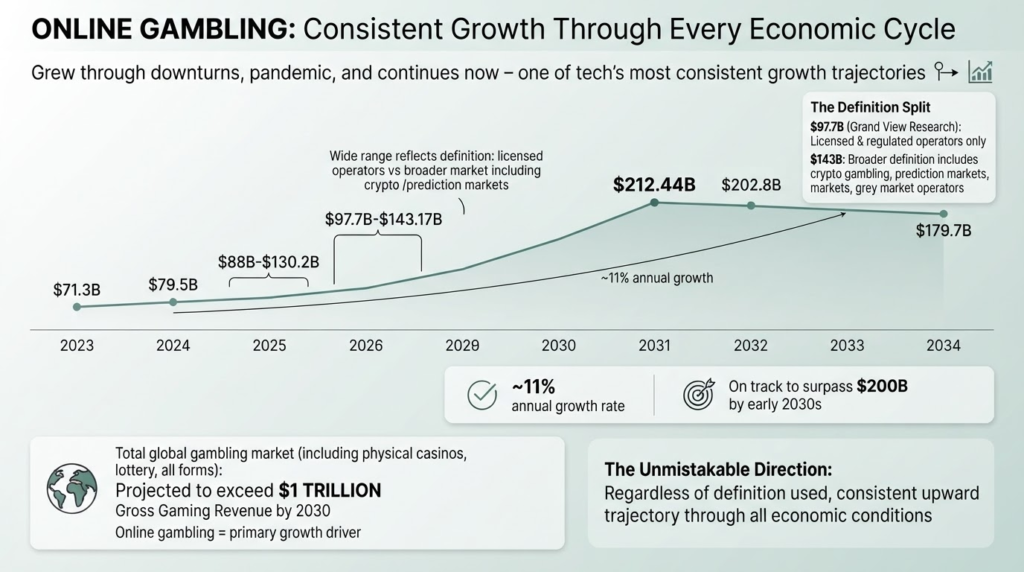
The online gambling industry’s growth trajectory is one of the most consistent in the tech and entertainment space. It grew through economic downturns, through a global pandemic, and it continues to grow now.
Year | Global Online Gambling Market Size |
2023 | $71.3 billion |
2024 | $79.5 billion |
2025 | $88 billion to $130.2 billion |
2026 | $97.7 billion to $143.17 billion |
2030 | $212.44 billion (projected) |
2033 | $202.8 billion (projected) |
2034 | $179.7 billion (separate projection) |
The wide range in 2026 estimates reflects whether researchers include crypto gambling, prediction markets, and grey market operators in their definitions. The narrower estimate of $97.7 billion from Grand View Research covers licensed and regulated operators. The broader $143 billion figure includes a wider definition of the market.
Regardless of which figure you use, the direction is unmistakable. The industry is growing at roughly 11% per year and is on track to surpass $200 billion by the early 2030s. The global gambling market as a whole, including physical casinos, lottery, and all other forms, is projected to exceed $1 trillion in Gross Gaming Revenue by 2030, with online gambling being the primary growth driver.
United States: The Fastest-Growing Regulated Market
The US gambling landscape has transformed completely since the Supreme Court overturned the federal ban on sports betting in 2018. What started as a slow rollout has become a full-scale regulatory gold rush.
Sports Betting:
39 states plus Washington DC have legalized sports betting in some form as of May 2026
30 states offer legal online sports betting through licensed operators
Americans wagered approximately $166 billion on sports in 2025, more than the entire US movie, music, book, and museum industries combined
US sportsbooks processed $40.47 billion in handle in Q1 2026 alone, producing $3.82 billion in revenue
Sports betting revenue in May 2026: $1.34 billion on $12.06 billion handle
27% of Americans have an active online sports betting account as of April 2026, up from 22% in 2025
52% of American men aged 18 to 49 have an active online sports betting account
83% of account holders have placed at least one bet using their account
iGaming (Online Casinos):
Only 8 states have legalized real-money online casino gaming as of August 2026
States with legal online casinos: Connecticut, Delaware, Michigan, New Jersey, Pennsylvania, West Virginia, Rhode Island, and Nevada
Internet gaming revenue across these states exceeded $10 billion in 2025, with iGaming revenue growing 27.6% year on year
Monthly iGaming revenue in May 2026: $1.03 billion
Monthly slot machine revenue in May 2026: $3.39 billion (including physical casinos)
Tax Revenue:
Commercial gaming operators paid a record $17.86 billion in direct gaming tax revenue to state and local governments in 2025, according to the American Gaming Association’s State of the States 2026 report. This is the statistic that is driving more states to consider legalization. When politicians see that New Jersey generates hundreds of millions in online casino taxes every year, the argument for keeping online gambling illegal becomes harder to make.
State | Online Gambling Tax Rate |
New Jersey | 19.75% on online sports betting |
Vermont | 31% (revenue share model) |
Pennsylvania | 36% on online slots |
Michigan | 20% to 28% depending on game type |
States that have not yet legalized, including California, Texas, and Florida, are estimated to be missing out on hundreds of millions in annual tax revenue. The Tax Foundation estimates California alone could generate $570 million in additional annual tax revenue from expanded sports betting legalization.
Europe: The World’s Most Mature Regulated Market
Europe has the most developed online gambling regulatory framework in the world, but it is still fighting a massive illegal market alongside its licensed sector.
European online gambling market reached $45.7 billion in 2025 and is projected to reach $78.8 billion by 2034
The UK generates 30% of all gaming revenue in Europe, making it the continent’s largest single gambling market
European online gambling revenue grew to nearly €48 billion ($55.6 billion) recently
Illegal online gambling operators generated €80.6 billion in European revenue
European illegal gambling grew 26% compared to 2023
92% of illegal gambling activity in Europe is conducted through offshore unlicensed platforms
The European regulatory picture varies dramatically by country. The UK Gambling Commission operates one of the strictest licensing regimes in the world. Germany unified its state-by-state rules under a new Interstate Treaty. Sweden, Denmark, and the Netherlands have mature licensing frameworks. Several Eastern European countries are still developing their regulatory approaches.
European regulators joined forces in 2026 specifically to combat the growing illegal online gambling market, which dwarfs what their licensed operators generate. The key challenge is enforcement: players can access offshore platforms with a VPN in seconds, and shutting down offshore websites is a slow and often ineffective process.
Who Is Gambling Online? Demographics
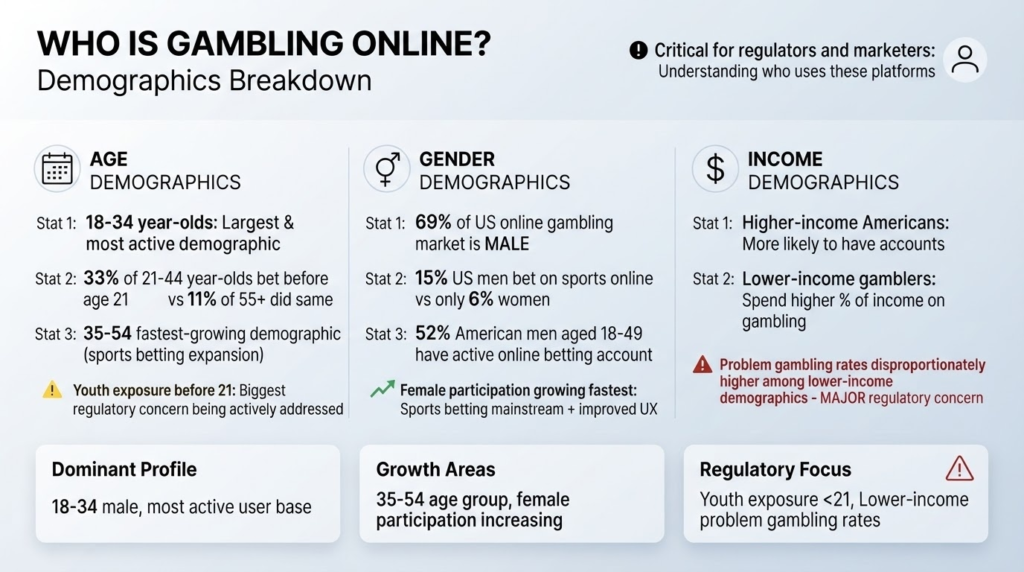
Understanding who is actually using these platforms is critical for both regulators and marketers.
Age:
18 to 34 year-olds represent the largest and most active online gambling demographic
33% of 21 to 44 year-olds placed a sports bet before the age of 21, compared to just 11% of those aged 55 and above
The fastest-growing demographic is 35 to 54 year-olds, driven by sports betting expansion
Youth exposure before age 21 is one of the biggest concerns regulators are actively working to address
Gender:
69% of the US online gambling market is male by user share
15% of US men bet on sports online versus only 6% of women
52% of American men aged 18 to 49 have an active online betting account
Female participation is growing fastest as sports betting becomes more mainstream and platforms improve their user experience
Income:
Higher-income Americans are more likely to have online betting accounts but lower-income gamblers spend a higher percentage of their income on gambling
Problem gambling rates are disproportionately higher among lower-income demographics, which is a major regulatory concern
The Problem Gambling Crisis
This is the part of the online gambling statistics story that often gets overshadowed by revenue numbers. The expansion of legal online gambling is creating measurable increases in gambling-related harm.
Problem Gambling Metric | Figure |
Americans with gambling disorder (DSM-5 diagnosis) | 5 to 8 million |
Americans classified as problem gamblers (broader) | 10 to 15 million |
At-risk or recreational harm category | 20 to 30 million |
US adults affected by gambling disorder (%) | 1 to 3% |
US annual gambling losses by consumers | $100 billion plus |
Rate of gambling disorder in states with legal sports betting | 4.8 per 100,000 (up from 3.0 before legalization) |
Bettors reporting “chasing losses” | 60% (up from 52% in 2025) |
Americans who view gambling addiction as serious as alcohol or drug addiction | 79% |
The NBC News report citing Epic Research data is particularly alarming. In states where sports betting has been legalized, the rate of gambling disorder rose from 3.0 per 100,000 to 4.8 per 100,000, a 60% increase directly linked to legalization. This is not a theoretical risk. It is measurable in hospital admissions, bankruptcy filings, and clinical diagnoses.
The chasing losses figure is especially concerning. 60% of bettors now report chasing losses, up from 52% the previous year. Chasing losses is the defining behavioral marker of problem gambling. The fact that this number is rising sharply at the same time as account numbers are rising points to a serious public health challenge that regulation has not yet adequately addressed.
Responsible Gambling Tools:
The industry is responding, partly from genuine concern and partly from regulatory pressure:
84% of past-year gamblers are aware of at least one responsible gaming resource
91% of sports bettors specifically are aware of responsible gaming tools
AI is being deployed to detect at-risk behavior in real time by analyzing betting patterns, deposit frequencies, and session lengths
Deposit limits, cooling-off periods, and self-exclusion programs are mandatory in most regulated markets
AI-powered responsible gambling tools can now flag potential problem gambling behavior before the player self-identifies
Research shows that players who engage with responsible gambling tools are actually more likely to remain active customers over time, meaning responsible gambling is commercially beneficial as well as ethically important. This alignment of commercial incentives with harm reduction is one of the more encouraging developments in the regulatory space.
Cryptocurrency Gambling: The Fastest-Growing Segment
Crypto gambling is one of the most significant and least regulated corners of the online gambling world.
Crypto Gambling Stat | Figure |
Crypto casino deposit volume (Jan to July 2026) | $44.7 billion (up 84% year on year) |
Total crypto gambling projected for 2026 | $65 billion plus |
Crypto casino tool market size (2026) | $13 billion |
Crypto casino market projected by 2035 | $114 billion |
Crypto casino market CAGR | 27.29% |
Crypto gambling has exploded because it offers players something traditional platforms cannot: anonymity, instant transactions, no banking restrictions, and access regardless of jurisdiction. Platforms accepting Bitcoin, Ethereum, and stablecoins like USDT and USDC operate outside traditional banking systems, which makes them very difficult for regulators to restrict.
The $44.7 billion in tracked crypto casino deposit volume in the first half of 2026, up 84% year on year, tells you this market is growing at nearly triple the rate of regulated online gambling. Stablecoins in particular are taking over as the preferred gambling currency because they avoid the price volatility of Bitcoin while retaining the anonymity and speed benefits of crypto transactions.
The regulatory challenge here is severe. Most crypto gambling platforms are registered in jurisdictions with minimal oversight. Players in countries where online gambling is illegal routinely use crypto platforms to bypass the law. Regulators are developing crypto-specific frameworks but enforcement remains extremely limited.
Mobile Gambling: Where the Growth Is
The shift from desktop to mobile has transformed online gambling just as it transformed every other digital industry.
The majority of online gambling sessions now happen on mobile devices
Mobile’s share of online gambling revenue is growing year on year in every regulated market
Apps and mobile-optimized sites have replaced desktop as the primary gambling interface for users under 40
Smartphone penetration in emerging markets is the key driver of online gambling growth in Africa, Latin America, and Southeast Asia
Live dealer casino games, which stream real dealers in real time to players’ phones, are the fastest-growing product category in mobile gambling
The convenience factor is both the opportunity and the risk. A player who has to travel to a casino or even sit at a desktop computer has natural friction built into their gambling behavior. A player with a sports betting app on their phone can place a bet in 10 seconds from anywhere. That removal of friction drives both revenue and problem gambling simultaneously.
AI and Technology in Online Gambling Regulation
AI is playing an increasingly important role in both operating and regulating online gambling platforms.
On the operator side, AI is being used for fraud detection, personalization, customer service automation, and responsible gambling monitoring. Digital fraud suspected at account creation ran at 8.3% of attempted transactions globally in 2025, an 18% increase year on year. AI fraud detection systems are the primary defense against bot accounts, payment fraud, and match-fixing-related suspicious betting.
The AI sports betting fraud detection market itself is growing at a 25% CAGR, reflecting how serious this problem has become. Operators deploy AI systems that watch live odds movements, detect unusual account patterns, and flag suspicious betting clusters that might indicate insider information or coordinated manipulation.
On the regulatory side, government bodies are beginning to require operators to implement AI-based monitoring tools as a condition of their license. The UK Gambling Commission, for example, requires operators to use behavioral analytics to identify at-risk players and intervene before harm escalates.
The Illegal Market: A Massive Unsolved Problem
The regulated market is enormous. The illegal market is bigger.
$5.9 trillion in global unregulated online gambling wagering in 2025, larger than the GDP of Japan and Germany combined
Illegal gambling has more than doubled from $37.5 billion to $81 billion between 2015 and 2023 in tracked illegal market revenue
4,500 plus illegal gambling websites operate globally
European illegal operators alone generated €80.6 billion, growing 26% year on year
92% of illegal European gambling happens through offshore unlicensed platforms
States have missed an estimated $1 billion in tax revenues due to the rise of prediction markets operating in regulatory grey zones
The illegal market is not just a regulatory failure. It is a genuine consumer safety crisis. Players on illegal platforms have no protections. There are no responsible gambling tools. No dispute resolution. No guarantee of fair games. No age verification. And when they win, there is no guarantee they will be paid. The existence of this enormous illegal market undermines the case for strict regulation of legal operators, because players can always opt out of the regulated system entirely.
Country-by-Country Regulation Snapshot
Country / Region | Legal Status | Key Features |
United Kingdom | Fully regulated | Strict licensing via UKGC. Mandatory responsible gambling tools. |
United States | State by state | 39 states for sports betting. 8 states for online casino. |
Germany | Regulated (2021 Interstate Treaty) | Restricted game types. Strict advertising limits. |
Netherlands | Regulated (2021 Remote Gambling Act) | Licensed operators must meet strict Dutch requirements. |
Australia | Sports betting legal. Online casino banned. | No legal online casino. Sports betting heavily regulated. |
Canada | Province by province | Ontario launched regulated market in 2022. Other provinces following. |
France | Regulated | Sports betting and poker legal. Online casino still banned. |
China | Banned | Extremely strict. All forms of online gambling illegal for residents. |
Japan | Mostly banned | Sports pools legal. Online casino illegal but widely accessed via offshore sites. |
India | State by state | Some states allow online games. Sports betting in legal grey area. |
The Bottom Line
Online gambling regulation in 2026 is a story of enormous economic opportunity colliding with serious public health challenges and a massive illegal market that dwarfs everything the regulators have managed to bring under control.
The industry generates nearly $100 billion in legal revenue, creates record tax revenues for governments, and provides entertainment to hundreds of millions of people who gamble responsibly. At the same time, problem gambling rates are rising in direct proportion to the expansion of legal markets. The illegal market is measured in trillions, not billions. And crypto gambling is creating an entirely new regulatory frontier that governments are nowhere near equipped to manage effectively.
The next five years will be defined by how well regulators can balance the genuine economic benefits of legalization against the very real social costs. The countries and states that get this balance right will build sustainable, well-funded regulated markets. Those that get it wrong will either lose their players to illegal platforms or create serious public health crises in the name of tax revenue.
FAQs
In 2026, over 85 countries have established formal online gambling regulatory frameworks, with global licensed operator numbers exceeding 3,500. The regulated online gambling market is projected to generate more than $100 billion in tax revenue worldwide this year.
By 2026, approximately 30 US states have legalized some form of online gambling, including sports betting, poker, or casino games. This represents a significant increase from just 3 states in 2018 following the repeal of PASPA.
Regulated markets are outpacing unregulated ones in 2026, with licensed platforms accounting for nearly 68% of total global online gambling revenue. Stricter enforcement tools and player protection measures have driven millions of users from grey-market sites to licensed operators.
Governments are strengthening regulations primarily to combat problem gambling, money laundering, and unlicensed operator activity, which collectively cost economies billions annually. Enhanced data tracking and AI-driven compliance tools have made enforcement more effective and politically viable.
Players using licensed platforms in regulated jurisdictions benefit from mandatory responsible gambling tools, secure payment protections, and independent game auditing. Regulatory bodies in the UK, Malta, and New Jersey lead global standards, with compliance rates among licensed operators exceeding 92% in 2026.
