Godaddy SSL Pricing 2026: Is It Worth Paying For?
Godaddy SSL pricing starts around $5.99 to $7.99 a month for a basic single-site Domain Validation certificate on a multi-year term, with managed options near $9.99 a month and higher tiers for Wildcard or multi-domain coverage.
GoDaddy sells Domain Validation (DV), Organization Validation (OV), and Extended Validation (EV) certificates, plus Wildcard and multi-domain (SAN) versions of several types. A 30-day refund window applies on many purchases.
Free options such as Let’s Encrypt deliver the same browser padlock and encryption strength for most sites, so the paid difference usually comes down to installation help, warranty, support, and brand recognition rather than stronger security.
Most small blogs and simple business sites do not need a paid certificate. Sites that want hands-off management, a high warranty, or coverage for many subdomains sometimes find the managed or Wildcard options useful once the renewal price is factored in.
Standard Domain Validation SSL
The basic DV certificate verifies that you control the domain name. It encrypts traffic between the visitor and the server and shows the padlock in the browser. GoDaddy lists this option for a single website.
On multi-year terms the promotional rate often appears near $5.99 to $7.99 a month, which works out to roughly $70 to $100 a year depending on the exact offer and location.
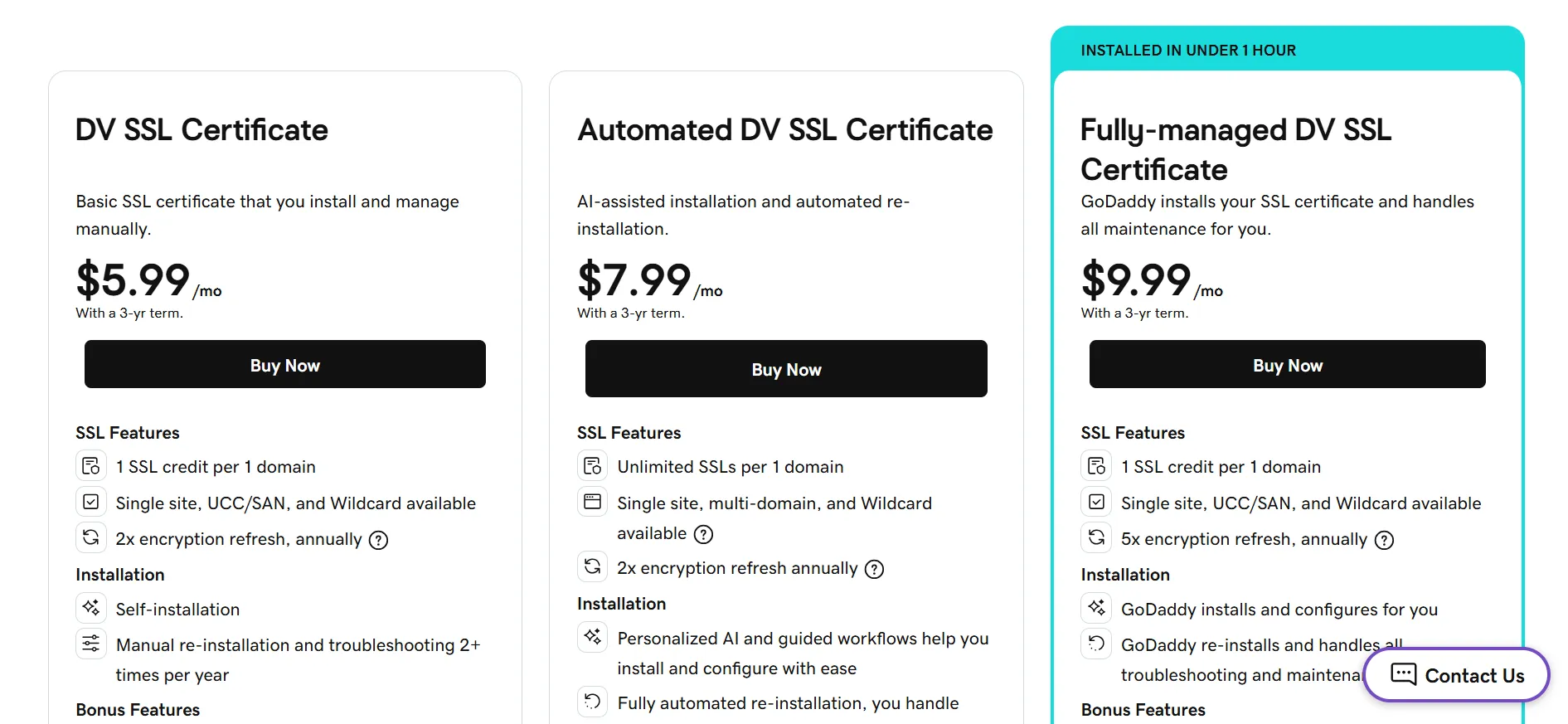
You install the certificate yourself and handle reissues. The plan includes strong 2048-bit encryption and a basic trust seal. Renewal rates are usually higher than the first-term price.
This tier suits a single personal site or small business that already knows how to install an SSL or can follow the host’s instructions. The encryption itself matches free certificates.
The paid difference is mainly convenience and support. If you can use Let’s Encrypt through your host or a control panel, the standard DV certificate rarely saves enough time to justify the cost after the first term.
Managed Domain Validation SSL
The managed version costs more, commonly listed near $9.99 a month on multi-year terms. GoDaddy installs the certificate, handles reinstallation, monitors the setup, and takes care of routine maintenance.
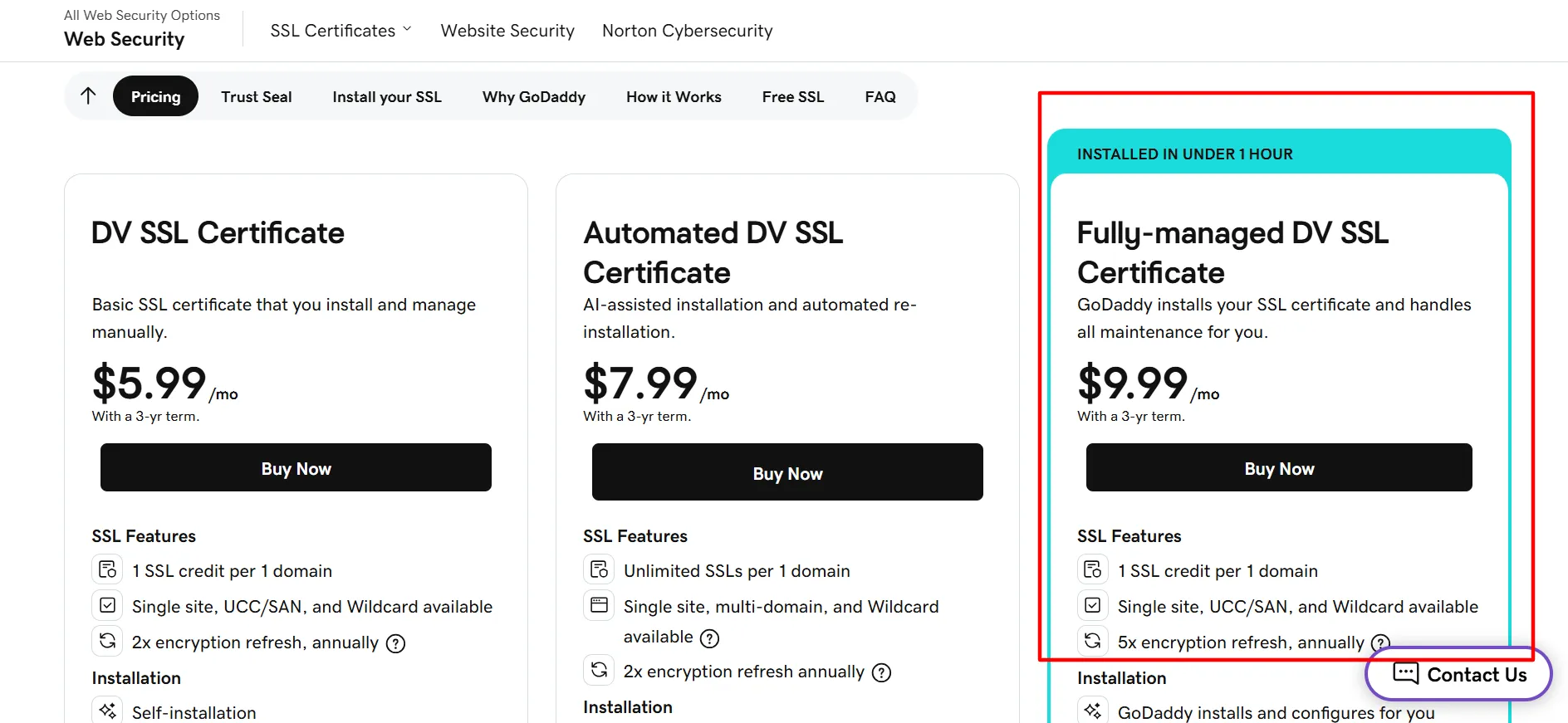
Some plans include more frequent reissuance. You still receive the same DV validation and encryption strength as the self-managed option.
This plan is aimed at people who prefer not to touch server settings. It can be worth the extra cost if your host charges for SSL installation or if you have run into problems with free certificate renewals.
For most shared hosting accounts the difference is small, because many hosts already offer free Let’s Encrypt with automatic renewal. Check the renewal price before you commit, because the long-term cost adds up.
Wildcard SSL
A Wildcard certificate covers the main domain and unlimited first-level subdomains with one certificate. Pricing is commonly listed near $28.99 to $35 a month on multi-year terms, or roughly $280 to $350 a year.
It uses Domain Validation and includes the same encryption strength as the standard certificate. Free reissues are usually included, and many plans carry a high warranty (up to $1,000,000 on some listings). You can choose a self-managed or managed version.
Wildcard makes sense when you run several subdomains such as shop.example.com, blog.example.com, and app.example.com and want one certificate instead of several.
The cost is higher than buying multiple single-site certificates from budget providers, but it is lower than buying a separate certificate for each subdomain.
Free Wildcard options exist from some certificate authorities, though they may require more setup. If you only have one or two subdomains, a standard certificate or free option is usually cheaper.
Multi-Domain (SAN / UCC) SSL
The multi-domain option secures several different domain names on one certificate. Pricing often starts near $17.99 to $22 a month on multi-year terms for a base number of domains (commonly five), with extra domains available at an additional cost.
Both DV and higher validation types can be ordered this way. Managed versions are also available.
This certificate fits agencies or businesses that manage several unrelated sites and want to reduce the number of certificates they track. It is not necessary for a single domain with subdomains; that use case is better covered by Wildcard.
Compare the total cost against buying separate certificates, because the multi-domain price can rise quickly once you add extra names.
Organization Validation (OV) and Extended Validation (EV)
OV certificates verify both domain control and the existence of the organization behind the site. Pricing is higher than basic DV, often in the $100 to $250 a year range depending on term and current offers.
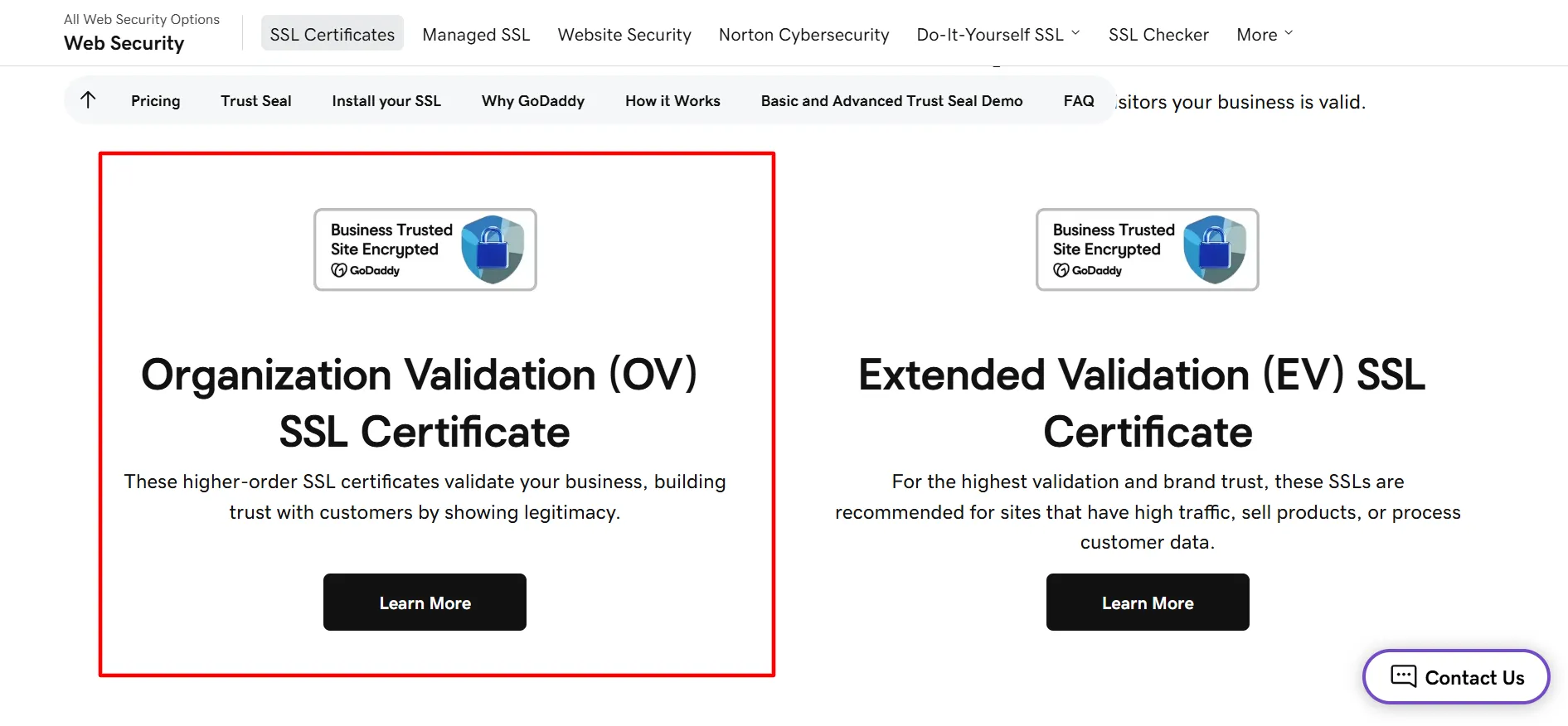
EV certificates add a deeper check of the organization’s legal status, address, and operational details. EV pricing is usually the highest, commonly $300 or more a year on renewal. Both types can be ordered as single-site, multi-domain, or (for OV) Wildcard.
These higher-validation certificates used to show the company name in the browser address bar. Most major browsers no longer display that indicator, so the visual difference for visitors is small.
The remaining value is mainly for organizations that need documented identity checks for compliance, procurement, or insurance reasons. For ordinary business sites the extra cost rarely changes visitor behavior.
What the Price Actually Buys
All GoDaddy certificates use industry-standard encryption. The padlock and HTTPS prefix look the same as free certificates. The paid features are installation help, a warranty, support from GoDaddy, and the convenience of buying the certificate from the same company that may host the site or manage the domain.
Certificate lifetimes are limited by industry rules (currently capped near 398 days), so frequent reissuance is normal across all providers. Renewal prices are almost always higher than the promotional first-term rate.
Multi-year terms lower the average monthly cost but lock you in. Check the exact renewal figure on the order page before you pay.
Who Might Find the Pricing Worth Paying
Site owners who already use GoDaddy hosting and want the certificate installed and maintained for them sometimes find the managed plan convenient.
Businesses that run many subdomains and prefer one certificate can use the Wildcard option. Organizations that need OV or EV documentation for compliance reasons may still buy those tiers even though browsers no longer show the company name. Everyone else can usually meet the same security need with a free certificate.
Pros and Cons: Godaddy SSL Pricing 2026
Pros
- Managed plans handle installation and routine reissuance.
- Wildcard covers unlimited subdomains with one certificate.
- High warranty listed on many certificates.
- 30-day refund window on many purchases.
- Available alongside domain and hosting services.
Cons
- Renewal prices are higher than introductory rates.
- Basic DV encryption is identical to free Let’s Encrypt certificates.
FAQs: Godaddy SSL Pricing 2026
Promotional rates for a single-site DV certificate often appear near $5.99 to $7.99 a month on multi-year terms. Renewal is higher.
It can be useful if you do not want to install or renew the certificate yourself. Many hosts already offer free automatic certificates.
Yes. One Wildcard covers the main domain and unlimited first-level subdomains.
Most major browsers no longer display the company name in the address bar.
Many GoDaddy SSL purchases include a 30-day refund window. Check the current terms at checkout.
Quick Links:
Final Notes: Godaddy SSL Pricing 2026
Godaddy SSL pricing is worth paying for mainly when you need managed installation, Wildcard coverage for many subdomains, or formal OV/EV documentation.
For a typical single website the encryption and padlock are identical to free certificates, so the extra cost rarely improves security or visitor trust. Compare the renewal price, not just the first-term rate, and check whether your host already includes a free certificate.
Use the 30-day refund window if you want to test the managed setup, then decide whether the convenience matches the long-term cost for your specific sites.
